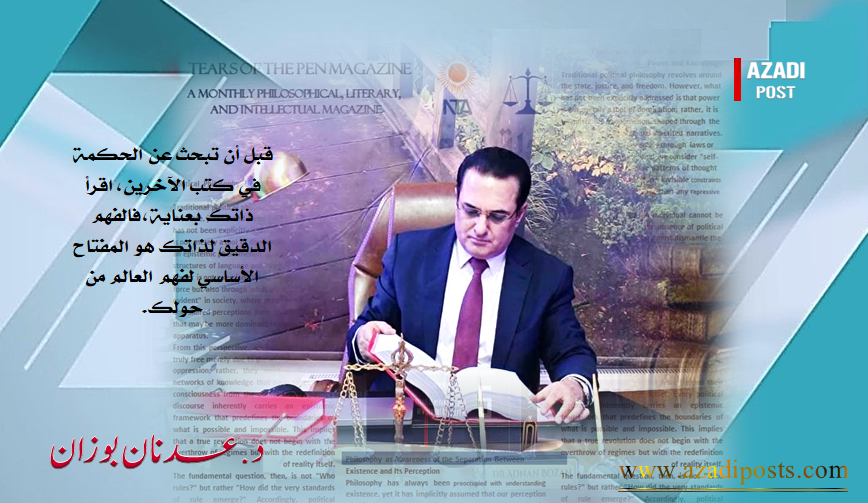
By Dr. Adnan Buzan
It is unfortunate that, today, some relatively new writers have emerged among us who treat the history of Kurdish writing and creativity as though it began with them. They rush to question the work and achievements of Kurdish writers, thinkers, and academics, as if nothing existed before their arrival, or as if writing had not carried its own price in an era when there was no social media, no artificial intelligence, and none of the open platforms that now allow anyone to write and publish within minutes.
Criticism is a legitimate right; indeed, it is essential to any healthy cultural life. But questioning the history of others without understanding the circumstances in which that history was shaped is not criticism. Rather, it is ignorance of context and an attempt to erase memory.
There were dozens of Kurdish writers, thinkers, and academics who wrote under the rule of the two Assad regimes—the father and the son—at a time when merely holding a different political or cultural position could be enough to place a person under surveillance, expose them to arrest, interrogation, torture, and accusation. Yet they continued to write because they believed that the written word could itself be an act of resistance.
I say this as a reminder of an experience, not as an act of self-praise. I began writing in the 1980s, when my first attempts at poetry appeared. During the 1990s, I continued to write articles, political analyses, and research. At that time, there was a Palestinian magazine called Al-Hurriya (Freedom), in which I published, as well as the newspaper Nidal al-Shaab (The People’s Struggle), which later became Sawt al-Shaab (The Voice of the People), the official newspaper of the Syrian Communist Party. I also published in Al-Mawasim magazine and in most of the party newspapers affiliated with Kurdish political parties. At certain stages, I was forced to write under pseudonyms.
Yet writing did not come without a price. I was arrested more than once and subjected to torture, threats, and pressure. Nevertheless, I did not retreat from my literary and political project. Instead, I continued my political work, contributed to the founding of a Kurdish political party, and continued along my path with determination and resilience.
At that time, there was no artificial intelligence to assist writers, nor were there Facebook, X, or YouTube platforms through which a text could reach thousands of readers. Publishing and reaching an audience were nowhere near as easy as they are today. Words were written under difficult circumstances, copied and circulated through limited means, and reaching the Kurdish reader was itself another battle.
During that period and in the years before it, there were numerous Kurdish websites and platforms, including Kimiya Kurda and Welatî Me, among others. They stand as witnesses to an important part of Kurdish writing, journalism, and intellectual production during that era. For the record, I began writing most of my books during that period, and a significant part of them was published at the time before being republished in recent years.
More importantly, many of those who dominate the cultural and political scene today were not, at that time, prepared to pay the price of the written word. Some were afraid even of their own shadows, while a small group of intellectuals, politicians, and writers insisted on continuing to write despite fear, persecution, and imprisonment. We did so because we believed that ideas had to reach the Kurdish intellectual and cultural community, and that culture was not a luxury to be abandoned when circumstances became difficult.
It is therefore very easy for someone today, after the space for expression has expanded, to sit behind a screen and begin distributing certificates of patriotism, culture, and creativity to those who came before them—or questioning their work—as though history began on the day they opened a social media account.
The problem is that some of these individuals began by directing their arrows at Kurdish political forces, then at the Syrian Democratic Forces (SDF), and at Kurdish politicians. This is their right, provided that their criticism is based on knowledge and responsibility. But when there seemed to be no one left to target, they turned their attention toward Kurdish intellectuals, thinkers, academics, and writers—as though the objective were not to correct shortcomings within the Kurdish sphere, but to bring down all its symbols, its memory, and its accumulated experiences.
We need genuine criticism, not a culture of suspicion and questioning.
We need people who read books before passing judgment on their authors, who return to press archives before denying history, and who study the circumstances in which texts were written before issuing judgments about them.
Disagreeing with a writer or a thinker does not give anyone the right to erase their history. Political disagreement does not necessarily mean that intellectual work is corrupt or without value. Nor does the emergence of a new writer give them the right to treat those who came before them as though they had never existed.
The Kurdish arena needs criticism, yes—but before that, it needs respect for memory.
Those who do not know who paid the price for the written word in an age of fear will never understand the value of that word in an age of freedom.
More dangerous still is the transformation of the Kurdish intellectual into an enemy, and the systematic attack on writers, thinkers, and academics without seriously reading their histories or examining their work. This serves neither Kurdish culture nor its intellectual project. Rather, intentionally or unintentionally, it may become a service to agendas that want the Kurds to begin from zero every time—to destroy their own memory with their own hands.
No one is above criticism, but neither does anyone have the right to falsify memory.
History is not written in a passing social media post, nor can it be erased by a passing act of suspicion. History is written through documents, books, positions, and years of work and perseverance.