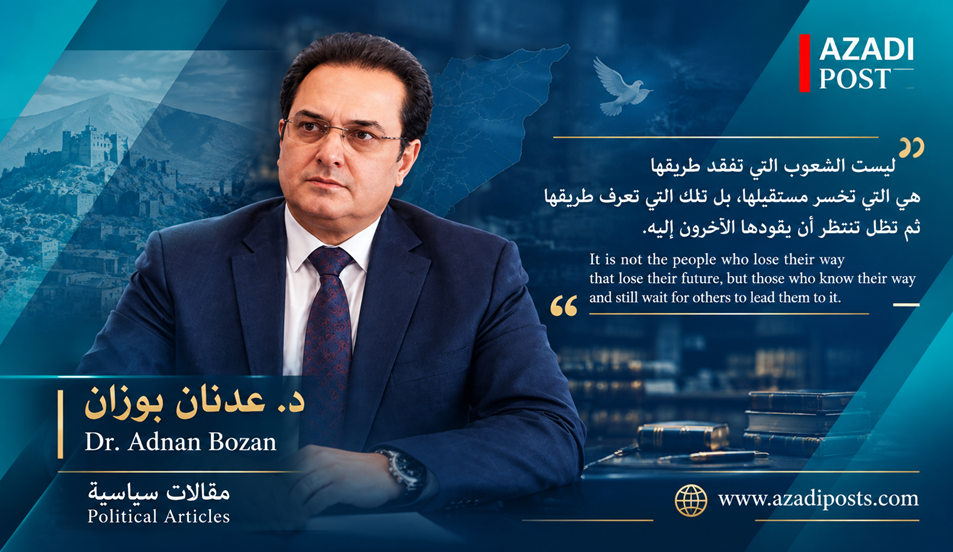
By Dr. Adnan Bozan
Some societies make history through their actions, sacrifices, and defining moments, leaving behind tangible evidence of their struggle, resistance, and resilience for future generations. Others, however, devote themselves to manufacturing imaginary glories, living off stories about their ancestors and recycling the same narratives from one generation to the next until repeated falsehoods acquire the status of a sacred history that no one is permitted to question or challenge.
Kobani, a city whose history we cherish, whose people's resistance we honour, and whose survival was secured through the sacrifices of our people, is not immune to this social phenomenon. It has become an issue that demands an honest and uncompromising confrontation, free from courtesy, hypocrisy, flattery, and the blind glorification of names, families, and tribes.
The time has come to speak openly about certain self-appointed tribal notables whose only occupation seems to be selling people stories about their ancestors, as well as individuals who speak endlessly of manhood, dignity, and patriotism as though these qualities were family heirlooms passed down from grandfather to grandson, regardless of what the grandson has actually done—or failed to do—and regardless of whether the history being celebrated has any basis in fact.
Let us take a step back, but this time without the embellished accounts and exaggerations we have grown accustomed to hearing in social gatherings. In Kobani, almost every family has a story about its past, and every tribe seems eager to present itself as the rightful heir to historic achievements, revolutions, heroic deeds, and patriotic stands. Listening to some of these accounts, one might imagine that every one of our ancestors was a revolutionary leader, an army commander, or a legendary freedom fighter, and that the entire history of this region was written by their hands alone.
But one question inevitably arises: Were our ancestors really the people their descendants portray them to have been? Were all these supposed acts of heroism and all the endless claims made by those boasting of their lineage and tribal heritage grounded in historical fact, or are some merely social fables invented to inflate a family's standing and elevate its status above others?
Perhaps a grandfather was a farmer, a labourer, a shopkeeper, a merchant, or a man who practised an ordinary trade. All these are honourable occupations that diminish neither a person's worth nor their standing. On the contrary, working hard and struggling to provide for one's family are sources of dignity that require no historical fabrication.
The problem, however, is that some descendants cannot accept the possibility that their grandfather was simply an ordinary man who lived his life under the circumstances and limitations of his time. Instead, they turn him into a revolutionary, a commander, a resistance fighter, or a man of extraordinary historical significance. They add achievements to his biography that never existed, then pass these inventions down through generations until they become part of an artificially constructed family identity.
Why can we not take pride in our ancestors as they actually were? Why do we need to invent revolutions and heroic deeds to convince ourselves that we have worth? Has a person become insignificant simply because his grandfather was not a commander, a tribal sheikh, or a revolutionary?
The problem is not that a grandfather was a farmer or a labourer. The problem is turning lies about his past into an instrument of arrogance, social superiority, and contempt for others.
Manhood is not inherited. Dignity is not a family title. Patriotism does not pass through the bloodline. No one becomes a hero simply because he belongs to a large tribe, carries a prestigious social title, or has dozens of relatives gathering around him at public occasions.
No one can borrow his grandfather's heroism, and no grandson has the right to live off sacrifices he never made. History does not recognise names alone; it recognises what people actually did when circumstances became difficult. Manhood is not measured by what a person says about himself, but by what he does when a genuine test of character arrives.
As for those who possess nothing but stories about their ancestors and believe that having numerous relatives gives them the right to monopolise social status, they are not making history. They are merely living off paper-thin glory that cannot withstand the first serious question.
When we speak about Kobani, we cannot ignore the Syrian revolution that erupted in 2011 and the political, social, and military transformations that followed, culminating in the Battle of Kobani, which became a defining chapter in the history of resistance against ISIS.
During that period, heroism was not a story told in social gatherings, nor was manhood a title distributed among members of different tribes. Death was a real and immediate presence. The city faced an existential threat, and people's positions were measured by what they actually contributed on the ground, not by what they claimed in front of others.
Here, I address a direct question to those who never stop boasting about their tribes' supposed glories:
Where was all that heroism when Kobani faced an existential danger? How many of your sons actually participated in defending the city? How many of those you now portray as men of courage and principle stood at the forefront of the confrontation? And how many of the families that now proclaim their bravery and dignity made genuine sacrifices?
I do not deny that individuals from Kobani's families and tribes made tremendous sacrifices, nor do I deny that men and women stood against ISIS and gave their lives to defend their city and their people.
What I reject is the transformation of individual sacrifices into the collective property of entire tribes. I also reject the exploitation of the names of martyrs and fighters by certain individuals seeking to manufacture family glory that they themselves had no part in creating.
Those who fought, participated, and sacrificed have earned their place in history. Their names deserve to be remembered. But those who remained far from the battlefields and emerged only after the fighting had ended, speaking about manhood and heroism as though they had been at the front lines, have no right to appropriate the history of others.
The truth that must not be overlooked is that Kobani was not defended by its own inhabitants alone. Kurds from different parts of Kurdistan came to its defence and made sacrifices alongside its people.
The irony is that some of Kobani's own sons, who today endlessly boast about tribes and ancestry, have gone on to form increasingly numerous Kurdish communities across Europe, far removed from the land to which they so proudly claim allegiance, as though history were defined by bloodlines rather than actions and sacrifices.
Moreover, a substantial proportion of those who fell on Kobani's soil came from Afrin, Jazira, Turkish Kurdistan, Iraqi Kurdistan, and Iranian Kurdistan. They came to defend Kobani and gave their lives alongside its ordinary and impoverished inhabitants. Their sacrifice demonstrated that the Battle of Kobani was not merely the struggle of one city, but the struggle of an entire people whose geographical and human bonds extended across all parts of Kurdistan.
They left their homes, families, and communities behind and travelled to Kobani knowing full well that they might never return to their loved ones. They did not necessarily have family or tribal connections to the city. They had no personal interests, property, or social calculations to protect there. They came because of their national belonging, their human solidarity, and their conviction that defending Kobani meant defending the cause of an entire people.
Some fell on its soil and were buried there, far from their hometowns and families. They carried into that battle nothing but their faith in their cause and their determination to resist.
These are the people whose names and sacrifices should be preserved in Kurdish collective memory, rather than allowing certain boastful individuals to reduce the Battle of Kobani to the supposed history of their own families and tribes.
Anyone who visits the Martyrs' Cemetery in Kobani and takes the time to examine its gravestones will encounter a truth that no tribal gathering can erase.
There are graves bearing the photographs and names of their occupants, some of whom were Syrian Kurds. Others are adorned with red flowers, marking the resting places of Kurds from Turkey, Iraq, and Iran. They left behind families, mothers, fathers, and unfinished dreams, only to become part of Kobani's memory and history.
This cemetery is not simply a place where the dead are buried. It is living testimony to the fact that Kobani was never the cause of one family or one tribe. It was the cause of an entire people whose sons and daughters came from different regions to defend it.
Do those who dominate tribal gatherings understand the significance of these gravestones? Do they remember that many of those resting beneath Kobani's soil had no blood ties to the city, but were bound to it by a shared identity, a common cause, and sacrifice?
Another question arises here: Where were some of the families that never stop boasting about their history and achievements? Where were the sons of those who fill social gatherings with endless talk of manhood and courage?
Why do we find the names of young people who travelled from distant regions among Kobani's martyrs, while all we hear from certain local pretenders are stories about ancestors, lineages, and titles?
I do not measure a person's worth by the number of graves, nor do I turn martyrs into figures in some tribal competition. But I refuse to allow their history to be stolen or their blood to become social capital traded by individuals whose actual contributions bear no resemblance to the scale of their claims.
These martyrs have the right to have their names remembered. Their families have the right to have the magnitude of their sacrifices recognised. No self-appointed tribal sheikh, corrupt notable, or social pretender has the right to speak in their name merely because he belongs to a large family or a well-known tribe.
Weapons were also present in many homes across Kobani. Some families kept rifles and ammunition, and possessing weapons had become part of a social culture associated with protecting relatives, family members, and neighbours.
But the truth that must be stated is that the presence of these weapons did not necessarily mean that people were prepared to defend Kobani. Most were kept for confronting personal rivals and settling internal disputes among members of the local community, rather than confronting the threats facing the city itself.
Some individuals spoke constantly about strength, manhood, and courage. They boasted about the weapons they possessed and presented themselves as men of confrontation who feared no one.
But what happened when defending the land became a real test?
Were the rifles hanging on the walls proof of courage? Did the abundance of ammunition mean that their owners were prepared to fight?
Events proved that possessing a weapon and possessing the determination and conviction to take a stand are two entirely different things.
A rifle does not make a man. A large stockpile of ammunition does not turn its owner into a hero. Manhood is not measured by what a person keeps in his home, but by what he does when the lives, land, and dignity of others are under threat.
And for the record, those who engage in all this endless boasting were among the first to cross the border and flee to Turkey as soon as the first shot was fired. Meanwhile, I remained in Kobani, along with a handful of other so-called madmen like myself. We did not leave until the final hours, when the danger had intensified and the city stood on the brink of falling.
Kobani witnessed massive waves of displacement. Many people crossed the border into Turkey, while some subsequently moved on to Europe.
Displacement itself was never a disgrace. People have the right to protect their children and families, and no one should automatically be accused of betrayal or cowardice simply for leaving their city. War shows no mercy to civilians, and survival is a fundamental human right.
My criticism, however, is directed at those who, before danger arrived, were distributing certificates of manhood to everyone around them, boasting about their tribes, weapons, and ancestral glories, only to change their rhetoric and positions when confrontation became a reality rather than a story.
These are the people who once declared that they would never abandon their land, only for everyone to discover that the distance between their words and their actions was far greater than anyone had imagined.
Civilians are not required to die in order to prove their patriotism. What is required is that those who failed to take a stand when it mattered must not later emerge with exaggerated claims of courage and heroism once the danger has passed.
If we turn back to the period of the former Ba'athist regime, we encounter another issue no less important than the question of fabricated tribal achievements: the nature of the relationships that connected certain influential figures and self-appointed notables in Kobani with the former authorities and their security apparatus.
For decades, the Kurdish people endured repression, discrimination, and deprivation of their national, political, cultural, and civil rights. Thousands of young people were arrested, persecuted, and tortured. Security agencies monitored political and social life, sought to penetrate local relationships, and exploited family and tribal influence in pursuit of the regime's interests.
Kobani was not outside this system. It too experienced the consequences of these policies and the restrictions imposed on Kurdish political and social activity.
Here, I raise a question that many deliberately avoid:
Were all tribal notables in Kobani genuinely detached from the former regime's security agencies? Were certain influential figures merely social personalities with no political connections, or did some of them benefit from their relationships with the authorities and security services, thereby acquiring social influence through those connections?
Who used to mediate with government officials? Who had open doors within the security institutions? Who provided information about activists and opponents of the regime? Who benefited from proximity to the authorities while Kurdish youth were being persecuted and imprisoned?
These are not marginal questions. They are part of Kobani's history, and that history cannot be written accurately as long as certain names remain protected by family and tribal status.
Anyone who provided information to the security agencies, contributed to the persecution of opponents, or facilitated restrictions against Kurdish youth cannot erase that past simply by changing their political rhetoric or putting on a new public image.
Those who were close to the Ba'athist authorities and benefited from those relationships cannot now present themselves as figures with an unblemished record of patriotism without addressing legitimate questions about their past.
A tribe is not an institution above the law. Social prominence does not grant political immunity. A family name cannot conceal the truth about a person's conduct.
The problem is not belonging to a tribe. Tribes are part of the social fabric. The problem arises when tribal affiliation becomes a means of shielding individuals from accountability or a cover for a political past they would rather keep hidden.
Then came the era of ISIS, a period that exposed many people's true positions and revealed the difference between those who confronted the organisation, those who chose to stay away, those who remained silent, those who attempted to accommodate it, and those who established relationships or cooperated with it.
At that time, Kobani faced an existential threat. This was neither an ordinary social disagreement nor a routine political confrontation. It was a struggle against an organisation that committed widespread atrocities against civilians and different communities.
During that period, some individuals spoke incessantly about religion, piety, morality, and religious commitment. Some presented themselves as religious or social authorities, claiming a standing rooted in Sunni Islam and Sufism.
Yet the events of that period raise serious questions about the actual positions of certain local figures, the nature of their relationships with ISIS, and the roles played by individuals in providing assistance, facilitating communication, or supplying information.
People circulated allegations and testimonies concerning contacts between certain individuals and ISIS, as well as the provision of various forms of assistance to the organisation. Questions were also raised about the conduct of certain local figures during that period.
Such allegations and accounts cannot simply be silenced because the individuals concerned belong to prominent families or well-known tribes.
Anyone who played a role in supporting the organisation or facilitating its operations must understand that their name and conduct form part of the historical record of that period. Social standing must never become a shield against responsibility.
Let me make this absolutely clear: I am not concerned with how often someone speaks about religion or how frequently they raise slogans of morality and piety if their actions contradict everything they publicly profess.
Religious commitment is not a social performance. Sufism is not a title used to improve one's public image. Islam is not a cover for personal interests. And no one becomes an honourable person merely by describing himself as religious or claiming a prestigious tribal heritage.
History does not change when people change their rhetoric, and contradictory actions do not become heroic achievements simply because the years have passed.
One of the most painful aspects of Kobani's recent history is that those who paid the heaviest price were often the sons and daughters of poor and ordinary families. They were young people who possessed neither social influence nor family privileges nor political protection. They had no gatherings to dominate and no titles with which to boast.
They came from modest homes, left their families and dreams behind, went to the battlefields, and fell there.
Many of their families were left to face poverty, grief, and absence, enduring the pain of losing their children. Meanwhile, certain self-appointed tribal notables emerged as prominent figures at social occasions and gatherings, endlessly boasting about their achievements, history, and dignity, as though they themselves had paid the greatest price.
What kind of social justice is this, when the son of a poor family who sacrificed his life receives less recognition in collective memory than someone who contributed nothing but happens to possess a prominent family name?
What kind of logic makes social standing dependent on the number of relatives a person can gather around himself rather than what he has contributed to his community and people?
The son of a poor family who stood his ground and sacrificed his life deserves a standing that a thousand stories about ancestors could never confer. His mother, who lost her son, deserves more respect than all the gatherings filled with people speaking about manhood without understanding what it means.
Kobani's recent history was not made by titles. It was made by ordinary people who paid an extraordinary price. It is deeply regrettable that some individuals who contributed nothing have become prominent figures in the social and political arena, while the families of martyrs continue to live on the margins of public attention and collective memory.
This brings us to a political issue no less important than everything discussed above: the recycling of certain familiar faces within Syria's new political institutions, particularly the current Syrian People's Assembly.
Let us think about this for a moment, beyond the slogans filling the media.
Who are the individuals who have entered the People's Assembly? Who selected them? What are their political and social backgrounds? Were there really no other Syrians with the necessary competence, integrity, and record of national service, that we must now witness the return of certain figures who were already familiar to us during the Ba'athist era?
And is changing the political system enough to automatically qualify everyone who was once part of its institutions to return to the forefront of political life?
Presidential Decree No. 143 of 2026, dated 1 July, was issued to designate members of the Syrian People's Assembly. It provided for the formation of an assembly in which two-thirds of the members would be selected through electoral bodies, while the President of the Republic would appoint the remaining third—that is, 70 of the 210 seats—under the interim electoral system.
But the question that matters is not merely how the assembly was formed. It is the nature of the individuals who entered it, their political records, their relationships with the former regime, and whether they genuinely differ from the figures who occupied positions of political representation under Ba'athist rule.
Do Syrians not have the right to know who served as members of the People's Assembly under the former regime and who has now returned to the new political scene?
Do people not have the right to ask these individuals about their positions when prisons were filled with detainees, when security agencies were pursuing opponents, and when the Syrian people were suffering under tyranny, corruption, deprivation, and arbitrary killing?
What did you do at the time? Did you object to the regime's policies? Did you defend the rights of Syrians? Did you stand alongside the Kurdish people when they were subjected to discrimination and deprived of their national rights? Or were you part of a political institution operating under the authority of the regime and providing it with a veneer of representative legitimacy?
The problem is not that someone previously held a government position or worked within one of the state's institutions. The real issue is the nature of their role, their positions, and their political responsibility.
There is a fundamental difference between a civil servant performing administrative duties and a political figure who participated in decision-making, benefited from the machinery of authoritarian rule, or helped justify its policies.
What is unacceptable, however, is for previous positions to become a closed chapter, allowing their former occupants to return to public office without answering the questions people have about their political past.
Nor does this issue end with the members of the People's Assembly. It extends to the networks of social and tribal influence that developed under the former regime, benefited from their relationships with its institutions and security apparatus, and subsequently found a place in the new political landscape.
Here, I return specifically to Kobani.
Were there not individuals whose social influence was built upon their old relationships with the authorities? Were there not prominent figures who mediated with the security agencies, benefited from their proximity to officials, and enjoyed privileges unavailable to ordinary Kurdish citizens?
How can some of these individuals now present themselves as people with a distinguished record of patriotism, dignity, and principled positions without addressing the nature of their previous relationships?
I reject the idea that a change of government should become an opportunity to recycle old networks of influence under new names and slogans.
We cannot demand that Syrians turn the page on the past while some of the very men who belonged to that past return to positions of influence as though nothing ever happened.
Nor can we speak about building a new state while allowing old networks of vested interests to reproduce themselves within political and social institutions.
Anyone who played a role in serving the former regime's security agencies, participating in the persecution of opponents, or providing information about activists cannot erase that record through a new position, new political rhetoric, or another tribal gathering.
The contradiction is now painfully obvious.
Some individuals from whom we never heard a meaningful position when the Ba'athist regime was carrying out its repressive policies now speak loudly about patriotism, dignity, and popular representation.
Others who benefited from their former connections to the authorities are attempting to portray themselves as figures of distinguished social and political standing.
Have their positions genuinely changed, or have they merely changed the side in whose name they speak?
Has patriotism become a seasonal slogan that emerges with every new authority, or does it have a history and a record of positions that cannot be fabricated?
This issue cannot be separated from the reality of Kobani and its tribal relationships. Some of the figures who now claim to speak on behalf of the community continue to regard social standing as an inherited privilege and seek to impose themselves on others through family names, ancestry, and the sheer number of relatives surrounding them.
Kobani belongs to no one individual or family. It must not become a closed sphere of influence divided among a group of personalities who believe they possess a historical entitlement to speak on behalf of its people.
A community is not family property. Politics is not a tribal inheritance. Public representation is not a reward granted to whoever commands the largest following or the biggest crowd of unquestioning supporters in social gatherings.
In the context of discussing martyrs and sacrifices, we must also address the killing of Saleh Muslim's son and the questions raised about the circumstances of his death and the surrounding events. This is an issue that raises numerous questions that cannot simply be bypassed or ignored.
We will certainly examine this matter in detail in a dedicated instalment, as there are many other files containing similar incidents and serious allegations that deserve to be opened and discussed without silence or concealment.
Now I want to address directly those tribal figures who never stop boasting about the achievements of their ancestors, manhood, dignity, and history.
Show us the names of the men who made genuine sacrifices in defence of Kobani. Show us your positions when the Ba'athist regime was persecuting Kurdish youth. Show us where you were when ISIS approached the city. And show us the history of your relationships with the former authorities and their security agencies.
Do not tell us about a grandfather who was supposedly a revolutionary unless there is historical evidence to support the claim.
Do not boast about belonging to a large tribe if all you possess is the ability to gather a crowd of relatives in one meeting.
And do not raise your voices as though you alone own Kobani, as though the city, its memory, and its history were private property inherited exclusively from your ancestors.
I am not asking anyone to ensure that every member of their family becomes a fighter or a martyr. Nor do I believe that a person's worth should be measured by tribal or social affiliation.
What I reject is the practice of certain individuals exploiting the sacrifices of particular family members to manufacture a collective historical record in which they themselves played no part.
If there are men among you who made genuine sacrifices, let their names be mentioned and their actions remembered. They deserve respect and recognition.
But turning the name of a martyr into a means of elevating an entire family's social standing, or transforming one individual's sacrifice into a collective certificate of heroism for every member of a tribe, is a falsification of memory and an insult to those who genuinely sacrificed their lives.
To those making these claims, I say this:
Do not confuse respect for a tribe with the blind glorification of its members. Do not confuse social history with the invention of heroic achievements. And do not confuse genuine social respect with influence built through political and security connections.
There is a profound difference between a sheikh respected by people for his contributions to reconciliation, community welfare, and humanitarian causes, and someone who uses the title of sheikh as an instrument to impose himself upon society.
There is also a difference between a family whose members have made genuine sacrifices and a family that seeks to turn the sacrifice of one of its sons into permanent political and social capital for every other member.
I challenge those responsible for this endless boasting to come forward with the names of their sons who were martyred defending Kobani, to speak openly about their actual positions during the years of the revolution and the battle against ISIS, and to place their social and political records before the public.
Where were those who spoke so loudly about manhood before the war? Where were those who boasted about their weapons? Where are those who claim that their ancestors made history?
And where were these paper-thin tribal notables when Kurdish youth were being persecuted and arrested under Ba'athist rule?
What exactly were the relationships between certain figures and the former authorities and their security agencies?
These questions concern the history and collective memory of our society. They cannot be silenced through shouting, accusations of betrayal, or hiding behind the name of a tribe.
I will not accept that anyone who raises these questions should automatically be accused of insulting Kobani or its tribes.
This is one of the most common tactics employed by certain self-important individuals when they are unable to provide answers: turning criticism into an insult, turning questions into accusations, and transforming a tribal name into a shield that protects individuals from confronting their own history.
Criticising certain individuals and self-appointed tribal notables does not mean insulting an entire community. Exposing the contradictions between words and actions does not mean denying the sacrifices of others.
The real problem lies with those who want to monopolise the history of the city, appoint themselves its exclusive representatives, and impose a single narrative that no one is permitted to question.
Kobani is greater than your tribes, greater than your gatherings, and greater than the titles you so proudly display.
Its history was not made by one family. It was not defended by one tribe. And its chapters were not written by people who now sit in gatherings boasting about the achievements of their ancestors.
Its history was made by farmers, workers, intellectuals, fighters, women, men, and young people who left their lives behind and went to face the enemy.
It was also made by those who came from Afrin, Jazira, Turkish Kurdistan, Iraqi Kurdistan, and Iranian Kurdistan, standing alongside the city without asking about family names, tribal size, or anyone's social standing.
I refuse to allow Kobani's history to become a marketplace for tribal one-upmanship, where martyrs are reduced to names brought up whenever certain individuals need to manufacture social or political standing for themselves.
I refuse to see the public arena dominated by people who speak about manhood and dignity but cannot provide a clear account of their own positions, or who evade questions about their former relationships with the authorities and their security agencies.
I also refuse to see the sons of poor families, who carried the heaviest burdens of war and paid for their convictions with their lives, forgotten while certain individuals with prestigious titles and social influence monopolise public gatherings and conversations about heroism.
The time has come to move beyond a culture that blindly glorifies names, families, and tribes. We must stop turning grandfathers into superhuman heroes and grandchildren into automatic heirs to manhood and dignity.
Those who have no convictions of their own cannot borrow those of their grandfathers. Those who have no historical record cannot purchase one through their tribal affiliation. And those who played no part in creating heroism have no right to place themselves among its makers.
Kobani does not need paper heroes, sheikhs who manufacture glory through words, lies, and deception, or tribes that borrow the heroism of martyrs.
Kobani needs an authentic collective memory that preserves the names of those who sacrificed their lives. It needs a society that refuses to submit to the authority of titles, and a history that is not written according to the interests of influential individuals.
Those who fell defending the city did not need tribal titles to become heroes, nor did they wait for anyone's approval to validate their sacrifices.
They earned their place through their blood and their actions, while some of those who are still alive continue trying to manufacture a place for themselves through stories about the dead.
As for those who possess nothing but stories about their ancestors, hide behind tribal names, change their rhetoric and positions whenever those in power change, and then emerge at every new political stage to speak about dignity, manhood, and patriotism, I say this to them:
Do not sell us a history you never made. Do not trade on the blood of martyrs you never stood beside. And do not demand that we respect achievements we know only through the stories you tell in your own gatherings.
Do not turn tribal affiliation into a means of blackmailing society. Do not turn ancestry into an authority beyond criticism. And do not use the names of your ancestors as immunity for their descendants.
History cannot be inherited. Manhood cannot be purchased. Dignity cannot be conferred through titles. And patriotism cannot be measured by the number of relatives standing behind a person.
I will continue to say this openly:
Not everyone who raises his voice in a gathering is a man of courage. Not everyone who carries the title of sheikh commands genuine respect. Not everyone who speaks about revolution is a revolutionary. And not everyone who invokes the names of martyrs deserves to speak on their behalf.
There is a difference between those who make history and those who trade on it, between those who pay the price of taking a stand and those who attempt to live off the sacrifices and convictions of others.
Enough of lying to yourselves. Enough of manufacturing imaginary glories. Enough of exploiting the sacrifices of martyrs.
The time has come to write Kobani's history as it was made by those who stood firm and made genuine sacrifices, not as those who hide behind fabricated tribal histories would like to tell it.
"And finally, I say this: Some of the behaviour in Kobani is utterly disgraceful, on the very land that has embraced the noblest of martyrs and the greatest of sacrifices."
To be continued...