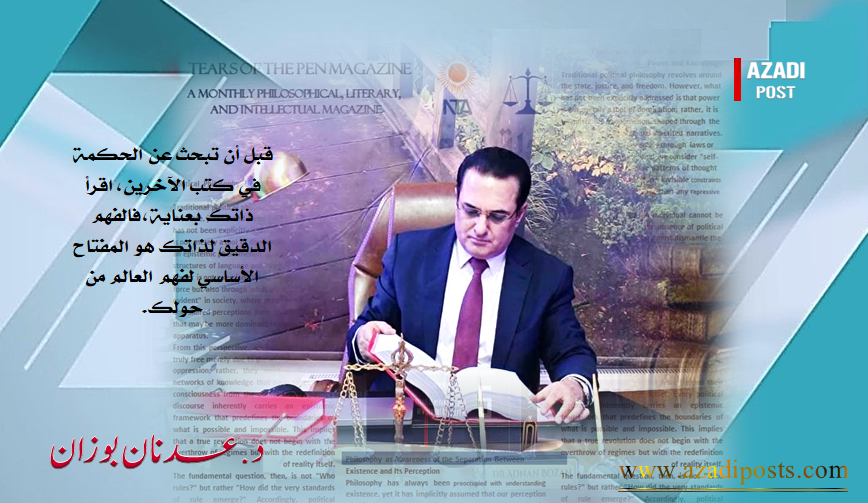
By: Dr. Adnan Bouzan
We are a people who cannot be defeated—not because we have never been defeated at certain moments in history, but because we have never accepted defeat as a final destiny, nor allowed it to transform into a fixed identity that defines us. Defeat, in its deeper meaning, is not merely a passing military or political event; it is a moment of inner surrender, a moment of accepting erasure, a tacit admission that we no longer deserve to exist. And this moment, precisely, has never occurred in Kurdish consciousness, despite the accumulated historical catastrophes it has endured.
The uniqueness of the Kurdish experience does not lie solely in the magnitude of its suffering, but in its ability to transform that suffering into a continuous historical consciousness. We are the children of pain that did not break us, but reshaped us; the children of a geography that sought to swallow us, yet we turned it into meaning—into identity, into a sense of belonging that cannot be reduced to artificial political borders. Every wound within us has not remained a wound, but has become memory; every memory has become a form of resistance; and every act of resistance has become an existential affirmation that we are still here.
We Kurds are not strangers to this land, nor are we mere passersby in the pages of history, as some nationalist narratives have tried to portray us. We are an integral part of the very fabric of this region—of its deep history and its civilizational interactions. Our roots are deeper than the maps drawn after wars, more enduring than the borders imposed by international agreements, and more truthful than the narratives written about us without our participation. Our history is not merely a recounting of events; it is an ongoing struggle for recognition, for existence, and for the right to be agents rather than mere objects of policy.
When we are told, “Follow the right path,” this statement is not an innocent piece of advice. It implicitly assumes the existence of an authority that monopolizes truth, grants itself the right to define direction, and places itself in a position of guardianship. This raises a fundamental question: who has the authority to define the “right path”? And can a path built upon the denial of identity, the marginalization of language, or the erasure of history ever truly be considered right?
A path that does not preserve our dignity is not a path, but a political and moral labyrinth. A path imposed upon us at the expense of our existence is not a choice, but a form of soft erasure. Therefore, rejecting guardianship is not merely an emotional stance; it is both a political and philosophical position grounded in the principle that peoples who know themselves are not led—they choose their own paths in accordance with their consciousness, experience, and history.
Over the course of a full century, the Kurds have experienced various forms of guardianship: nationalist, religious, and international. Each time, the result has been the same—greater marginalization, deeper fragmentation, and further postponement of resolution. This explains the transformation of Kurdish consciousness from seeking an “external protector” to forming a firm conviction that no solution can emerge except from within a self-determined will, through a political project that embraces pluralism and establishes genuine partnership rather than exclusion.
The Kurdish experience reveals a striking paradox: a people subjected to such extensive oppression has not become broken, but rather more conscious of its existence and more determined to claim its rights. This consciousness is not measured by the number of military victories, but by a society’s ability to preserve its language, culture, and memory despite all attempts at erasure. We do not measure time by years, but by the depth of experience; nor do we measure strength by the size of armies, but by the human capacity to say “no” when asked to abandon oneself.
In this context, it is essential to affirm that the Kurds are not guns for hire, nor a mere card in the game of nations, as some regional and international powers have attempted to reduce them. Reducing an entire people to a temporary political function is a form of symbolic violence, as it strips them of their identity as a people with a cause, a right, and an independent existence. We are not a tool, but an actor; not a margin, but the center of our own cause.
A people may lose a battle or be defeated in a round, but peoples who possess a living memory are never defeated. Kurdish memory is not merely an archive of pain; it is a latent energy that regenerates itself with each generation and gives meaning to continuity. It is a memory written in tears and blood, yet it has not turned into despair, but into a persistent affirmation of life.
At its core, the Kurdish question is not a crisis in search of a technical solution; it is an expression of a structural flaw in a regional order built upon the denial of pluralism and the imposition of a singular identity model. Therefore, any genuine solution can only be achieved through redefining the state, identity, and citizenship on democratic, pluralistic foundations that recognize all.
We Kurds are not an obstacle to anyone; rather, we are the victims of obstacles imposed upon us. Yet we have not lost our capacity to dream, for in the context of oppressed peoples, dreaming is not a luxury but an existential necessity. It is the purest form of resistance, for it refuses to accept reality as it is and insists on imagining what ought to be.
In conclusion, we do not claim that we cannot be defeated because we are stronger than others, but because we are more truthful to ourselves, and more steadfast in our right to exist. Simply put, we have never abandoned this right—even in the darkest of times. And those who do not abandon themselves can never be defeated… no matter how long time endures, how severe oppression becomes, or how many disappointments unfold.