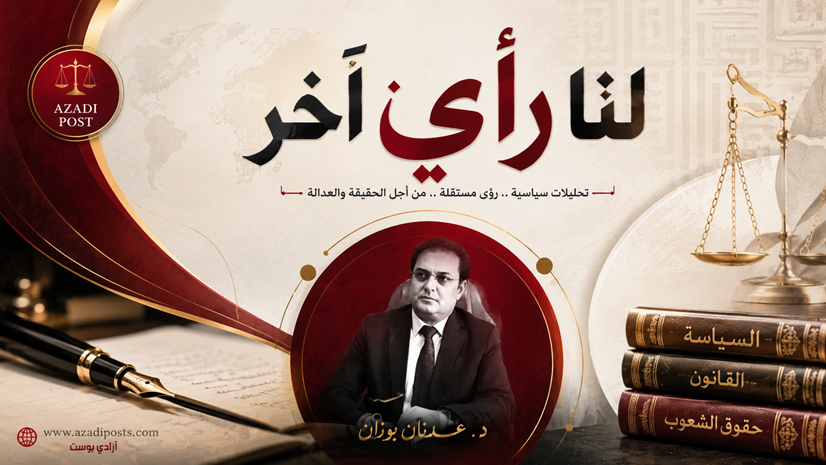
By: Dr. Adnan Bouzan
We are not dealing here with a simple question concerning the status of an educated person, a writer, or an academic within society. Rather, we are confronted with a deeper question that touches upon the nature of the relationship between knowledge and Kurdish society, between reason and the social environment, and between the individual who thinks independently and a collective that has often grown accustomed to viewing difference as a departure from what is familiar.
Why do some Kurdish intellectuals feel like strangers within their own society? And why does a person who possesses knowledge and a different vision become, instead of a source of strength and contribution, someone who finds himself constantly compelled to defend himself, his ideas, and even the soundness of his own mind?
These are questions we should neither evade nor, at the same time, turn into an accusation against the Kurdish people as a whole. The Kurdish people are not a single homogeneous entity, and their culture, history, and experience cannot be reduced to one image. Yet genuine criticism begins when we possess the courage to look at our own shortcomings with the same honesty with which we look at the shortcomings of others.
One of the problems that deserves serious consideration is that society may sometimes celebrate slogans more than it celebrates knowledge, loud voices more than it values ideas, and collective belonging more than it values intellectual independence.
You may encounter someone who speaks extensively about culture, science, and renaissance, yet cannot tolerate an opinion that contradicts his own. He raises the banner of freedom, yet feels constrained by the critic; he speaks about the future of his people, yet does not grant the person with a different intellectual perspective enough space to speak.
And here the paradox emerges.
How can a society demand political and intellectual freedom while its members are unable to tolerate differences within their own social environment?
How can we demand that others respect our identity and culture while we do not always know how to respect a Kurdish person who differs from us in opinion and vision?
And how can we speak of building a new future if we continue to reproduce the very mentality that makes questioning a source of annoyance, criticism an insult, and the intellectual someone whose intentions are viewed with suspicion?
The problem is not that the intellectual is different.
The problem begins when difference itself becomes a problem.
The intellectual does not live for applause, nor should he become a mouthpiece for the collective, a follower of a political party, or a captive of social moods. His fundamental role is to ask questions when others remain silent, to challenge ideas when they turn into unquestioned truths, and to say what he believes to be right—even when what he says is uncomfortable.
For this reason, the Kurdish intellectual who genuinely fulfills his role may find himself confronted by more than one force at the same time: political authority, the pressure of the collective, society’s misunderstanding, and sometimes even the isolation of the cultural sphere itself.
More troubling still is that the debate over his ideas may turn into a debate over his person.
Instead of asking, “What did he say? Is his idea right or wrong?” people may ask: “Who is he? Which side does he belong to? Why does he disagree? What does he stand to gain? And why does he speak in this way?”
Thus, the struggle moves from the idea to its author.
This may be one of the easiest ways to kill an idea before it reaches society. Instead of refuting the argument, its author is discredited; instead of discussing the opinion, its author is attacked; and instead of confronting the question, the person who raised it is accused.
Sometimes the matter goes as far as describing the person who thinks differently as insane, unstable, or detached from reality, simply because he does not think in the way those around him have become accustomed to.
And here we must ask ourselves honestly: Why?
Is it because the person has truly lost his mind, or because society has not yet learned how to deal with a mind that does not resemble the prevailing minds around it?
Not every person who thinks differently is insane. Not every critic is hateful. And not everyone who refuses to follow the crowd is arrogant, a traitor, or detached from reality.
Sometimes a person is different because he sees what others do not see.
And sometimes his silence speaks more powerfully than his words, because his silence stems from his realization that society does not want to listen.
Here lies the tragedy of the Kurdish intellectual: to live in a society to which he belongs emotionally and historically, yet within which he may feel intellectually estranged.
He knows his language, his history, his cause, and the suffering of his people, yet he may not always find an environment that allows him to be himself.
Perhaps what hurts the intellectual most is not rejection, but being misunderstood.
The intellectual does not seek special privileges, nor does he wish to stand above society, nor does he want to be treated as though he were better than others. All he asks is that his ideas be discussed on their own merits, that he be allowed to be right or wrong, and that he be able to disagree without his disagreement turning into a social trial.
A society that respects the intellectual does not mean that it must always agree with him. On the contrary, a conscious and aware society may strongly disagree with an intellectual, but it disagrees through argument rather than insult, through dialogue rather than defamation, and through criticism rather than exclusion.
And here we arrive at an even more important point: the intellectual himself is not always innocent.
Just as society is required to reassess its relationship with the intellectual, the Kurdish intellectual is also required to reassess himself. Not everyone who holds a degree is an intellectual; not everyone who writes an article possesses an intellectual project; and not everyone who raises his voice in criticism of others is capable of practicing self-criticism.
The true intellectual does not content himself with criticizing society; he criticizes himself, criticizes the elite, criticizes political parties, criticizes the prevailing culture, and even criticizes the ideas to which he belongs when he sees that they have become an obstacle to truth.
This is where genuine culture begins.
We do not need an intellectual whom everyone applauds, just as we do not need a society that rejects every intellectual who thinks differently. What we need is a society capable of tolerating the intellectual, and an intellectual capable of tolerating criticism.
We need a culture that does not ask first, “Whose side are you on?” but rather asks, “What are you saying?”
We need a society that does not judge a person according to his affiliation, but engages with his ideas.
We need a culture in which difference becomes a source of enrichment rather than a cause of hostility.
For a people that seeks to build its future cannot live with a mentality that fears questions.
And a people that wishes to preserve its identity should not fear criticism. An identity that cannot tolerate criticism becomes a cage; a culture that does not accept self-examination becomes a habit; and a cause that does not allow questions becomes a slogan.
The future of the Kurdish people does not need more voices that sound alike as much as it needs different minds.
It needs the historian who reexamines history, the thinker who questions, the writer who criticizes, the academic who investigates, the poet who gives expression to what others cannot say, and the ordinary person who has the courage to say: “I disagree.”
This is not a problem; this is life.
The real problem is when everyone becomes united in agreement because they are afraid of disagreement.
And when the intellectual becomes a stranger in his own society, this is not merely the intellectual’s loss; it is the loss of society itself. For a society that drives its most conscious members into isolation, silence, emigration, or withdrawal from public life loses part of its ability to think about its own future.
Therefore, the real question is not: Why does the Kurdish intellectual differ from his society?
Perhaps we should instead ask:
Why is Kurdish society not always able to benefit from those among its own people who disagree with it?
This is an issue that deserves to be discussed without fear, without flattery, and without ready-made accusations.
A free society cannot be built with fearful minds. Nor can a cultural renaissance be achieved if the intellectual pays a social price simply for thinking. And no different future can be built if we demand that a person surrender his individuality and difference merely to gain acceptance.
If the Kurdish person is to live freely, he must not submit to the power of ignorance, nor bargain away his mind or his dignity.
Ignorance builds no homeland, safeguards no dignity, and creates no future.
And on this matter, we have a different view.