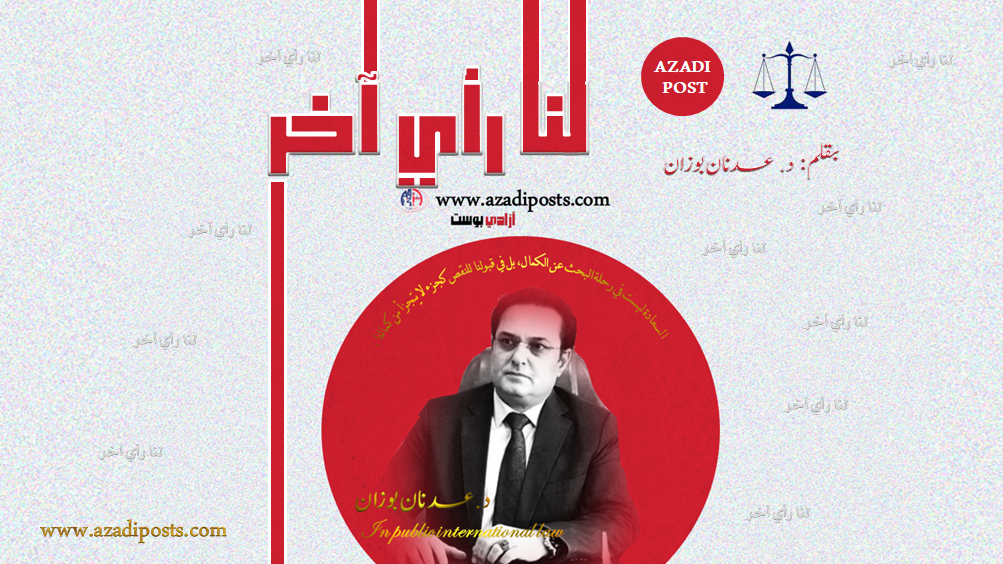
By Dr. Adnan Bouzan
We are not among those who speak recklessly, nor among those who wake up too late to shout after it is all over. What we write today was said yesterday and warned against repeatedly, yet no one listened—or perhaps many chose not to hear. Today we have reached a moment when words seem to have lost their weight, and yet we write, not because we believe words will suffice, but because silence at this stage is an explicit partnership in political crime.
What happened in the neighborhoods of Ashrafieh and Sheikh Maqsoud is not an isolated security incident, nor a tactical mistake that can be excused by claims of complexity or exceptional circumstances. It is a new link in a long chain of abandonment that began in Afrin, passes today through these two neighborhoods, and will—without the slightest doubt—reach eastern Euphrates tomorrow. Whoever believes the bleeding will stop here is either politically deluded or a partner in manufacturing that delusion.
Recent history requires no genius to read: those who abandoned the Kurds in Afrin abandoned them again today, and will abandon them tomorrow unless the hard questions are asked and the choices held to account. Collapse does not occur suddenly; it is the outcome of an accumulation of small concessions wrapped in grand rhetoric about wisdom, necessity, and avoiding the worst. This is how ruin is always managed.
The question many evade is simple and direct: what is the real function of the Syrian Democratic Forces? Were they created to protect the people, or to guard geography as a reservoir of wealth and oil? Facts on the ground contradict the rhetoric. What kind of “protection” is measured by evacuating Kurdish neighborhoods and leaving their residents under pressure, threat, slaughter, and displacement? And what kind of “liberation project” prioritizes land over people, resources over dignity and existence?
What occurred was neither a technical withdrawal nor an unavoidable redeployment; it was a full-fledged political decision, passed through deception and misinformation. People were misled when they were told the abandonment was temporary, that the alternative would be safer, and that necessity required silence. This is always how catastrophe begins: with a small promise, a temporary lie, and a discourse that frightens people with a greater unknown.
Most dangerous of all is the recurring illusion that the alliance with the United States constitutes a guarantee. This is not political analysis; it is denial. The United States does not protect peoples or democratic projects—it protects its strategic interests. Anyone who believes Washington will defend a Kurdish neighborhood or a popular existence has learned nothing from decades of experience. It protects oil, corridors, and maps of influence, and when the need ends, it closes the file without hesitation.
Any alliance not built on a real balance of interests but on political dependency is a ready-made recipe for deferred betrayal. Everyone who wagered solely on American power ended up either a victim or a burned card. The question is not whether abandonment will occur, but when, how, and at whose expense.
We write today not to incite, but out of responsibility. What is happening is neither an administrative dispute nor a passing miscalculation; it is a complete trajectory that leads to emptying the Kurdish cause of its political substance and turning it into a security function tasked with guarding wealth rather than protecting existence.
Those who lack the courage to speak the truth today will become witnesses for the prosecution tomorrow. Those who justify abandonment in the name of “realism” will later justify total collapse in the name of “rationality.” What was lost in Afrin was not an isolated incident; what is happening today is not an exception; and what awaits eastern Euphrates is no mystery.
We say it plainly and without evasion: the path being taken today leads to a new catastrophe, and silence about it is not neutrality—it is full participation. History shows no mercy, peoples are not deceived forever, and anyone who chose abandonment once will be held to account when the last fig leaves fall.