By: Dr. Adnan Bozan
Introduction: When Madness Becomes a Subject of Civilization
Medieval and early Renaissance European art was not merely an aesthetic reflection of the world; it often functioned as an intellectual mirror reflecting the deep structure of collective consciousness—its fears, beliefs, and conceptions of humanity, the cosmos, sin, and order. Within this context, Ship of Fools transcends its status as a remarkable visual creation by Hieronymus Bosch, becoming instead a dense cultural text that reveals a complex relationship between power, knowledge, and the human body at a historical moment when the boundaries between reason and madness were not clearly defined, but rather saturated with religion, myth, and fear.
Ship of Fools does not present madness as a temporary individual condition or a psychological disorder in the modern sense. Instead, it reconstructs it as an existential, social, and religious category at the same time. In the medieval European imagination, the mentally ill were not seen as patients in need of understanding or care, but as beings excluded from organized humanity—individuals cast out of the moral order of the world, marked by demonic possession, or associated with deviation from divine will. Madness, therefore, was not measured by behavioral disturbance, but by the degree of deviation from the “sacred norm” that defined reason itself.
This perception was not marginal or accidental; it was embedded within a broader intellectual framework that viewed the universe as a strict hierarchical order, in which human beings occupied a position between earth and heaven and were expected to maintain balance through obedience, faith, and moral discipline. Within such a system, any deviation from this order became a threat not only to the individual, but to the cosmic structure itself. Thus, cognitive difference was transformed into a sign of chaos and evidence of a rupture in what was presumed to be a divine and absolute system.
Within this cultural climate, artworks addressing madness—such as Ship of Fools—acquired a function that exceeded aesthetic representation and entered the realm of symbolic performance. They did not depict the mad as individuals, but as a separated collective pushed to the margins and placed aboard a symbolic vessel drifting toward the unknown. It is as though society purifies itself through a structured act of expelling everything it cannot contain or interpret. Madness here is no longer a medical or psychological condition; it becomes a social ritual and a form of symbolic punishment enacted in the name of public order.
The intellectual danger embedded in this perception lies in its transformation of illness or psychological disturbance into sin, and human suffering into moral fault. It turns cognitive difference into a justification for exclusion rather than understanding. For this reason, interpreting this painting cannot be separated from a critique of the epistemological structure that produced it, where theology merges with authority and “reason” becomes simultaneously a tool of definition and exclusion.
From this perspective, Ship of Fools is more than a visual scene; it is a symbolic structure that reveals how European civilization at the time drew the boundaries of the human itself: who is considered rational, who is excluded from reason, who is allowed to remain inside the symbolic city, and who is cast into the sea as an open space of disappearance.
The ship, therefore, is not merely a means of transport. It is a cosmic metaphor for exclusion and for the transition of the human being from “inside” to “outside,” from order to chaos, and from recognition to erasure.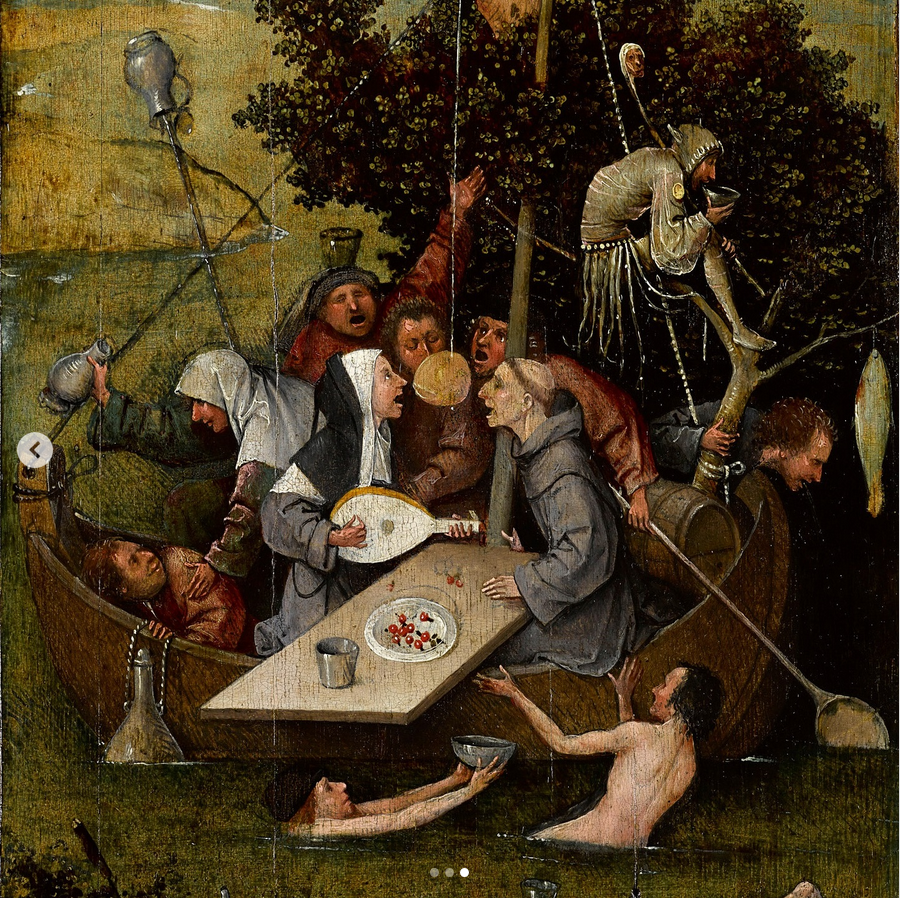
Thus, this painting is not ultimately about madness itself, but about the civilization that defined madness, established its criteria, and shaped the mechanisms for dealing with it. It reveals that every society, in defining reason, simultaneously produces its opposite and constructs the “Other” who must be isolated, interpreted, or expelled.
In this sense, the importance of such artworks lies not only in their aesthetic value, but in their function as intellectual documents that expose the deep structures of human consciousness at different historical moments.
It is a moment in which madness becomes not merely a subject of art, but a subject of civilization itself—a moment where myth, religion, knowledge, and fear intersect within a single image that concentrates humanity’s questions about itself before it becomes a question about the Other.
First: The Historical and Intellectual Context of the Painting
Hieronymus Bosch belongs to a transitional and highly sensitive moment in European history—a moment positioned at the threshold between the late Middle Ages and the early Renaissance. During this period, intellectual transformations had not yet settled into their modern form; instead, they were still taking shape within a profound tension between a religious worldview and the emergence of a new humanist sensibility that began to place the human being at the center of experience and meaning. In this phase, art was not merely an aesthetic practice, but a means of reflecting on cosmic order, sin and salvation, and the position of humanity within a dense web of theological and moral symbols.
Within this context, Bosch distinguished himself through an extraordinary visual vision, arguably unique in the history of European art. He does not present the world as a balanced or rational system, but rather as a disturbed and unstable space filled with fragmented symbols, hybrid creatures, and scenes that oscillate between dream and nightmare. In his works, evil is not merely a moral deviation; it is a pervasive force embedded in the fabric of everyday existence, infiltrating the body, behavior, and even religious ritual itself. His artistic universe, therefore, is not based on a clear binary opposition between good and evil, but on their constant entanglement, making the human being a fragile entity perpetually exposed to moral and existential سقوط.
Within this dense symbolic climate, the idea of the “Ship of Fools” emerges as a cultural and intellectual extension of a wide range of representations that circulated in Europe during the fifteenth and sixteenth centuries. These representations turned madness into both a social and moral concern. At the time, German and Dutch literature produced texts and symbolic images depicting the “Ship of Fools” or “Ship of Madmen,” in which groups of individuals who had lost their moral or rational compass were shown aboard a rudderless ship adrift at sea, as though it were a representation of a society that had lost its internal direction.
This image was not a passing literary metaphor; it was an expression of a deep civilizational anxiety regarding the collapse of social and moral order during a period in which Europe was undergoing major religious and political transformations, paving the way for the Reformation and the struggles between ecclesiastical and secular power. In this context, “madness” is no longer an isolated individual condition, but a sign of a broader disturbance affecting society as a whole, as if collective reason itself had become vulnerable to disintegration.
The concept of the ship here carries a complex symbolic meaning. On the one hand, it represents the journey of human existence in the world; on the other, it symbolizes the city or society that is supposed to be structured and guided. However, when such a vessel is occupied by “fools,” it becomes a metaphor for the loss of leadership, the collapse of epistemological authority, and the absence of the ability to distinguish between correct and incorrect directions. The ship thus ceases to be a means of transport and becomes an image of the world losing consciousness of itself.
Within this symbolic framework, the painting transcends its depiction of a group of individuals in a state of disorder, evolving into a visual meditation on a deeper idea: the possibility that society itself may be in a state of “madness” without realizing it. The mad figures in the painting are not presented as exceptions to the norm, but as a condensed reflection of a broader reality in which the boundaries between reason and unreason, order and chaos, are blurred to the point where it becomes difficult to define rationality itself in absolute terms.
From this perspective, the work can be read as an implicit critique of society’s claim to rational stability. It suggests that what is called collective reason may not be pure rationality at all, but rather a mixture of illusions, fears, and moral-religious constructions that generate various forms of exclusion and categorization. When madness is attributed to a specific group, it simultaneously reveals how society preserves its own definition of reason, even if that definition is historically contingent or structurally fragile.
In this sense, The Ship of Fools is no longer merely an image of the socially excluded or rejected; it becomes a reversed mirror of society itself, revealing that the concept of “reason” is not a fixed truth but a cultural construct shaped by time and context. Thus, at its intellectual core, the painting does not only ask about the fate of the mad, but also about the fate of the society that defines them, delineates their boundaries of existence, and determines where reason begins and where it ends.
This tension between individual and society, between reason and unreason, between order and chaos, is what grants the work its enduring symbolic power and makes it open to multiple readings beyond its original historical moment—transforming it into an open text that continually raises fundamental questions about humanity, its limits, and its capacity to define what it considers “reason” or “madness.”
Second: A Visual Reading of the Painting
When we approach the painting as a visual structure rather than merely a narrative subject, a world charged with silent tension is revealed—a world that relies not on eventfulness but on suggestion, not on movement but on the sensation of a slow drift toward emptiness. Hieronymus Bosch’s Ship of Fools does not present a clearly defined scene in the classical sense of artistic composition; instead, it constructs a visual field based on deliberate fragmentation, where human elements intertwine with spatial symbolism to produce both a visual and psychological state of disturbance.
At the center of this composition, a group of individuals appears aboard a small boat that seems to have lost its original function as a means of passage or salvation. The boat itself does not suggest stability or direction; rather, it appears as a floating body in an undefined void, disconnected from any navigational system or clear destination. More importantly, the absence of a captain—or any sign of leadership—is not a secondary detail, but a foundational element in the painting’s visual meaning. This absence does not simply signify chaos; it signifies the collapse of the very idea of guidance itself, as though the ship has been left to move according to an obscure internal logic beyond control.
The figures occupying the boat are not presented as distinct individuals, but rather as a marginalized human mass sharing a single condition of dispersion and inner absence. Their faces do not carry clearly readable expressions that can be easily classified within defined emotional categories; instead, they tend toward numbness, distraction, or detachment from the present moment, as though they are not fully connected to what surrounds them. This absence of expression does not merely produce a sense of indifference; it opens the way for a deeper reading concerning the separation of consciousness from the body, as if the figures are physically present within the boat yet mentally absent from the meaning that should bind them to space and event.
This condition is also reflected in the structure of the bodies themselves, where movements appear slow, uncoordinated, and devoid of any clear purpose. There is no visual rhythm suggesting deliberate action or decision; instead, there is a continuous sense of drifting or slackening, as if time within the painting does not move forward but rather stalls in a suspended moment between action and inaction. This deceleration of visual rhythm creates an impression of internal stagnation, a stagnation that does not concern the scene alone but extends to the existential condition of the figures themselves.
The background completes this symbolic construction through the absence of any clear horizon that might provide a sense of direction or future. There are no decisive geographical markers, nor any indications of harbor, land, or point of arrival. This absence of horizon does not merely leave the scene open; it suspends it within a visual void in which neither beginning nor end can be determined, and no clear trajectory of the ship’s journey can be traced. Here, the visual void becomes a central semantic element, deepening the sense that this movement does not lead anywhere but instead circulates within a closed loop of displacement and loss.
Within this context, the ship is no longer a spatial element within the painting; it becomes a dense metaphor for human exile. It is neither a vessel of salvation in the traditional sense nor a tool of transition from one state to another, but rather a symbolic form of expulsion from “place” itself. Place, in this painting, is not understood as geography, but as belonging and meaning. When individuals are deprived of this belonging, their existence becomes suspended in a void that allows neither stability nor genuine movement.
From here, the fundamental visual paradox of the work becomes more pronounced: the ship, which is supposed to symbolize passage toward salvation, transforms into an instrument for removing the human being from the very sphere of meaning. It does not transport them toward a destination; it strips them of the concept of destination itself. It does not lead them to a new place; it severs their connection to the idea of “place” altogether. This transformation grants the painting its profound existential dimension, where exile is no longer a geographical condition but an epistemic one in which the sense of belonging, direction, and purpose dissolves.
This visual reading reveals that the work does not rely on direct narration but on the construction of a network of silent signs: absent faces, slackened bodies, aimless movement, a missing horizon, and a ship without a captain. Together, these elements do not form a traditional story; rather, they create a condition—a suspended existential state that leaves the viewer with an open question rather than an answer.
Thus, the painting becomes a visual experience that does not merely depict “fools” as its subject, but instead places the viewer inside their own visual logic: a logic of absence, disconnection, and drift, where seeing itself becomes a form of participation in this silent wandering that leads nowhere.
Third: The Madman in the Medieval European Imagination
Within the cultural structure of medieval Europe, “madness” was not understood as a medical or psychological concept in the modern sense. Rather, it formed part of a broader explanatory system in which Christian theology intertwined with popular traditions and collective superstition, creating a unified interpretive framework through which human beings, their behavior, and their destiny were understood. In this context, mental deviation was not interpreted as a dysfunction of the brain or a disturbance of perception, but as a sign of a deeper rupture in the relationship between the human being and divine will.
According to this worldview, madness was often attributed to sin, demonic possession, or a form of invisible punishment inflicted upon the individual as a result of their departure from the moral and religious order that defined “right” and “wrong.” Consequently, the madman was not perceived as a patient in need of understanding or care, but as a being who had stepped outside the boundaries of acceptable interpretation—an alien body within a social system that sought to preserve its cohesion by classifying everything threatening it as “other,” “deviant,” or “cursed.”
This entanglement of the religious, the moral, and the epistemological rendered the concept of “reason” itself normative rather than merely descriptive. That is, it did not only refer to the capacity for thinking or cognition, but already contained an embedded value judgment. To be rational in the medieval European imagination did not simply mean to think correctly, but to be aligned simultaneously with both divine and social order. Any deviation from this alignment was immediately interpreted as a threat to the cosmic order, rather than as an individual variation in behavior or perception.
Within this framework, the mad were not merely isolated individuals; they constituted a socially constructed category embedded within a discourse of exclusion. They did not appear as a multiplicity of personal cases, but as a symbolic mass unified under a single label that erased individual differences and transformed them into a “type” placed outside the natural classification of humanity. This shift from individual to category reflects a broader cultural mechanism for dealing with difference, whereby it is transformed into a fixed identity used to justify exclusion and expulsion.
From this perspective, their presence in Hieronymus Bosch’s Ship of Fools should not be read as a realistic depiction of patients or marginalized individuals, but as a visual embodiment of a deeper social mechanism: the mechanism of expulsion from meaning. The madman, in this sense, is not only someone physically banished from the city, but also someone expelled from language itself—that is, from the ability to participate in the discourse that defines what is “rational” and what is “acceptable.”
The descriptions attached to this group—exiles from the city, expelled from the system, outsiders to the shared language of reason—do not merely refer to a social condition, but to a complete existential state in which the individual becomes incapable of participating in the production or reception of meaning within the community. Language here is not simply a means of communication; it is a system of belonging, and exclusion from it means exclusion from the symbolic world that defines existence itself.
Within this framework, Ship of Fools becomes more than a symbolic scene; it becomes a theater of collective punishment, where exclusion is performed as an organized act aimed at reproducing social order through the removal of elements perceived as threatening to it. The ship does not appear as a vessel of salvation or passage, but as an instrument of expulsion, as though society were carrying out a symbolic cleansing of itself by removing everything that does not conform to its narrow definition of reason and order.
Thus, the sea is no longer a geographical space but a metaphysical realm of final separation. It becomes the place where “human surplus” is cast away—those whom the system can no longer accommodate or interpret. In this sense, the painting is no longer simply a depiction of people aboard a boat, but a profound critique of a social logic that makes exclusion a condition for maintaining balance, and transforms difference into sufficient grounds for expulsion.
This understanding of madness in the medieval European imagination reveals that the painting is not only about the “other” who is excluded, but also about the society that produces this other and continuously reproduces it through rigid systems of classification, where reason itself becomes an instrument of distinction as much as it is an instrument of understanding.
Fourth: The Ship as a Philosophical Symbol
In Hieronymus Bosch’s Ship of Fools, the ship acquires a value that goes far beyond being a mere visual element within the scene, transforming into a dense symbolic structure carrying multiple layers of philosophical, social, and existential meaning. It is not simply a transient means of transportation across water, but a symbolic entity reflecting a complete vision of the world, of humanity, and of society, as well as the troubled relationship between order and chaos, leadership and drift, belonging and exile.
At the first level of this symbol, the ship appears as a “ship without a captain.” This absence is not an incidental detail; it is the very center of meaning itself. In symbolic imagination, the captain represents the organizing mind, the authority that provides direction, or the structure that regulates the movement of the collective within a comprehensible and predictable path. When this captain is absent, what remains is not merely an administrative void, but the collapse of the very concept of guidance. Movement becomes possible, but meaningless; the group continues to exist, but without a center that binds its actions into a rational unity. Here, absence turns into a form of negative presence, where chaos is not the result of deviation, but the result of the absence of the structure that would otherwise prevent deviation from becoming a permanent condition.
At the second level, the ship emerges as a “ship without a destination.” This absence of direction opens the way for a deeper existential reading, in which the journey itself becomes the subject of reflection rather than the path it traverses. The ship does not move toward a known harbor, nor does it approach a defined goal; instead, it appears suspended in a circular motion or trapped within a void of time and space. This form of movement removes the journey from its conventional meaning—progress from one point to another—and transforms it into a metaphor for life itself when it loses its purpose or when meaning becomes indeterminate. In this sense, life is no longer a progression toward an end, but an ongoing drift within a space that offers no guarantee of arrival.
At the third level, the ship appears as a “ship loaded with the outcast.” Here, the social and political dimension of the symbol becomes concentrated. Those on board are not merely passengers; they are a category expelled from the general order. These outcasts are not randomly selected individuals, but the outcome of a broader social mechanism that resolves internal contradictions by displacing them outside the recognized field. Society, in this perspective, does not address its crises through understanding or reform, but through removal and expulsion, as if human or moral surplus can simply be isolated and pushed beyond the boundaries of the public sphere.
This threefold structure of the ship—the absence of the captain, the absence of destination, and the presence of the outcast—turns it into a condensed symbolic model of a world that has lost its internal equilibrium. It is not merely a vessel at sea, but an image of the world itself when it is left without leadership, without purpose, and without the capacity to contain its internal differences. Here, the visual structure converges with the philosophical structure, producing a meaning that transcends direct representation and moves into a reflection on the nature of social order itself.
Within this framework, the ship no longer represents only the transport of “madmen,” but becomes a mirror of a deeper mechanism: the production of madness itself through exclusion. When society fails to understand difference, it does not reconsider its epistemological tools; rather, it redefines that difference as a defect that must be isolated. Thus, madness is transformed from a complex human condition into a ready-made social category used to justify expulsion and exile.
From this perspective, the painting transcends its depiction of marginalized individuals or “fools,” becoming instead a critique of the social structure that produces such classifications in the first place. The ship carries not only the mad, but also the logic of exclusion itself—the logic that perceives difference as danger, plurality as threat, and disorder as the inevitable consequence of the absence of absolute control.
This transformation of meaning is what grants the ship its profound philosophical depth. It becomes not merely an image of a group of human beings in a state of drift, but a model of the world when it loses the ability to define itself without excluding a part of itself. Thus, the ship turns into an open question about the very limits of reason: Is reason what organizes the world, or is it what produces definitions that cast others outside the world?
Fifth: The Symbolic Dimension in Hieronymus Bosch’s Thought
The visual world of Hieronymus Bosch is founded upon an intensely dense symbolic logic, in which things do not appear as neutral or self-contained entities, but rather as charged signs intertwined with moral and religious meanings. In this world, no scene is innocent or devoid of significance; every detail—no matter how small or seemingly incidental—carries within it the trace of a deeper struggle between good and evil, sin and salvation, and between divine order and human deviation from it. Thus, a painting by Bosch is not read as a representation of reality, but as a symbolic construction that reshapes reality according to an internal logic based on warning, suggestion, and moral condensation.
Within this framework, Ship of Fools does not emerge as a visual story about a group of individuals in a state of disturbance, but as a symbolic field in which multiple layers of meaning intersect. The ship itself, the human figures aboard it, the unclear movement, and the functional absence of leadership—all these elements do not operate independently, but converge to form a composite vision of humanity and the world, a vision that does not separate the moral from the existential, nor the social from the religious.
On the social level, the painting can be read as a critique of mechanisms of exclusion practiced by societies against weak or non-conforming groups. The individuals depicted on the ship are not presented as distinct persons treated within a balanced human framework, but as a category pushed outside the organized social field, as though society re-establishes its internal equilibrium by disposing of elements it cannot integrate. In this sense, the painting does not merely reflect the existence of “marginalized people,” but reveals the very mechanism of marginalization itself, where exclusion becomes part of the logic through which social order is maintained.
On the religious level, the painting opens onto a deeper reading rooted in the moral imagination of the era, in which human behavior was interpreted through a strict system linking virtue and sin, obedience and deviation. In this context, the drifting of the figures aboard the ship does not appear merely as a social condition, but can be understood as a symbolic warning against straying from the righteous path, or as an image of the human being when he loses his spiritual and moral compass. However, this dimension is not presented in a direct or didactic manner; rather, it is conveyed through visual condensation that transforms loss itself into a sensory condition—something seen rather than said, experienced visually rather than explained discursively.
On the existential level, the painting transcends both social and religious frameworks to touch a more profound question concerning the human condition in the world. The figures, seemingly stranded aboard the ship, do not merely experience exclusion or deviation, but a more radical loss of certainty, in which no stable meaning or fixed direction is visible. At this level, the human being appears as a being in drift not because of a specific sin, but because of the very nature of the world, which offers no clear guarantees of meaning or stability. The ship thus becomes a condensed image of human existence when it is left without a fixed reference point and without any assurance of its ultimate destination.
It is precisely the intertwining of these three levels—the social, the religious, and the existential—that grants the work its distinctive symbolic power, making it open to multiple readings that do not cancel each other out, but instead overlap to form layered meanings that resist any single interpretation. Society in the painting is not separated from religion, nor religion from existence; each level reflects the others in an indirect manner, such that understanding one becomes dependent on understanding the rest.
From here emerges the central question posed by the painting in its symbolic conclusion: Is madness an individual condition arising from within the human being, or is it a reflection of the structure of the world surrounding him? This question does not aim to provide a definitive answer; rather, it opens the space for a broader reflection on the relationship between the individual and society, between reason and order, and between what is considered “normal” and what is classified as “deviant.” Perhaps madness does not lie in the figures aboard the ship as much as it lies in the way madness itself is defined within a system that perceives difference as a threat, plurality as disorder, and ambiguity as grounds for exclusion.
In this sense, the painting becomes an open text, suspended within an endless horizon of interpretation, where meaning does not close upon moral, religious, or social explanation, but remains suspended in the space of questioning—just as the ship itself remains suspended on a sea without a clear destination and without a captain to determine its course.
Sixth: The Louvre Museum and the Immortality of the Image
Hieronymus Bosch’s Ship of Fools acquires a new dimension when it is removed from its original historical context and placed within the modern museum space, where it is now exhibited among the collections of the Louvre Museum, one of the most significant institutions preserving the visual memory of human civilization. This transition from the time of production to the time of exhibition does not merely signify the preservation of the artwork from decay or disappearance; rather, it means its reinsertion into a new interpretive system, in which the function of the image shifts from being a moral or religious discourse addressed to a specific audience, to becoming a cultural document open to multiple readings across time and cultures.
The presence of the painting within the museum does not place it in a state of historical “stillness”; on the contrary, it grants it a renewed life within a different epistemological framework. The modern museum is not merely an exhibition space, but a cultural apparatus that reorganizes the relationship between human beings and images, between past and present, and between beauty and knowledge. Within this framework, the painting is transformed from a work that once addressed the moral and religious sensibilities of pre-modern Europe into an object of historical and philosophical reflection on how concepts such as reason, madness, and deviance were constructed within Western consciousness.
The inclusion of the work in a world museum such as the Louvre also means its insertion into what can be called a “universal archive of art,” where artworks are not read as isolated productions, but as milestones in the long history of the evolution of human perception of the world. Here, the work no longer belongs exclusively to its original local, religious, or cultural context; instead, it becomes part of a shared human memory—though this memory itself is marked by historical inequalities and asymmetries of power and meaning.
From a deeper perspective, this transformation can be understood as a form of “reframing” of meaning. The image that originally carried a warning, moral, or symbolic function within a specific cultural structure becomes, in the museum context, an object of aesthetic contemplation and historical analysis. This shift does not erase the original meaning, but adds new layers of interpretation, so that the work becomes suspended between what it meant in the past and what it means in the present.
Within this context, the painting gains particular significance because it belongs not only to the history of art, but also to the history of ideas. It is not merely a visual representation of a social or religious condition in medieval Europe, but a document revealing how human beings have conceptualized their relationship to difference, to the “other,” and to the boundaries between reason and unreason. This is what allows it to transcend its status as a silent artistic object and become a continuous epistemological question within the exhibition space.
Despite its relatively small physical size compared to the major works housed in the museum, its symbolic weight is not measured in physical dimensions, but in the density of the questions it raises. It carries within it a long history of human anxiety concerning the meaning of reason, the limits of social order, the nature of exclusion, and the mechanisms by which “the normal” and “the abnormal” are defined. These questions do not diminish with time; rather, they become more complex each time the work is reinterpreted from new perspectives.
Thus, the presence of Ship of Fools in the Louvre does not mark the end of its historical life, but the beginning of an extended interpretive existence, in which the image becomes an open space for dialogue between eras. It is no longer merely a relic of the past, but a mediator between past and present, between a specific European historical experience and the enduring human questions that remain relevant today.
In this sense, the museum is not simply a place that preserves the painting, but a space that continuously reproduces its meaning, transforming it into a living entity within the global cultural memory—capable of reawakening the same questions from which it emerged, yet in forms that correspond to each new historical moment.
Conclusion: The Human as a Perpetual Voyager on a Ship Without a Known Destination
Ultimately, Ship of Fools cannot be reduced to a mere historical scene or a moral allegory about a marginalized group. It should instead be read as a visual condensation of the human condition itself—of the moment when human beings lose their internal balance between meaning and meaninglessness, belonging and displacement, understanding and confusion. It is not about the “other” exiled in medieval Europe, but about the human being as an entity perpetually subject to redefinition within the shifting boundaries of reason and madness, according to the conditions imposed by each historical epoch.
Within this broader horizon, the painting becomes more than a work created by Hieronymus Bosch; it becomes a harsh mirror reflecting the fragility of the standards through which humans divide the world into rational and mad, normal and deviant, inside and outside. It reminds us that these boundaries are not fixed, but are the product of a long historical negotiation between power, knowledge, and belief—and that what is excluded in one moment as “madness” may later be reinterpreted as difference, or even as an alternative form of truth.
The logic of exclusion embodied in the painting does not end with the group of outcasts aboard the ship; it extends to the very society that produced this exclusion. When a society attempts to purify itself of “difference,” it does not eliminate it; rather, it redistributes it in other forms and implants the seeds of its disturbance within itself without realizing it. Thus, madness is no longer confined to the margins; it becomes a latent structure at the very center, emerging whenever the system that defines and monopolizes reason loses its balance.
From here, the ship transcends its material form to become a condensed image of human existence itself: a being in constant motion yet without final certainty about its destination; a creature living on the surface of a changing world, where no fixed maps of salvation or arrival exist. It is not only the ship of fools, but the ship of humanity when left alone in the face of its ultimate questions, without guarantees, without certainty, and without a final explanation of meaning.
In this context, the madmen in the painting are no longer merely objects of observation or study; they become a metaphor for humanity at its most vulnerable moments, when meaning disintegrates, language falters, and the sense of direction disappears. They are not exceptions to the human condition, but one of its possible manifestations when the compass linking the individual to the world breaks down.
Thus, the painting expands into an open question that refuses closure:
Is madness an individual condition affecting some, or a permanent possibility within the human structure itself? And is the ship carrying the “fools” a historical exception, or a permanent symbolic image of the world when it loses its balance?
Ship of Fools offers no answer. Instead, it leaves us before an unextinguished mirror in which we see ourselves whenever we attempt to draw rigid boundaries between reason and madness. And with each new reading, it seems that the ship is still sailing—and that all of us, in different degrees, may already be aboard it, searching for a harbor whose existence we are not even certain of.
ـــــــــــــــــــــــــــــــــــــــــــــــــــــــــــــــــــــــــــــــــــــــــــــــــــــــــــــ
- Gibson, Walter S. Hieronymus Bosch. Thames & Hudson, 1973.
- Fraenger, Wilhelm. The Millennium of Hieronymus Bosch. (trans. by Eithne Wilkins & Ernst Kaiser), London: Faber & Faber, 1951.
- Bax, Dirk. Hieronymus Bosch: His Picture-Writing Deciphered. (Various editions).
- Snyder, James. Northern Renaissance Art: Painting, Sculpture, the Graphic Arts from 1350 to 1575. Prentice Hall, 1985.
- Koldeweij, Jos; Vandenbroeck, Paul; Vermet, Bernard. Hieronymus Bosch: The Complete Paintings and Drawings. Mercatorfonds, 2001.
- Marijnissen, R. H. Hieronymus Bosch: The Complete Works. (Various editions).
- Baxandall, Michael. Painting and Experience in Fifteenth-Century Italy. Oxford University Press, 1972.
- Foucault, Michel. Madness and Civilization: A History of Insanity in the Age of Reason. Vintage Books, 1965.
- Huizinga, Johan. The Autumn of the Middle Ages. University of Chicago Press, 1996.
- Didi-Huberman, Georges. The Surviving Image: Phantoms of Time and Time of Phantoms. Penn State University Press, 2017.
- Panofsky, Erwin. Studies in Iconology: Humanistic Themes in the Art of the Renaissance. Oxford University Press, 1939.
- Gibson, Walter S. “Bosch’s ‘Ship of Fools’ and the Medieval Tradition of the Ship of Fools.” Art Bulletin, Vol. 58, No. 2, 1976.