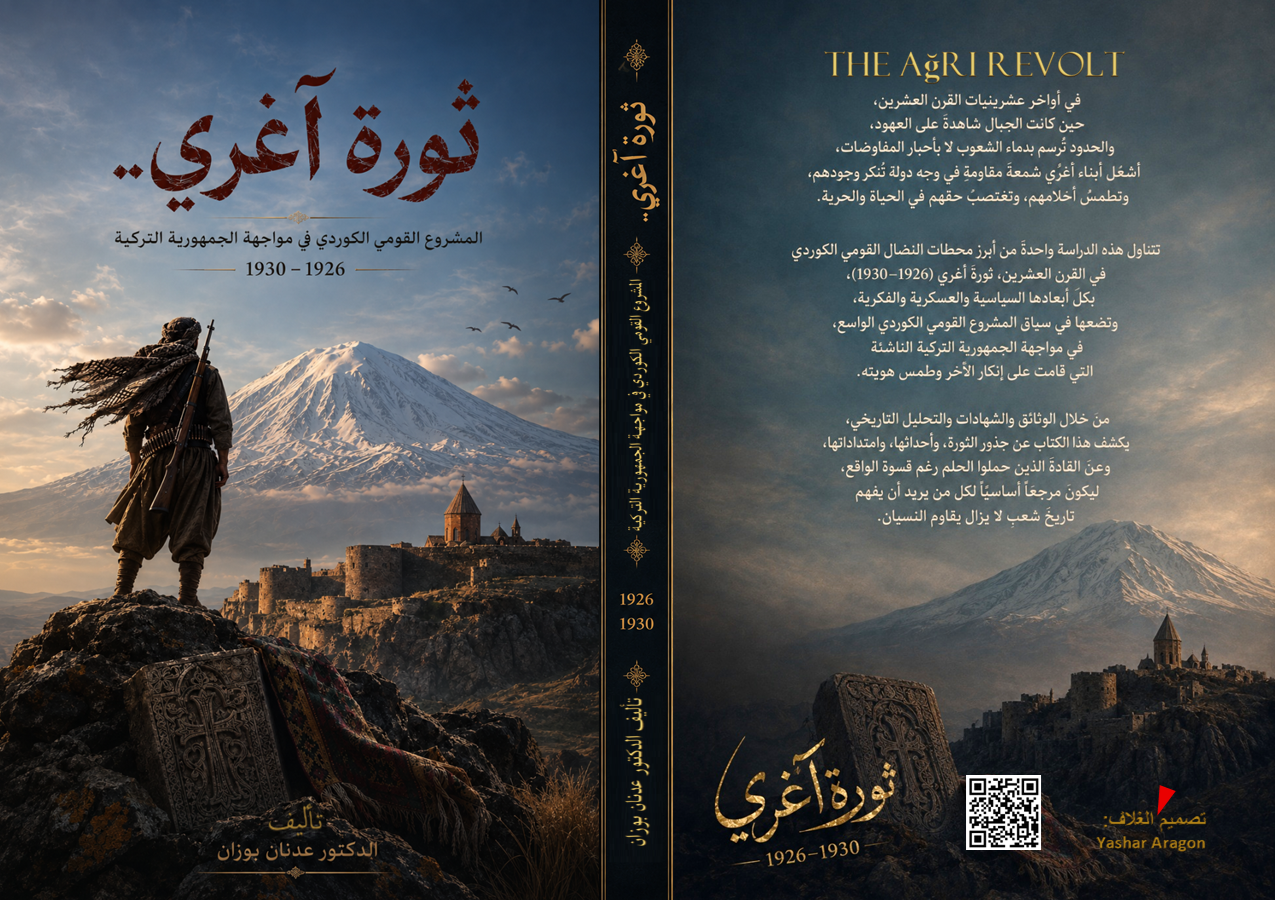
More than a century after the great transformations that redrew the map of the Middle East, the Ağrı Revolution remains one of the most significant moments in modern Kurdish political history—not merely because it was a military confrontation between Kurdish fighters and the Turkish army, but because it represented an early attempt to transform Kurdish resistance from a scattered local struggle into a national project with a political vision, military leadership, and a reach extending beyond the boundaries of geography and tribe, in confrontation with a modern state rebuilding itself on the basis of a rigid and centralized nationalist system.
It is from this perspective that this book approaches the Ağrı Revolution—not simply to recount its events or rearrange the chronology of its battles, the names of its leaders, and the course of its campaigns, but to examine it as a political and historical experience whose rise and defeat contain questions far greater than the revolution itself: How did the Kurdish national project emerge during that period? What did Xoybûn seek to achieve through Ağrı? How did the mountains become a space for confronting two contradictory visions of the state, identity, and future? Why was the revolution able to resist militarily, yet ultimately unable to transform its military strength into political victory? And where did the causes of its failure lie—in the balance of power, the regional and international environment, Kurdish divisions, or the limitations of the political and organizational project itself?
This book is the outcome of many years of research, reading, and re-examination. I began working on it in 2014, and it remained present within my intellectual and political project throughout these years. In 2026, I returned to it, reread its material, reviewed several of its chapters, and introduced revisions and additions shaped by the distance of time, the broader perspective, and the accumulation of knowledge. It is therefore not a book written at a single moment, but a work that accompanied a long period of thought and research, carrying me from the question of history to the question of politics, and from narrating the event to attempting to understand its meaning, consequences, and the limits of the project that stood behind it.
In approximately 700 pages, the book seeks to place the Ağrı Revolution within its full historical and political context, and to examine it beyond the details of its military campaigns: the nature of the Kurdish national project; the revolution’s relationship with organization, leadership, geography, and borders; its position within the conflict with the Turkish Republic; and, ultimately, the reasons why an experience of such magnitude ended in defeat.
Ağrı was not merely a revolution that ended in 1930; it was an open political question and an experience that left a profound imprint on Kurdish national memory, while its failure also left lessons that have not always been examined with sufficient depth. Therefore, this book does not approach the history of Ağrı as a closed chapter of the past. Rather, it seeks to draw from that past what may help explain some of the questions of the present. For history that is not read critically becomes memory, and memory that is not transformed into knowledge may reproduce defeat under new names.
To read and download the book, click on the file below.
 ثورة آغري - المشروع القومي الكوردي ثورة آغري - المشروع القومي الكوردي | [ثورة آغري - المشروع القومي الكوردي] |