I have followed with deep concern the recent developments in Syria and the growing prominence of tribal rhetoric, along with the increasing involvement of tribal structures in political and military disputes. This trend poses a serious threat to the future of the Syrian state and its national unity, while undermining the foundations of the modern state based on institutions and the rule of law.
What Syria is witnessing today is not merely a regression to the pre-2011 period; rather, it represents a retreat from the very concept of the modern nation-state. It reflects the revival of primordial loyalties and narrow tribal affiliations that contradict the principles of equal citizenship, constitutional governance, and institutional statehood. States are not built on tribalism and division, but on the rule of law, strong institutions, national partnership, and justice among citizens.
In this context, I categorically reject the statement attributed to the Sheikhan Tribe, which purported to declare a political position on behalf of the tribe and to place its decision-making authority under the leadership of Commander Mazloum Abdi without consulting or obtaining the consent of the tribe's members. Such statements represent only those who issued them. No individual or group has the right to claim representation of a distinguished tribe without a clear mandate or genuine consensus among its members.
As one of the sons of the Sheikhan Tribe, I reaffirm our unwavering commitment to the unity of Syria—its land and its people. We reject all projects aimed at partitioning the country or fueling internal conflict, and we firmly believe that Syria belongs to all its citizens: Arabs, Kurds, Syriacs, Assyrians, Turkmens, Armenians, Circassians, and all other national components, as well as followers of all religions and sects, on the basis of complete equality in rights and responsibilities.
At the same time, preserving Syria's unity is fully compatible with the constitutional recognition of the legitimate national rights of the Kurdish people. Indeed, guaranteeing these rights, consolidating the principle of genuine national partnership, and establishing a democratic, pluralistic, and participatory state founded upon equal citizenship, the rule of law, and respect for human rights constitute the most effective path toward strengthening Syria's unity and ensuring its long-term stability.
The continuation of policies of exclusion and denial, coupled with the rise of extremist rhetoric, will drive Syria into a political deadlock and increase the likelihood of renewed civil conflict. Such an outcome would serve no party's interests and would have devastating consequences for all Syrians without exception.
Therefore, I call upon all Syrians to exercise wisdom and self-restraint and to refrain from being drawn into extremist rhetoric or statements issued in the name of tribes or other social components for the sake of personal interests or narrow political gains. Syria's future cannot be built upon division or incitement, but rather upon national dialogue, consensus, and partnership among all components of the Syrian people.
Today, Syria is in urgent need of a comprehensive national project that lays the foundations for a modern democratic state—one that respects human rights, safeguards fundamental freedoms, guarantees the constitutional rights of all its national, religious, and cultural communities, and is founded upon the principles of justice, equality, and the rule of law. This alone is the path capable of preventing further strife, preserving the unity of the homeland, and building a secure and stable future worthy of all Syrians.
25 July 2026
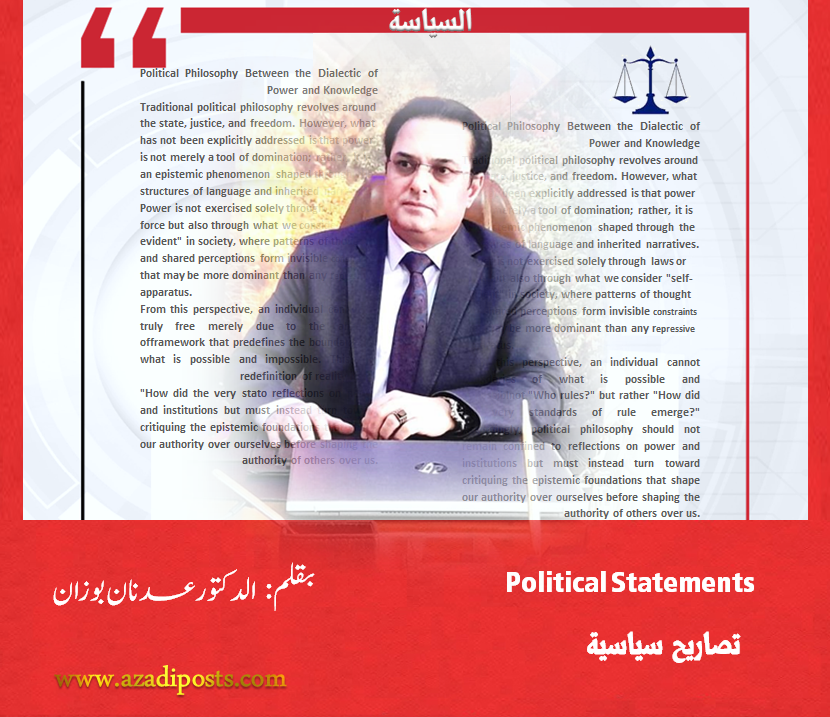
Dr. Adnan Bozan