



The Betrayal of the Kurdistan Workers’ Party (PKK) Against Syrian Kurds: When the Slogans of Liberation Turn into the Defeat of a Cause
- Super User
- مقالات سياسية
- Hits: 1389
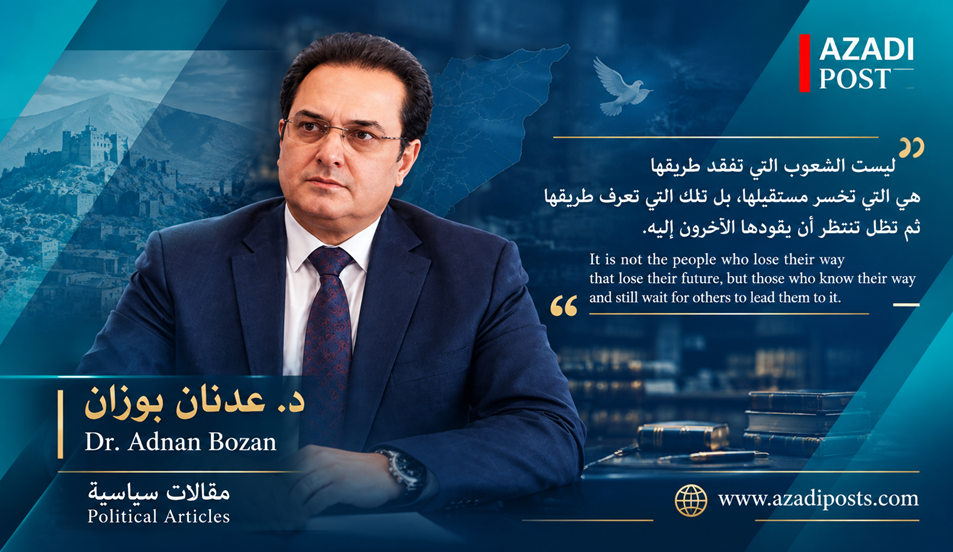
By Dr. Adnan Bozan
Throughout history, political betrayals have not always taken the form of openly declared decisions, exposed agreements, or positions that can easily be judged at the moment they occur. More often than not, they have concealed themselves behind grand slogans, drawn legitimacy from the sacrifices of peoples, and justified their mistakes in the name of historical necessity, only for the passage of time to reveal the true nature of the paths they had taken. Politics has never been measured by the banners it raises, the promises it makes, or the supporters it mobilizes, but by the consequences it leaves for people’s lives, their future, and their rights. As some of the storms that swept across northern and eastern Syria began to subside, numerous questions emerged concerning the decisions that had been made, the priorities that had been established, the sacrifices that had been endured, and the outcomes of a political and military experiment conducted in the name of freedom and liberation. Among the most pressing questions at the time was the role played by the Turkish Kurdistan Workers’ Party (PKK) and the Qandil leadership in determining the course of Syrian Kurds, and whether their policies were consistent with the national interests of the society that bore the greatest share of the burdens of that experience.
The greatest danger facing a people’s cause was not merely defeat at the hands of its adversaries, but the exhaustion of its resources from within in the name of defending it, and the conversion of its people’s sacrifices into political capital for an organization whose priorities did not always align with those of that people. From this perspective, reviewing the PKK’s experience and the role of the Qandil leadership in Syria did not mean hostility toward the Kurds, denial of the sacrifices made by the men and women who fought ISIS, or minimization of the dangers the region endured throughout the years of war. Rather, it meant holding political and military decisions accountable and examining whether they served the interests of Syrian Kurds, whether they helped build a safer and more stable future for them, or whether they pushed their cause onto paths that made it more complicated and weakened the independence of its decision-making. The Kurdish cause was greater than any party and more enduring than any leadership. No organization had the right to reduce the future of an entire people to its own calculations or to treat its history of struggle as a substitute for accountability.
One of the fundamental problems that emerged from the experience established in northern and eastern Syria concerned the nature of the relationship between local forces and the decision-making center associated with the Qandil leadership. This relationship raised fundamental questions about the independence of Syrian Kurds’ political will and their ability to determine their priorities in accordance with the particular realities they faced and their national interests. When military and political decisions became linked to a cross-border organizational structure, it was legitimate to ask who was determining the direction of events: were decisions driven primarily by the needs of the people living on the ground, or were they also influenced by organizational calculations and regional strategies extending beyond Syria’s borders? And who bore responsibility when those calculations conflicted with the needs of local communities or with the requirements of protecting the Kurdish cause within Syria? These were not ready-made accusations, but political questions that should have been openly debated, because revolutionary slogans were not sufficient to exempt leaders from responsibility for their choices, just as a history of resistance did not grant them permanent immunity from criticism.
A review of that period does not require an exhaustive account of every military and political issue that unfolded in Afrin, Aleppo, Ashrafieh, Sheikh Maqsoud, Manbij, and the Tishrin Dam area, nor does it require combining all the transformations experienced by Kurdish areas into a single narrative. Each case has its own circumstances and details, and every incident carries responsibilities that must be established through documents, testimonies, and facts. Nevertheless, it is essential to examine an issue that lay at the heart of the experience: the place of Kurdish areas east of the Euphrates within political, developmental, and military priorities, and how that compared with the attention given to other areas that fell under the Autonomous Administration and the forces associated with it. Segments of Kurdish society came to feel that their areas, which had formed a central base of the experiment and paid a heavy price to defend it, had not always received sufficient attention in development, public services, stability, and employment opportunities. That perception deserved serious investigation rather than justification or dismissal as a mere partisan dispute.
Here, a contradiction emerged that should have been subject to accountability. The Autonomous Administration and the forces associated with it expanded across extensive territories, including Raqqa and Deir ez-Zor, and the administration and defense of those areas, along with meeting the needs of their populations, became part of their responsibilities. The objection was not to governing areas with Arab majorities, nor was it a rejection of their inhabitants’ rights. It would have been unjustifiable to deny those areas public services, development, or political participation on the basis of their ethnic identity. The question, however, was entirely different: was this territorial expansion accompanied by a proportionate commitment to the Kurdish areas from which the experiment had emerged? Did those areas receive a fair share of projects, public services, investment, and employment opportunities? Were the needs of their inhabitants placed at the heart of the policies pursued, or did military and organizational calculations absorb a disproportionate share of attention while numerous social and economic problems remained inadequately addressed?
These questions could not be answered simply by exchanging accusations or relying on impressions. They required a documented comparison of budgets and implemented projects, service provision, expenditure levels, and the distribution of resources across different areas. Yet the lack of sufficient transparency in presenting such details created room for suspicion and reinforced the belief among some residents that priorities had been unbalanced and that Kurdish areas had not received the attention they should have received, given their role in the emergence of the experiment and the sacrifices they had made. If this picture reflects a reality supported by documents and figures, then the problem was not merely administrative or developmental; it pointed to a deeper political failure in understanding the relationship between authority and the society from which it derived a significant part of its legitimacy.
Residents of Kurdish areas had every right to ask why these disparities existed, what criteria had been used to determine spending and project priorities, and whether the burdens they had shouldered were proportionate to the results they experienced in their daily lives. Their areas were not merely a human reservoir for fighters, geographical territory to be used to consolidate influence, or communities expected to make sacrifices indefinitely while their economic and social needs remained unresolved. If the leadership had succeeded in expanding its military influence and administering areas far from the principal Kurdish population centers, it was entirely legitimate to demand an explanation of how it had balanced those responsibilities against the need to protect the communities that formed a central base of its experiment. A project that invoked the slogans of freedom and dignity was obliged to translate those slogans into tangible results, rather than use them as a permanent justification for postponing questions about development, representation, and the future.
The issue was not confined to public services and the distribution of resources. It also extended to the political price paid by the Kurdish cause as a result of the way relations with the Arab surroundings were managed. Northern and eastern Syria constituted a diverse social, economic, and geographical space in which interests were deeply interconnected. This diversity could have provided the foundation for a genuine political partnership among Kurds, Arabs, and other communities, based on mutual recognition of rights, participation in decision-making, and rejection of exclusion and domination. Kurds and Arabs were not two peoples destined to remain locked in perpetual conflict, nor were disagreements between them an inevitable and unavoidable consequence of their coexistence. Many tensions could have been contained through more transparent policies, more representative institutions, and political dialogue that placed the demands and interests of local populations at the forefront.
However, any authority that failed to build a balanced partnership with the communities it governed risked opening the door to resentment and tension, particularly when political disputes became entangled with struggles over power and resources, tribal loyalties, or extremist religious rhetoric. Under such circumstances, armed groups and hard-line forces found opportunities to exploit grievances and divisions and expand their influence. It would have been a mistake to interpret all these developments as an ethnic conflict between Kurds and Arabs, just as it would have been wrong to reduce Arab communities to armed groups or extremist movements. Arab tribes did not constitute a single political bloc, and their members did not all share the same positions. Nor did opposition to the administration necessarily imply support for extremism or hostility toward the Kurds.
Nevertheless, ignoring local demands or addressing them through an excessively narrow security-based approach, where such practices can be established in specific cases, could turn disputes amenable to political resolution into more complex crises. Where such policies had these effects, they contributed to declining trust between some communities and the authorities in place, widening the gap between official rhetoric and the realities experienced by residents. This served neither Kurds nor Arabs. Instead, it undermined the prospects for shared stability and gave forces hostile to pluralism and the rights of different communities opportunities to exploit divisions. When politics failed to build trust, local crises became more likely to escalate into confrontations, forcing diverse communities to bear the costs of conflicts that did not serve their genuine interests.
From this perspective, a fundamental question emerged regarding the responsibility of the Kurdistan Workers’ Party (PKK) and the Qandil leadership for the course taken by Kurdish-Arab relations during that period. Did some of the policies pursued contribute to undermining trust between the two sides? Did prioritizing organizational and military calculations over the requirements of political partnership weaken Syrian Kurds’ ability to build broad national alliances capable of protecting their rights? Could some of the tensions have been avoided had greater space been given to dialogue over local demands, and had partnership with Arab communities been treated as a long-term political necessity rather than merely an administrative or security arrangement imposed by circumstances?
These questions did not mean holding a single leadership responsible for every conflict that the region experienced, for the Syrian landscape was far too complex to be explained by the will of one party alone. Regional and international actors intervened, armed forces multiplied, interests clashed, and local divisions were exploited in wider conflicts. Yet the complexity of the circumstances was not sufficient reason to exempt leaders from reviewing their choices, particularly when decisions affected public trust and the future of the Kurdish cause. Political responsibility does not necessarily mean that one party caused everything that happened. Rather, it means holding each party accountable for the decisions it made and for the consequences that could reasonably have been anticipated or mitigated within the limits of its capacity and responsibility.
For decades, Kurds in Syria suffered from policies of denial and marginalization and were deprived of linguistic, cultural, and political rights. At the heart of their cause was the need to rectify this injustice and secure recognition of their identity and rights within a Syrian state that acknowledged ethnic diversity and guaranteed equality. Achieving these rights did not require turning Arab communities into a historical adversary, just as establishing a local administration or a political project in Kurdish areas did not necessitate weakening ties with the wider Syrian society. A wiser policy could instead have combined the defense of Kurdish national rights with the building of strong partnerships with other communities, distinguishing legitimate political disagreements from ethnic hostility that serves only those forces seeking to keep societies divided.
If some of the policies pursued contributed to deepening mutual fears, they would have inflicted political damage on the Kurdish cause extending far beyond everyday disagreements. The way the cause was perceived by segments of the surrounding society played an important role in determining whether it attracted solidarity or opposition. When legitimate national demands were portrayed in the rhetoric adopted by certain forces as a security issue or a source of suspicion, hard-line centralist and nationalist movements—long accustomed to portraying Kurdish rights as a threat to the country’s unity—benefited from that portrayal. In this way, political mistakes, if the leadership’s responsibility for them can be established, could weaken the prospects for building broad Syrian alliances in support of pluralism and further isolate the Kurdish cause at a time when it needed the widest possible support.
The political and historical responsibility of the Kurdistan Workers’ Party and the Qandil leadership for the course taken by the Kurdish cause in Syria cannot be reduced to whether secret agreements or direct coordination with the Kurds’ adversaries existed. It must instead be assessed in terms of the party’s decisions, the policies it imposed, the priorities it pursued, and the consequences these had for the lives of Syrian Kurds and the future of their cause. Those who directed political and military decision-making and wielded the greatest influence over the course of events cannot evade responsibility when their policies ultimately weaken the Kurdish people, disrupt their relations with the surrounding society, and place their achievements and national interests at risk. Organizational and regional calculations should not have taken precedence over the needs of Syrian Kurds, nor should their sacrifices have been expended on a course that failed to secure the rights, stability, and independent decision-making they deserved. If these policies weakened the Kurdish cause, deepened its isolation, and enabled its adversaries to exploit divisions and tensions, then the PKK and the Qandil leadership bear political and historical responsibility for their choices and their consequences. No ideological justification or invocation of the history of resistance can absolve them of that responsibility. History does not judge leaders by the slogans they proclaimed, but by what they did, what they failed to protect, and the consequences their decisions left for the people they claimed to defend. Even if secret coordination with the adversaries of the Kurdish cause were never proven, that would not erase the party’s responsibility for its policies. The decisive criterion is whether those policies served the interests of Syrian Kurds or undermined them. This people has the right to hold accountable any leadership whose decisions became a burden on their cause, regardless of the slogans behind which it sought shelter.
In my assessment, the fundamental failure lay in subjecting part of the Syrian Kurdish cause’s trajectory to organizational and regional calculations that did not always align with the specific interests of the Kurdish people in Syria. Syrian Kurds were not merely an organizational extension of a cross-border party, nor was it right to treat them as a reserve force within a regional strategy. They had their own social and political particularities, their national rights within Syria, and their own interests. These interests could intersect with those of Kurds in other parts of Kurdistan, but they did not necessarily coincide with them under every circumstance. National solidarity could be a source of strength when it respected independent decision-making; it became a burden when it was used to justify subordination or restrict local society’s ability to determine its own priorities.
National solidarity was not synonymous with organizational obedience, the unity of the Kurdish cause did not mean monopolizing decision-making, and respect for any movement’s history did not entitle its leadership to determine the future of an entire people without accountability. Syrian Kurds had the right to participate freely in choosing their representatives, to debate their national priorities, and to review the policies of the forces claiming to represent them. If the Qandil leadership considered itself part of a liberation project, it should have been willing to have its decisions assessed according to what they achieved for Syrian Kurds, rather than according to the slogans it raised or the history of struggle to which it appealed. Political legitimacy was not a permanent privilege acquired once and for all; it was a responsibility that had to be renewed to the extent that decisions served people’s interests and rights.
It was therefore essential to assess the consequences of that period through specific questions: Did the policies pursued strengthen Syrian Kurds’ ability to secure their rights constitutionally? Were stable institutions established that derived their legitimacy from the population and enabled genuine participation in decision-making? Did conditions in Kurdish areas improve in proportion to the sacrifices made by their inhabitants? Was a strong partnership built with Arab communities and other components of society, or did disagreements accumulate that could have been contained through wiser political means? Did the leadership preserve the independence of the Syrian Kurdish cause, or did its priorities become entangled with broader organizational calculations that weakened its ability to respond to the particular realities of Syria?
These questions could not be answered through party statements alone. They required facts, documents, figures, and independent testimony. Information on resource allocation and budgets needed to be published, completed projects assessed, levels of services and development compared, decision-making mechanisms disclosed, and responsibility assigned for policies that produced negative outcomes. Accountability was not an act of revenge against a political experiment, and criticism did not constitute a denial of the sacrifices made. Rather, accountability was essential to understanding mistakes and preventing their recurrence. Resorting exclusively to mobilizing rhetoric and invoking the history of resistance to shut down debate could only widen the gap between society and the leaders who claimed to speak in its name.
It is essential to emphasize here that the sacrifices made by the men and women who fought ISIS were real and must neither be denied nor diminished. Many fought battles of extraordinary danger, lost their lives defending their communities, and endured burdens that cannot be reduced to political disputes. Yet the sacrifices of individuals were one thing, and the decisions of leaders were another. It was unjust for fighters’ sacrifices to become a shield granting political immunity to those who made the decisions, or for residents to be expected to remain silent about their mistakes simply because the price paid had been so high. Honoring those sacrifices did not require sanctifying the leadership; it required protecting the people for whom those sacrifices were made, safeguarding their rights, and reviewing policies that may have squandered some of the gains that could otherwise have been achieved.
The policies and decisions pursued by the Kurdistan Workers’ Party and the Qandil leadership that harmed the Kurdish cause in Syria cannot be justified by revolutionary slogans or concealed behind the language of resistance or national solidarity. Syrian Kurds bore immense burdens and made enormous sacrifices, and they had every right to expect that their national interests, the security of their areas, and their future would stand at the forefront of the priorities of the party that had imposed its influence over the course of their cause. But when organizational calculations took precedence over the national interests of Syrian Kurds, when the needs of their areas were neglected, their independent decision-making weakened, and their relations with the surrounding society were managed in ways that harmed their cause, responsibility rested with the leadership that formulated and implemented those policies. This was a political and historical responsibility that did not expire with time, could not be erased by the sacrifices of fighters, and could not be evaded through slogans of liberation and resistance. If the consequences of those policies weakened the Kurdish position, deepened divisions, damaged relations between Kurds and their surrounding society, and enabled the cause’s adversaries to exploit the resulting circumstances, then the PKK and the Qandil leadership bear full responsibility for their choices and their consequences. It is not necessary to prove the existence of a secret agreement with adversaries to condemn a policy that harmed a people’s interests. Responsibility for weakening the cause stands on its own, and political betrayal must be judged by what was done to a people’s interests and future, not by the intentions or slogans proclaimed by those who made the decisions. Those who assumed leadership of the project, monopolized decision-making, and imposed its direction must bear the consequences of its failures and outcomes. They have no right to make the people pay for their mistakes and then hide behind the history of resistance to escape accountability.
The experience of those years demonstrated that the gravest danger facing any political project was to proclaim the protection of the people while failing to convince them that its decisions had safeguarded their interests; to speak in the name of liberation while narrowing the space for independent decision-making; and to call for building a shared future while allowing divisions to deepen until a potential partner became an adversary and resolvable disagreements turned into protracted crises. Such outcomes did not serve the Kurdish cause merely because those responsible for the decisions claimed to act in its name. Nor could every failure be regarded as conclusive proof of betrayal. What was required was a careful review that assigned responsibility where it belonged and drew lessons from the experience to prevent similar mistakes from recurring.
When the history of that period is written, the lesson will not be measured by the number of banners raised, statements issued, or slogans repeated. It will be measured by the rights, institutions, and independent decision-making that Syrian Kurds retained; by the security, development, and stability achieved in their areas; and by the extent to which the experiment succeeded in building a just relationship with the other components of Syrian society. History does not merely record the intentions of those who launch political projects. It also examines the consequences of their decisions and the distance between what they promised and what was actually achieved. Reviewing that experience was therefore not an attack on the history of resistance, but an attempt to understand the failures that afflicted the project, what could have been accomplished more effectively, and whether the mistakes made weakened the very cause the project claimed to defend.
Syrian Kurds did not merely need a leadership that spoke in their name; they needed a project that protected their interests, guaranteed their rights, and safeguarded their independent decision-making. They did not need slogans greater than the realities they faced, but institutions that reflected their aspirations, policies that responded to the needs of their areas, and political partnerships that prevented exclusion and ensured mutual recognition. Nor did they need permanent hostility toward Arabs to prove the legitimacy of their rights. They needed a relationship founded on equality and mutual respect, one that prevented political disagreements from being transformed into ethnic conflicts. These principles could have provided a stronger foundation for protecting the Kurdish cause had they been placed at the forefront of priorities rather than subordinated to narrow organizational calculations.
Peoples that fail to review their experiences remain vulnerable to repeating their mistakes, while peoples that grant their leaders absolute immunity may discover too late that they have paid the price for decisions in whose making they had no part. After years of struggle, sacrifice, and profound change, Syrian Kurds had every right to ask difficult questions without fear or deference: Who genuinely served their cause? Who made decisions that weakened it? What became of the promises made in their name? Where did the leadership fail to protect their interests? And were their sacrifices a path toward securing rights and building a future, or did some of their consequences become political capital for a project whose decision-making remained insufficiently independent of broader organizational calculations?
The Kurdish cause belonged neither to Qandil, nor to the Kurdistan Workers’ Party, nor to any leadership claiming an exclusive right to represent it. It was the right of a people to freedom, dignity, recognition, and political participation. Respecting the history of any liberation movement did not mean relinquishing society’s right to criticize it, just as defending Kurdish rights did not require remaining silent about policies that harmed Kurdish interests. When an organization’s interests conflicted with those of the people, the people’s interests had to come first. And when the slogans of liberation, through misguided decisions or narrow calculations, produced outcomes that weakened the cause they claimed to serve, criticism became a national and moral duty.
Thus, the historical judgment of the Kurdistan Workers’ Party and the Qandil leadership’s experience in Syria should be based neither on slogans alone nor on unsupported accusations, but on an examination of decisions, facts, and outcomes, together with a precise determination of responsibility. One principle, however, must remain non-negotiable: no organization has the right to turn an entire people’s cause into an instrument for advancing its own priorities, nor to demand that people make sacrifices without subjecting itself to accountability. The Kurdish cause is greater than parties and leaders, and the future of Syrian Kurds must be built on their free will and national interests, not on the tutelage of a cross-border organization. When the slogans of liberation produce outcomes that weaken the cause in whose name they were raised, exposing the failures and holding those responsible to account becomes a duty owed to the people, their sacrifices, and their history.