


Thus Spoke Zarathustra: A Marriage Contract in the Shadows and a Flood from the East
- Super User
- مقالات سياسية
- Hits: 5024
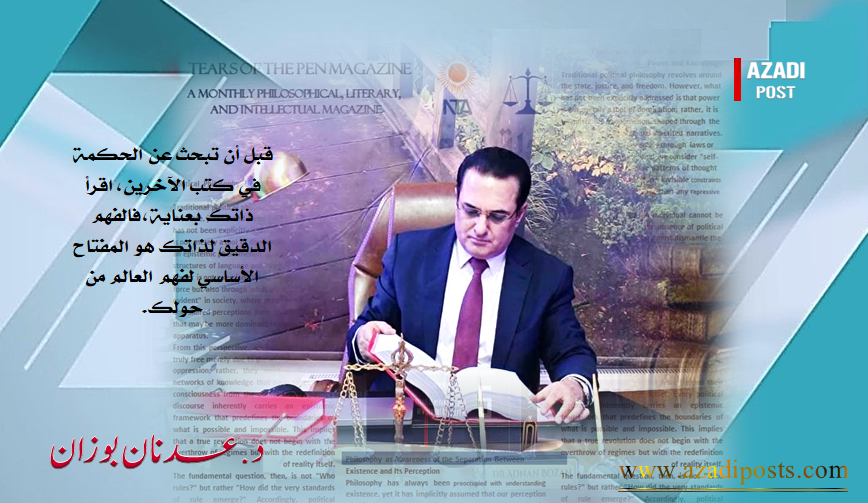
By Dr. Adnan Buzan
Thus spoke Zarathustra—not as a prophet of the age, nor as a sage emerging from mountain caves to grant humanity a new certainty, but rather as a sarcastic question standing before this strange Syrian and Kurdish scene and asking:
When did this love affair begin? Where did the story start? And how did enemies, friends, and rivals become one political family?
When did this sudden romance arise between the Syrian Democratic Forces (SDF), Hay’at Tahrir al-Sham (HTS), Turkey, and the leadership of the Kurdistan Region? Who wrote this love story behind closed doors? Who arranged the seats, chose the witnesses, and placed the ring on the finger before everyone emerged before the public to speak of “principles,” “rights,” and “national interests”?
In Syrian politics, nothing appears to be what it truly is.
The enemy who is cursed in the morning may become a partner by evening. The ally whose portraits are raised during celebrations may be handed over at the first turning point. And the slogans written with the blood of young people may be erased with the stroke of a pen at a negotiating table about which those who shed that blood know nothing.
It is as though we are witnessing a political marriage contract concluded in the shadows before the public was allowed to see it in the open.
And if we continue with this bitter metaphor, then the question becomes legitimate: Who performed the marriage ceremony? Who were the witnesses? And who was the real absentee from the celebration?
Political interpretations speak of regional and international roles and understandings conducted through direct and indirect channels, while the United States and France stood at the heart of international balances, knowing more than they were willing to say. As usual, however, the peoples themselves were not invited to the celebration. Their role had already been assigned: to applaud when asked to applaud, to fight when asked to fight, and to mourn when the lists of the dead and the victims began to grow.
But the most dangerous part of the story is not what is said publicly.
It is what remains unsaid.
Kurdish and Syrian political memory is sometimes short—or perhaps it has been exhausted to the point where it can no longer arrange events in their proper order. Everyone remembers the slogans, but few pause before the dates. Everyone remembers the battles, but few ask:
Why did this battle take place? Who decided its timing? Who benefited from its consequences? And who knew in advance that it was going to happen?
In October 2022, the Afrin region—particularly the village of Qirzihil—witnessed military confrontations and developments that revealed new paradoxes within the Syrian landscape. At that moment, it appeared as though new political and military lines were beginning to be drawn behind the curtain.
And here the real question begins:
Was that merely a passing military battle, or was it an early signal of understandings and transformations that were never revealed to public opinion?
A serious political researcher must not transform every rapprochement or coincidence of events into a fully constructed “conspiracy”; history is far more complex than that. But people have the right to ask questions, and politics has the duty to provide explanations.
What actually happened?
Who spoke to whom?
Who reached agreements with whom?
And what was the nature of the communications that preceded those transformations?
These are not questions of treason or accusation. They are legitimate political questions—especially when the price involves human lives and the future of an entire people.
The Kurd in Syria has grown accustomed to constantly hearing that the current phase is dangerous, that the battle is decisive, that the enemy stands at the gates, that patience is a duty, and that the leadership knows what the people do not know.
But the problem begins when the phrase “the leadership knows” becomes a license to conceal everything.
No political project has the right to ask its people to die without allowing them to know why.
And no leadership has the right to demand absolute trust from its public while remaining incapable of explaining its movement from alliance to hostility, from hostility to understanding, and from understanding to silence.
Trust is not obedience.
Politics is not a religion.
And a leader is not a prophet.