



The Middle East: The Reconfiguration of the Regional Order From Geopolitics to the Engineering of Influence
- Super User
- ملفات
- Hits: 5460
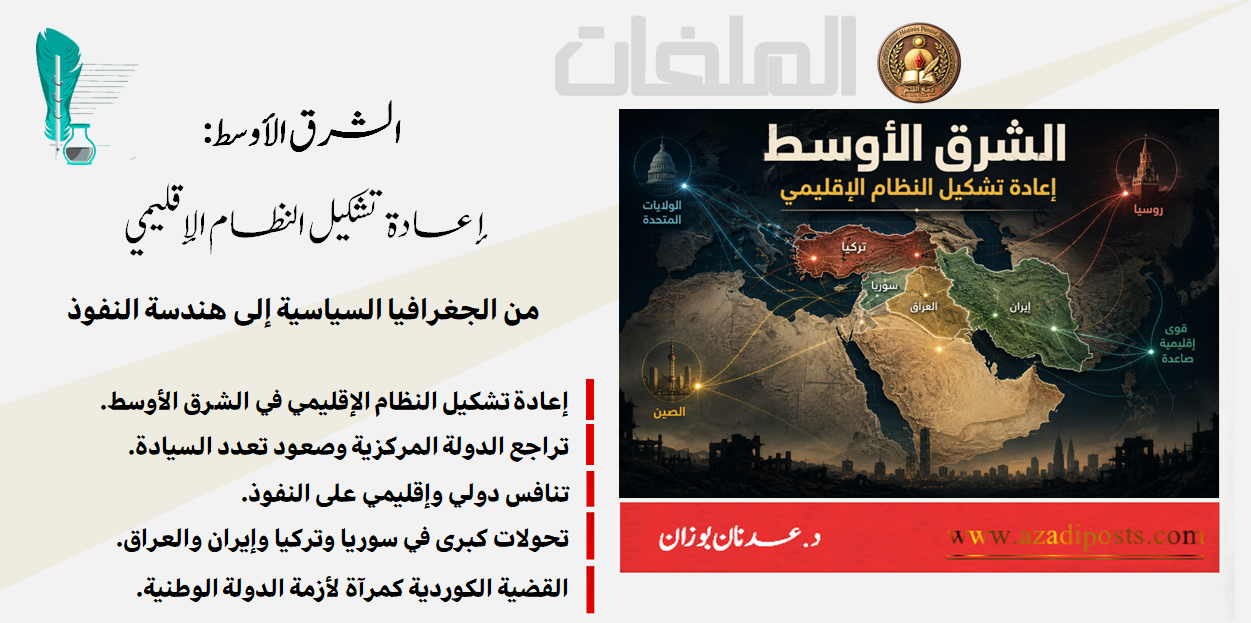
By: Dr. Adnan Bozan
Introduction:
The concept of the “Middle East,” as it took shape in the twentieth century, is no longer capable of explaining the current reality or absorbing its accelerating dynamics. The region whose political map was drawn in the aftermath of the First World War, and whose state structure crystallized during the Cold War, is now entering a fundamentally different phase that can be described as a phase of structural reconfiguration of the regional system. It is a phase that does not merely redistribute influence, but rather redefines the meaning of the state, the boundaries of sovereignty, and the very function of geopolitics itself.
Within this new context, geography is no longer fixed as it was in classical conceptions; instead, it has become a fluid and dynamic space reshaped through the intersection of three overlapping levels: technology, global political economy, and non-conventional instruments of power. Thus, the region is no longer governed solely through borders, but through networks—security, economic, sectarian, and media networks—that render each state a point of intersection within a broader system of influence extending beyond its formal boundaries.
This transformation does not necessarily imply the collapse of the nation-state as a legal and sovereign framework; rather, it practically entails its internal redefinition. The state, traditionally understood as a centralized entity monopolizing decision-making and sovereignty, is now functionally distributed across multiple levels: an official center seeking to preserve legitimacy, local and regional actors operating within power vacuums, and international powers recalibrating balances according to interests that transcend the region itself.
Accordingly, the Middle East can be said to be experiencing a transition from the model of the strong centralized state to a more complex configuration, in which three major structural forces intersect:
- The classical nation-state, still attempting to reproduce its historical legitimacy through political and institutional centrality.
- Non-state actors, including militias, autonomous administrations, and transnational movements, which have become part of the decision-making equation rather than a marginal element.
- International and regional powers, which no longer merely exert external influence, but have become embedded in the engineering of domestic political structures through complex security, economic, and political instruments.
Within this entanglement, states such as Syria, Iraq, Turkey, and Iran are no longer merely independent political entities, but central nodes within an open regional network undergoing continuous reconfiguration. Syria represents a model of a state contested by multiple maps of influence; Iraq embodies the equation of a multi-sovereign state; Turkey moves as a rising regional power redefining its sphere of influence; while Iran represents the model of an ideological state with transnational strategic depth.
What unites these cases is not similarity, but their shared position within a broader historical process: the disintegration of the old regional order and the emergence of a new system that has not yet fully crystallized. It is a system that is not based on classical stability, but on the continuous management of fragile equilibria, where power is defined not only as the ability to control, but as the capacity to reproduce influence within an ever-changing environment.
From this perspective, the Middle East today cannot be understood as a set of fragmented crises, but rather as an open laboratory for the reconfiguration of the global regional order. Within it, the projects of major powers intersect, the limits of the nation-state are tested, and the concepts of sovereignty, identity, and belonging are being redefined.
Thus, we stand before a historical moment measured not merely by the change of events, but by the transformation of the deep structures that produce those events. A moment in which the central question is no longer: Who controls the Middle East?
But rather: How is the Middle East itself being reconfigured, and who possesses the capacity to engineer this reconfiguration?
First: Syria – A Laboratory of State Reproduction or Soft Disintegration
Syria today constitutes the most dense and complex model in the contemporary Middle Eastern landscape, not only as an arena of conflict that has undergone a prolonged and bloody military phase, but also as an open political space subject to continuous reconfiguration. In this space, the fundamental questions concerning the nature of the state, the boundaries of sovereignty, the criteria of political legitimacy, and the mechanisms of power production remain unresolved. Syria is no longer a “war state” in the traditional sense describing an armed conflict between two or more parties, nor has it regained its position as a stable and fully functional state. Rather, it has transformed into an intermediate model that can be described as a post-conflict state in incomplete formation—a state that has exited the logic of war without fully entering the logic of stability, remaining suspended in a grey zone between fragmentation and reconstitution.
After more than a decade of profound structural disintegration, the Syrian case can no longer be read as a transient political or security crisis, but rather as a structural transformation in the very nature of the state itself. Syria has shifted from the model of a strong centralized state that monopolized political, security, and economic decision-making within a single center, to a more fluid and fragmented configuration that can be described as a multi-layered sovereign space. Within this space, sovereignty is no longer a unified or centralized concept; instead, it is distributed across multiple levels of power and authority, where legal legitimacy intertwines with de facto realities, and official state institutions intersect with competing authorities of control, all within a complex web of internal, regional, and international balances that do not stabilize into a final form.
In this context, it is no longer possible to speak of a “single sovereign center” that exclusively defines the Syrian state or fully determines its political unity. Rather, we are dealing with a multi-layered power structure operating within the same geographical space, yet belonging to different political logics at each level. Three main layers can be identified in this complex configuration:
First, the official center in Damascus, which seeks to reproduce the Syrian state according to its former classical model through traditional instruments of sovereignty: centralized administration, unified legislation, institutional reconstruction, and the restoration of monopoly over political and military decision-making. This center is not only driven by the desire to recover what was lost, but also by the ambition to redefine the state as a unified entity capable of gradually reintegrating peripheral regions, even if through slow, complex processes conditioned by delicate external balances.
Second, overlapping regional and international zones of influence, which do not operate as traditional occupying forces in the classical sense, but rather as complex networks of influence that redistribute effective power on the ground. These networks do not merely control geography; they re-link parts of the Syrian interior to broader political, security, and economic systems that extend beyond the Syrian state itself. This renders sovereignty fragmented, conditional, and permanently exposed to intervention—whether direct or indirect.
Third, local administrations and de facto authorities that emerged during the war years and gradually evolved from emergency formations into semi-institutional entities possessing administrative, service, security, and economic functions. These actors are no longer merely byproducts of the conflict; they have become part of its continuing structure and, in some areas, one of the elements sustaining a relative form of stability, despite their incomplete integration into the legal framework of the central state.
This intricate entanglement between the three layers makes Syria a political case that cannot be explained through traditional binary frameworks such as “state unity versus fragmentation” or “stability versus chaos.” Instead, it imposes a deeper and more complex question: are we witnessing a gradual path toward the re-unification of the Syrian state under a new configuration different from the past, or the consolidation of a long-term model of de facto, unacknowledged decentralization, in which the state is governed through shifting balances between internal and external actors without restoring its former rigid central structure?
A realistic reading of current trajectories suggests that Syria’s future is neither a return to the pre-2011 model with its closed centralism, nor a move toward final disintegration or formal partition. Rather, the most plausible scenario is the emergence of a hybrid and complex formula based on the coexistence of a security and political centralization at the core, alongside varying forms of administrative and economic decentralization in the peripheries. This would constitute a continuously re-engineered state, shaped under the pressure of competing regional and international balances, where stability becomes a permanent process of negotiation rather than a fixed and final condition.
Thus, Syria is transformed from a former battlefield into something far deeper: a living laboratory for the redefinition of the concept of the state in the contemporary Middle East. In it, not only the future of the Syrian state is being tested, but also the future of the entire regional model, as well as the limits of the new international system’s capacity to reproduce stability within a political space that no longer accommodates rigid traditional definitions of statehood, sovereignty, and borders.
Second: Turkey – From Nation-State to a Soft Expansionist Regional Power
Turkey today represents one of the most central actors in the process of reshaping the regional order in the Middle East and its surrounding environment, not only because of its strategic geographical position linking Asia, Europe, and the Middle East, but also due to the profound transformation in the nature of its political and strategic role over the past two decades. Turkey has gradually shifted from the model of a traditional nation-state focused on its internal consolidation and maintaining narrowly defined external relations, to a more open and complex configuration that can be described as a regional power with an expanding geopolitical reach and multi-layered instruments of influence.
This transformation cannot be interpreted as a circumstantial foreign policy shift or a tactical expansion, but rather as a redefinition of the Turkish role itself within the international and regional system. Turkey no longer operates solely within its fixed geographical boundaries; instead, it manages its influence through three interconnected strategic circles that together constitute what may be called the Turkish engineering of regional space:
The first circle is the Caucasus and Central Asia, where Turkey seeks to strengthen its historical, cultural, and linguistic presence, leveraging extended Turkic ties and the geopolitical vacuums left by the retreat of traditional powers in the region. This circle provides Turkey with strategic depth beyond its immediate Middle Eastern environment and opens avenues of influence over energy routes as well as land and maritime corridors.
The second circle is the Arab Middle East, where Turkey plays a complex role combining direct security presence in certain arenas with political, economic, and cultural influence in others. In this sphere, Turkish power does not operate as a traditional occupying force, but rather as a flexible network of influence in which limited military tools are intertwined with economic engagement, political relations, and cultural and media dimensions. This makes its presence more sustainable and less costly than classical forms of domination.
The third circle is the Eastern Mediterranean and Eastern Europe, a region whose importance has grown significantly in recent years due to issues related to energy, gas resources, maritime routes, and the balance of power with the European Union and Russia. In this context, Turkey becomes an indispensable actor in maritime security and energy equations, granting it an advanced negotiating position in both regional and international systems.
This expansion of spheres of influence does not take the form of direct military conquest or classical occupation. Rather, it manifests as a more complex model that can be termed composite influence, where economic instruments intertwine with security tools, and cultural dimensions integrate with political and diplomatic presence. This model produces a “soft-hard” power configuration, enabling Turkey to operate within regional vacuums without reproducing traditional colonial or direct domination structures.
However, this external ascent cannot be separated from Turkey’s internal state structure, which simultaneously constitutes both the boundary and the condition of this project. Turkey faces several deep structural challenges that define the limits of its capacity to transform into a long-term stable regional power:
The first challenge is the political identity tension between the secular legacy of the modern state and the rise of political Islam as a governing and influential framework. This tension remains one of the most important sources of political and social fragmentation within the state, directly affecting the stability of the political model and its ability to persist without periodic disruptions.
The second is the recurring economic crisis, which is not only linked to financial cycles but also to the structure of the economy itself, its dependence on external financing, and currency volatility. This makes the Turkish regional project vulnerable during periods of economic slowdown or global reconfiguration.
The third challenge is the unresolved Kurdish question, one of the most sensitive issues in Turkey’s internal structure. This question is not limited to internal security concerns, but extends to the very nature of the state, the definition of citizenship, and the model of managing ethnic plurality within the modern nation-state.
In light of these challenges, a central strategic question emerges that will determine the future of Turkey’s role in the coming phase:
Is Turkey truly moving toward becoming a stable and sustainable “soft imperial” regional power, capable of combining internal cohesion with external expansion? Or will it remain constrained by deep structural contradictions that render its external expansion a temporary extension of internal instabilities, ultimately limiting its ability to consolidate its geopolitical project in the long term?
The answer to this question will not determine Turkey’s future alone, but will also define a fundamental part of the emerging regional order in the Middle East and its broader surroundings.
Third: Iran – A Geopolitical Ideological State and the Limits of Influence
Iran continues to play its role as one of the most influential and complex actors in the Middle Eastern regional system, not only due to its geographic and demographic weight, but also because of the nature of the strategic model it has adopted for decades. This model is based on the concept of “strategic depth” rather than direct expansion, or what may be described as the management of influence through the indirect extension of the state beyond its formal borders.
This Iranian model is not grounded in the logic of traditional control or direct occupation, but rather in the construction of a multi-layered network of political, military, and security relations that produces what can be described as a “functional sphere of influence.” This sphere transcends the state’s geographical boundaries and grants Iran the ability to shape the balance of entire states without the need for direct governance of those territories. In this sense, Iran does not operate merely as a state within the region, but as an extended system of influence that redefines the very concept of the regional state.
This strategic depth is most clearly manifested in four key arenas that constitute the geopolitical architecture of Iranian influence:
• Iraq, as the closest and most interwoven arena, where political, security, and economic influence intersects within a post-conflict state structure, making Iranian presence part of internal balances rather than a purely external factor.
• Syria, as a strategic linkage between the Levant and the Mediterranean, where the Iranian presence forms part of a broader regional and international equation in which multiple interests intersect.
• Lebanon, as a model of extended political-military-social influence through local actors that have become embedded within the complex structure of the Lebanese state.
• Yemen, as a geographically distant yet highly significant arena in the balance of regional pressure and the control of Red Sea and Gulf maritime routes.
However, despite its resilience and adaptability, this model no longer operates in a strategic vacuum. Today, it faces a set of profound structural challenges that raise fundamental questions about the limits and future possibilities of its influence.
At the forefront of these challenges is the pressure of long-term economic sanctions, which are no longer a temporary external factor, but have become embedded within the economic structure itself. These sanctions affect the state’s capacity for internal investment, the sustainability of its external instruments, and increasingly reshape the balance between domestic and foreign priorities in a more complex and constrained manner.
Alongside this is the gradual erosion in the effectiveness of regional “proxy networks,” one of the most important tools in Iran’s influence management strategy. Although these networks continue to exist, they face increasing challenges linked to changing local environments, shifting regional political dynamics, and the reconfiguration of international actors, all of which require a reassessment of their role and function within the broader strategy.
The third challenge lies in the internal social and political transformations within Iran itself, where generational divides are widening and questions of economy, identity, and political freedom are becoming more pronounced. This makes the domestic sphere no less important than the external one in determining the state’s trajectory and its capacity to continue playing its traditional regional role.
Nevertheless, these challenges do not place Iran in a position of inevitable collapse or retreat. Rather, they position it in a more complex phase: a stage of major strategic recalibration. Iran is not a state exiting the equation of influence, but one entering a phase of redefining the tools, limits, and priorities of that influence amid shifting regional and international power balances, the rise of new actors, and a transformation in the nature of Middle Eastern conflict—from direct confrontation to flexible and overlapping struggles for influence.
Thus, Iran today appears as an actor standing at a sensitive transitional point: neither at the peak of its previous expansion nor in a phase of withdrawal, but in an intermediate zone of strategic repositioning, where the relationship between the state’s geopolitical ideology and the limits of its actual capacity to shape the region is being fundamentally redefined.
Fourth: Iraq – A State Between Plurality and Institutional Fragmentation
Iraq represents a highly distinctive political case in the Middle Eastern landscape, which can be described as a model of a “multi-sovereign state,” or a state in which sovereignty is no longer fully centralized, yet has not transformed into outright and final disintegration. It is a state situated in a delicate middle zone between formal unity and substantive plurality, where official state institutions intersect with parallel political, security, and economic forces within a complex and unstable governance structure.
In this context, Iraq cannot be understood as a traditional centralized state, nor can it be classified within the framework of failed states in its strict sense. Rather, it should be seen as a state of incomplete institutional and political equilibrium; a state that possesses functioning institutions and constitutional legitimacy, but simultaneously suffers from a fragmented structure of decision-making and multiple centers of power. This makes governance closer to a continuous process of negotiation among overlapping internal and external actors.
This composite nature is reflected in the intersection of four main levels of authority within the Iraqi state structure:
First, a central government in Baghdad that holds constitutional legitimacy and the formal legal framework of the state, yet faces real limitations in exercising full control over the entire political geography of the country. These constraints stem both from internal power balances and from the consociational political system that emerged after 2003.
Second, semi-autonomous regions, foremost among them the Kurdistan Region, which enjoys a high degree of self-governance and possesses its own political, security, and economic institutions. This makes it constitutionally part of Iraq, while simultaneously functioning as a distinct political and administrative entity with clear specificity.
Third, armed factions with political influence, which have become an integral part of the internal state equation. These actors are no longer external to the system, but have evolved into political and security players that directly or indirectly participate in shaping national decision-making and influence power balances both within and beyond the state.
Fourth, multiple regional interventions, which turn Iraq into an open arena of competing influence projects, where regional and international calculations intersect. This adds an additional layer of complexity to the state structure and renders its sovereignty conditional and distributed.
In light of this entanglement, it is inaccurate to describe Iraq as a failed state. More precisely, it is an “imbalanced state”: a state that possesses all formal and institutional elements of a modern state, yet suffers from a profound dysfunction in the balance between these elements. As a result, stability becomes relative and temporary rather than a firmly established structure.
The Iraqi crisis does not lie in the absence of the state, but in the multiplicity of decision-making centers within it. There is no clear monopoly over political, security, or economic authority; instead, there exists a complex network of balances and intersections among various actors. This is further compounded by the weakness of the social contract that is supposed to bind societal components to the state within a shared conception of identity and public interest—a contract that remains fragile and fragmented due to historical legacies and deep political and social divisions.
One of the most significant structural problems is the absence of an inclusive national project capable of redefining the relationship among Iraq’s diverse components within a unified vision of the future. This often makes Iraqi politics resemble short-term management of power balances rather than the construction of a long-term state project.
Nevertheless, this complex reality does not negate the existence of a genuine historical opportunity for Iraq to reshape its political model. On the contrary, it may make this opportunity more urgent than ever. Iraq possesses latent potential to rebuild a more balanced state through fundamental reform pathways that could serve as the basis for a qualitative transformation in its political structure:
The first pathway is strengthening political decentralization within a clear constitutional framework, allowing for the management of internal diversity rather than suppressing or ignoring it, and transforming pluralism from a source of conflict into a mechanism of political organization.
The second is the fair redistribution of wealth and resources, in order to reduce economic inequalities that fuel political and social tensions, and to rebuild trust between the state and society.
The third is redefining Iraqi national identity on inclusive foundations that transcend sectarian and ethnic divisions, and establish a modern conception of citizenship capable of accommodating diversity rather than reproducing fragmentation.
Thus, Iraq today stands at a decisive crossroads: either it succeeds in transforming its complex plurality into a source of organizational strength within a coherent decentralized state, or it remains trapped in a fragile equilibrium among multiple power centers that indefinitely postpones resolution without eliminating it.
Fifth: The Kurdish Question – From the Periphery to the Center of the Regional Equation
The Kurdish question today constitutes one of the most sensitive and profound issues in the structure of the contemporary Middle East, not only as a national question related to a people geographically dispersed across several states, but also as a condensed mirror of the crisis of the nation-state itself in the region, and a genuine test of this state’s capacity to accommodate ethnic and political pluralism within its traditional framework.
The most significant transformation in the position of the Kurdish question over recent decades lies in its shift from a marginal issue managed within internal security considerations in each state separately, to a structural component in the equation of regional reconfiguration. It has become a point of intersection between geopolitics, internal transformations within regional states, regional and international interventions, and the redefinition of concepts such as citizenship, statehood, and identity.
Today, Kurds are distributed across four main states at the heart of the Middle East, which makes their issue inherently transnational, transcending the modern political borders drawn in the twentieth century:
• Turkey
• Syria
• Iraq
• Iran
This geographical distribution does not make the Kurdish question merely a local issue within each state, but rather an extended socio-political network across four different political environments, each varying in its state structure, governance model, limits of political freedoms, and degree of inclusion or exclusion. Therefore, understanding the Kurdish question cannot be achieved through the lens of a single state, but rather through an understanding of the interaction of these four arenas within a single regional system.
In the Iraqi case, the Kurdish presence is embodied in a relatively more advanced model represented by the Kurdistan Region of Iraq, which constitutes a semi-stable form of self-rule within a federal state framework. Despite internal political and economic crises and disputes with the central government, this model represents an important precedent in managing ethnic diversity within the structure of the modern Middle Eastern state, where part of a historical conflict has been transformed into an institutionalized framework of negotiation.
In the Syrian case, the situation takes a more complex form, where during the years of conflict an autonomous administrative structure emerged in the northeast within an intensely intertwined security and political context, where local, regional, and international factors intersect. This experience, despite its political fragility and the unresolved nature of its final status, reflects a significant transformation in the relationship between the central state and local components, and raises an open question about the future of decentralization in the emerging Syrian state.
By contrast, the Kurdish question in both Iran and Turkey remains closely tied to the concept of national security and the integrity of the central state. Kurdish demands in these two countries are often viewed through the lens of internal stability and national sovereignty, rather than as political and cultural rights subject to institutional negotiation. This makes the issue in these two states more sensitive and complex, and less amenable to rapid transformation compared to other contexts.
However, the most significant transformation in the structure of the Kurdish question today lies in the change of its very political content. It is no longer confined to a single fixed demand such as “independence” or a “nation-state,” but has become distributed across a set of interrelated demands that reflect deeper shifts in Kurdish political thought and in the broader Middle Eastern environment. These can be summarized in four main axes:
First, political rights, including effective participation in decision-making, expanded representation, and guarantees against structural exclusion within existing political systems.
Second, political and administrative decentralization, as an intermediate formula between a rigid centralized state and full secession, allowing the management of diversity within a unified state framework.
Third, cultural and linguistic recognition, as a fundamental component in building a political identity not based on denial or assimilation.
Fourth, the redefinition of citizenship in the Middle East, so that belonging to the state is based on equal rights rather than singular national affiliation.
In this sense, the Kurdish question transcends its traditional boundaries to become part of a broader and deeper question concerning the future of the nation-state in the Middle East:
Can this state, in its twentieth-century form, truly accommodate genuine pluralism without losing its cohesion? Or will its persistence in its traditional form continue to place diversity in a permanent state of tension with the political structure of the state?
The answer to this question does not only determine the future of the Kurdish issue itself, but also defines the direction of the entire regional reconfiguration. The Kurdish question thus becomes one of the clearest indicators of the transition from the unitary state to the pluralistic state, and from closed sovereignty to negotiated sovereignty that is simultaneously open to both internal and external dynamics.
Sixth: Regional and International Competition – The Middle East as an Arena of a New Global Order
The process of reshaping the Middle East cannot be understood in isolation from the profound transformations taking place in the structure of the international system itself. The region is no longer merely a peripheral theater for major conflicts; it has become one of the central arenas in which global balances of power are being reconfigured. The Middle Eastern equation is no longer governed solely by the logic of local or regional disputes, but has become part of a broader struggle over the shape of the emerging international order, the distribution of power within it, and the redefinition of concepts such as influence, sovereignty, and spheres of strategic interest.
In this context, the region becomes a point of intersection for the interests of four major circles of actors:
• The United States
• Russia
• China
• In addition to rising regional powers that operate within the gaps and intersections created by this global competition
This entanglement does not take the form of a direct comprehensive confrontation between great powers, but rather manifests as a new pattern of international conflict management based on flexible multipolarity instead of rigid bipolarity, and indirect competition instead of open war. Rather than total wars, what we observe today is a redistribution of influence through more complex and subtle instruments—less visible, but deeper and more enduring.
This transformation can be observed through three main mechanisms that now define the nature of competition in the Middle East:
First, flexible and shifting alliances, where international relations are no longer fixed or ideologically driven in the classical sense, but are instead based on situational interests and the management of temporary balances. States no longer operate within closed blocs, but within intersecting networks of interests that can shift rapidly in response to changing regional and global conditions.
Second, flexible spheres of influence, where power is no longer measured through direct control or military occupation, but through the capacity to influence political, economic, and security decision-making within states. These spheres are no longer rigid borders, but overlapping spaces in which different actors operate without clear dividing lines.
Third, the political economy of energy and strategic corridors, where energy, gas, maritime and land routes, and transnational infrastructure have become central elements in the restructuring of global influence. The Middle East today is not only a zone of political conflict, but also a key node in the global economic network and in energy and supply chains.
Within this reality, it becomes clear that the Middle East is no longer a “subject” of international politics managed externally according to predefined balances. Rather, it has become an active site of production for the emerging global order. In other words, it is no longer merely a recipient of global systemic effects, but one of the spaces where the system itself is being redefined.
Thus, what is unfolding in the region is not simply a competition for influence within a defined geographic space, but fundamentally a struggle over the shape of the world to come: will it be an unstable multipolar system, or a hybrid order in which major and regional powers are intertwined in a complex network of interdependence and continuous rivalry?
The answer to this question is not determined in global capitals alone; it is also being written within the Middle East itself, where every local crisis, every regional alliance, and every political realignment becomes part of a broader process of re-engineering the international system in the twenty-first century.
Seventh: The Future of the Nation-State – Collapse or Transformation?
The nation-state in the Middle East can no longer be understood within the classical theoretical framework that emerged in the twentieth century, which assumed that the state is a solid sovereign unit, monopolizing decision-making within clearly defined geographical borders, exercising its functions through stable centralized institutions, and relying on a cohesive social contract between state and society. The historical trajectory of the region over recent decades, particularly since the onset of major transformations in the past two decades, has demonstrated that this model no longer operates at full effectiveness, nor is it capable of explaining the actual patterns of power on the ground.
The nation-state in the Middle East today is neither in a state of total collapse nor in a condition of traditional centralized stability. Rather, it exists in an intermediate condition that can be more precisely described as a state of “multiple sovereignties,” in which sovereignty is no longer concentrated in a single center but is distributed across multiple levels of actors. These include official state institutions, local, regional, and international forces, as well as cross-border economic and security networks.
In this context, the central question is no longer: Is the state surviving or disappearing?
Rather, the question has become more complex: How is the state itself being transformed within an environment where it has lost its traditional monopoly over sovereignty?
This structural transformation opens the way to three possible models for the future of the nation-state in the region, not as entirely separate scenarios, but as overlapping trajectories that may coexist within the same regional space depending on different contexts and cases:
First: the modified centralized state model, which seeks to reproduce the traditional state in a more flexible form. In this model, the state remains centralized in its general structure and legal sovereignty, but adopts varying degrees of administrative and political reform, allowing limited forms of decentralization aimed at absorbing internal tensions without undermining the essence of central authority. This model can be observed in some states that still retain relatively strong institutions but are compelled to adapt to pressures of internal plurality.
Second: the federal or expanded decentralization model, which is clearly visible in some existing experiences or those gradually moving in this direction. In this model, power is distributed between the center and the peripheries within a clear constitutional framework that allows for the institutional management of ethnic, sectarian, and political diversity. This model does not imply state disintegration, but rather its re-engineering based on the recognition of plurality instead of its denial. Iraq and Syria, to varying degrees, can be seen as potential laboratories for this transformation.
Third: the model of unequal or constrained sovereignty, a more complex and fragile configuration in which the state formally continues to exist but loses a significant part of its decision-making autonomy to internal or external actors, including armed groups, economic networks, or overlapping regional and international influences. In this model, sovereignty becomes a relative concept, and the state turns into a space for managing influence rather than a fully autonomous decision-making entity.
The importance of these models does not lie merely in their theoretical classification, but in the fact that they reflect an evolving empirical reality in the Middle East, where there is no longer a single model of the state, but rather a plurality of state forms within the same regional system. This diversity reflects, at its core, a deeper crisis related to the redefinition of the modern state in an environment that no longer accommodates the rigid and closed formulas of the previous century.
Thus, the future of the nation-state in the Middle East remains open to multiple trajectories that cannot be predetermined. These trajectories will be shaped through a complex interaction between internal and external forces, between institutional strength and weakness, between societies’ capacity to produce a new social contract, and the ability of the regional and international systems to absorb or redirect this transformation.
In any case, what is certain today is that the state in the Middle East is no longer what it once was. It has already entered a comprehensive phase of redefinition regarding its function, its boundaries, and the very meaning of sovereignty itself—a phase that has not yet concluded, but is still in the process of deep formation.
In conclusion, the Middle East is not experiencing a transient political crisis that can be contained through partial solutions or temporary settlements, but rather a long and profound historical transition. It resembles, in its structure, a comprehensive reconfiguration of the geopolitical system that has governed the region since the early twentieth century. The order established on the basis of post–First World War balances, and later consolidated during the Cold War, is no longer capable of regulating the pace of ongoing transformations, nor of explaining the nature of emerging actors, nor of containing the fragmentation of power and the multiplicity of decision-making centers within a single state and across the region as a whole.
In this context, Syria, Iraq, Turkey, and Iran are no longer merely states in the traditional sense. They have become strategic nodes within a regional network open to continuous reconfiguration. These states are no longer closed sovereign units; rather, they function as points of intersection between the domestic and the external, between the local, regional, and international levels, and between the state as an institution and the state as a multi-layered field of influence. Therefore, understanding the future of the region is no longer possible through the study of each state in isolation, but only through reading the regional system as a single dynamic whole, continuously shaped by internal and external interactions.
At the same time, the Kurdish question is no longer merely an ethnic issue or a historical dispute between the state and a social component. It has become a profound mirror revealing the limits of the nation-state itself in the Middle East. It tests the capacity of the state to move from a logic of exclusion and rigid centralization toward a logic of pluralism, recognition, and the redistribution of power. In this sense, the Kurdish question is not on the margins of transformation, but at its core, as it reflects the fundamental question of political identity: is the state a monolithic structure, or is it capable of accommodating diversity without losing its cohesion?
At the same time, the dynamics of the region cannot be understood without recognizing that international competition is no longer merely external interference in the affairs of a turbulent region. It has become a structural component of its internal formation. Major and regional powers no longer stand outside the scene; they are embedded within its very construction—whether through military influence, the political economy of energy and strategic corridors, or the reconfiguration of alliances and security architectures. Thus, the Middle East is transformed from a mere arena of conflict into an active site of production for the emerging international order, where new models of power are tested and concepts of sovereignty, dominance, and balance are being redefined.
At the end of this complex trajectory, it can be said that the Middle East is entering its new era:
an era in which power is no longer built on absolute control and rigid centralization, as in traditional state models, but on the management of multiple and overlapping contradictions, and on the ability to adapt to an inherently unstable political environment in which balances of power continuously shift and alliances are formed in flexible and temporary configurations.
This profound transformation is the essence of what can be called “reconfiguration” — not as an isolated political event, but as a long historical process that redefines the region itself: its borders, its states, its identities, and its instruments of influence, ultimately reaching a redefinition of the very meaning of statehood, sovereignty, and stability in the contemporary Middle East.