


The new poetry collection “The Cry of the Night” by Dr. Adnan Bozan has been recently published.
- Super User
- مؤلفاتي الأدبية
- Hits: 21801
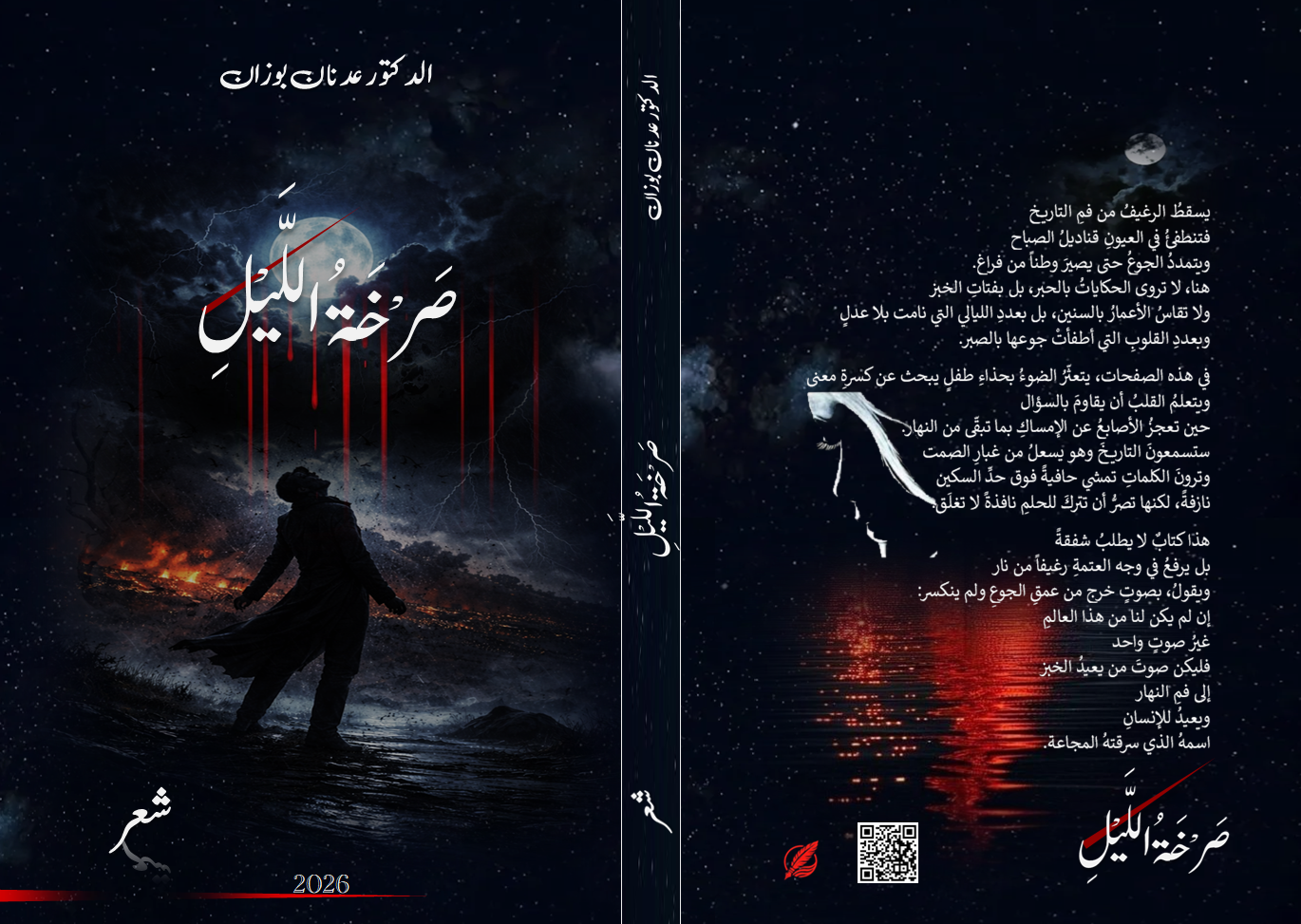
Here… you will not read words.
Here… you will face yourself.
Here, where silence sheds its own silence, and memory rises from its ashes, placing you before your truth as it is—without mercy, without delay. Here, pages do not open; wounds open—wounds you once believed time had sealed forever.
In this darkness, you will have nothing but your voice, nothing but your heart as your guide. You will hear your pulse as though it were a final confession, and you will see yourself as though you had never known it before.
Do not read… listen.
For some texts are not written to be understood, but to awaken what you believed had died within you.
Here… a new book does not begin; a postponed confrontation between the human being and the self begins.
Here… not only do the pages open, but memory itself opens, with all it concealed of tremors, and all it hesitated to confess aloud. The Cry of the Night is not a collection written in an ordinary time, nor born of reassuring circumstances; it was shaped in that fragile distance between breaking and surviving—in that moment when a person finds themselves alone before their greatest questions, without consolation, without certainty, and without any real ability to escape themselves.
This collection emerged from the depths of human experience, from t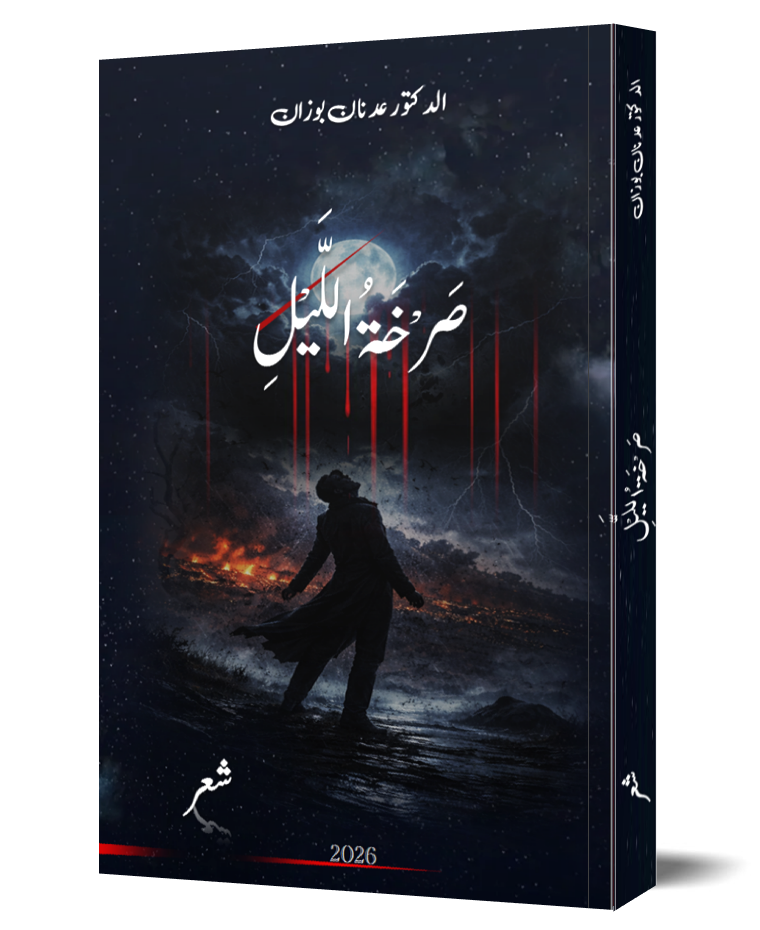 hose moments when silence becomes more eloquent than speech, and pain becomes more truthful than any attempt at beautification or denial. These poems were not written merely to be beautiful texts, but to stand as living traces of a soul that passed through its own shadows and emerged carrying its scars—not as marks of weakness, but as evidence that it lived, felt, endured, and did not completely break. In every poem of The Cry of the Night, there is a hidden confession, and a final attempt to save something before it dissolves into an irreversible silence.
The collection spans 160 medium-sized pages and contains thirty-seven poems. Yet they are not merely adjacent texts, but thirty-seven confrontations with the self, and thirty-seven mirrors reflecting multiple faces of sorrow, hope, longing, and the human being standing exposed before their fragility—at the edge of meaning. Here, words are not linguistic ornaments, but existential necessities; poetry is not aesthetic luxury, but a means of survival, a form of inner resistance against nothingness. Each text is an attempt to rename things that lost their names, and an attempt to return the human being to themselves after life scattered them in countless directions, leaving them a stranger even to their own voice.
The Cry of the Night is the collection of those who have known the weight of silence, and who have known how absence can become more present than presence itself. It is the collection of those who carried their dreams like open wounds, and walked with them despite exhaustion, despite disappointment, despite everything that tried to convince them that surrender was the only salvation. It is the collection of those who found in poetry their final refuge, and their voice that no one could confiscate. In these pages, night is no longer a time of absence, but becomes a space of truth; and the cry is no longer a sign of weakness, but transforms into an act of existence—an inner declaration that the human being, no matter how broken, remains capable of bearing witness to themselves.
This collection is not merely an attempt to write, but an attempt to survive. It is not a pursuit of beauty as much as it is a pursuit of truth. It is not simply an addition to library shelves, but an addition to human experience itself—where poetry becomes the memory of what was never said, the guardian of what was almost lost, and the trace of what can no longer be recovered except through words.
The Cry of the Night is not merely a collection… but the trace of a soul that passed through here, leaving its voice behind so it would not disappear. It is a testimony that the human being, even in their deepest fractures, remains capable of writing, dreaming, transforming pain into meaning, silence into presence, and night into another beginning unseen by anyone… yet enduring.
ــــــــــــــــــ
Read the collection online by clicking the following link:
https://online.fliphtml5.com/uczyba/yeke/#p=1
To read or download the collection, click the file below.
 ديوان شعر صرخة الليل ديوان شعر صرخة الليل | [ديوان شعر صرخة الليل ] |