


The Book “The Illusion of Knowledge: From Socrates to Contemporary Man” by Dr. Adnan Bouzan Has Been Published
- Super User
- مؤلفات فلسفية
- Hits: 14108
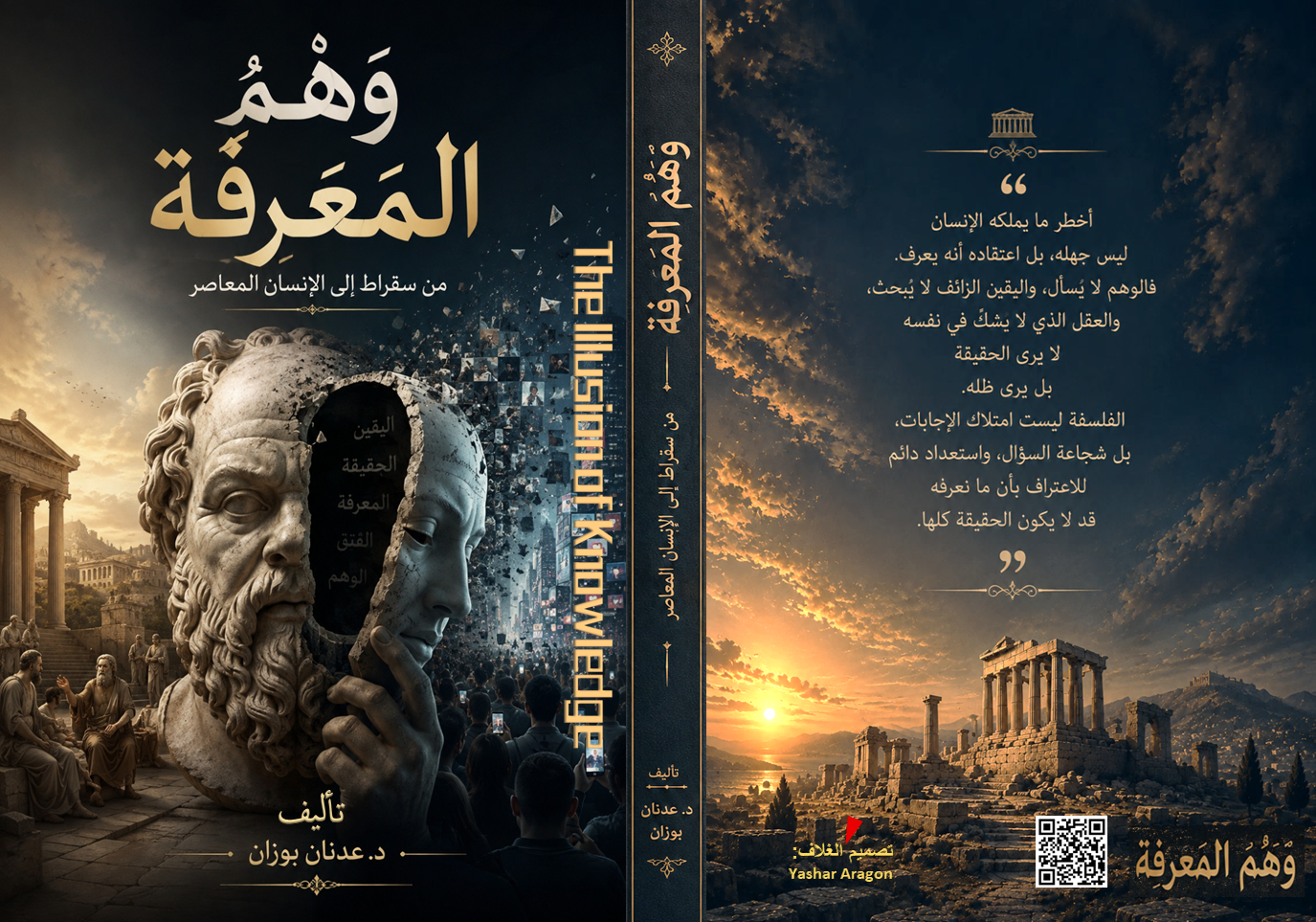
The book “The Illusion of Knowledge: From Socrates to Contemporary Man,” written by Dr. Adnan Bouzan, has recently been published in 215 pages. It is a philosophical work that begins with a question that appears simple on the surface, yet becomes increasingly unsettling and perplexing the deeper we venture into it: “What do we know?” It then moves beyond this question to a deeper and more disturbing one: “Do we really know what we think we know?”
Human beings have never been prisoners of ignorance alone; rather, they have often been prisoners of what they believe to be knowledge. Perhaps explicit ignorance is less dangerous than the illusion of knowledge, because an ignorant person knows—or can come to know—that they are ignorant, whereas the person trapped in the illusion of knowledge possesses a certainty that prevents them from seeing their own ignorance. Herein lies the great paradox: the most dangerous limits of human beings may not be the things they do not know, but the things they believe they know.
This book begins with ignorance, not as a defect or deficiency that must be concealed, but as the first point of departure for every genuine epistemological question. Human beings do not begin their journey toward knowledge by possessing truth; rather, they begin by discovering its absence and recognizing that what they see is not necessarily everything that exists, that what they believe is not necessarily true, and that the question may sometimes be more valuable than the answer.
From this point, the experience of Socrates emerges as one of the most important foundational moments in the history of philosophical thought. Socrates did not locate wisdom in the claim to possess knowledge, but in the awareness of its limits. In the Socratic perspective, acknowledging ignorance is not a surrender to incapacity; rather, it is a liberation of the mind from the arrogance of certainty and an opening toward questioning, dialogue, examination, and criticism. Yet humanity’s journey did not end there. Throughout the centuries, human beings continued to construct intellectual systems, beliefs, and conceptions of themselves, the world, and truth, and then, consciously or unconsciously, transformed some of them into assumptions that became increasingly difficult to question.
From here, the book seeks to trace humanity’s journey from ignorance to knowledge, from knowledge to belief, from belief to certainty, and from certainty to the illusion of knowledge. This journey is neither linear nor simple. Knowledge can liberate human beings, but it can also become a means of reproducing illusion when separated from criticism, revision, and epistemic humility. Not everything we know constitutes knowledge, not everything we believe is truth, not everything we can explain constitutes understanding, and not everything we can access through information represents genuine awareness.
The book does not approach ignorance merely as an absence of information; rather, it examines the very structure of ignorance: How does it arise? How does it persist? How does it sometimes transform into certainty? How can a human being live within a system of inherited or acquired ideas without questioning their sources, limits, and validity? At the same time, the book explores the other side of the problem: How is knowledge formed? When does knowledge become belief? When does belief become ideology? And when does certainty become a barrier to thought rather than the outcome of it?
The most complex problem is not always that human beings do not know; rather, it is that they do not know that they do not know. When a person becomes conscious of their ignorance, ignorance becomes a question, the question becomes the beginning of inquiry, and inquiry becomes a path toward knowledge. But when a person believes they possess the whole truth, questioning becomes a threat, criticism becomes hostility, revision becomes retreat, and the mind becomes a prisoner of the certainty it has created for itself.
Here, the book introduces the concept of “The Illusion of Knowledge” as a condition that goes beyond an ordinary error in thinking. It is an illusion that causes human beings to confuse information with knowledge, knowledge with understanding, and understanding with truth. A person may know the name of something without knowing its reality; they may know part of the truth and imagine that they possess the whole of it; they may hear a convincing explanation and treat it as an ultimate truth; and they may repeat an idea thousands of times until they forget that repetition does not make it true.
In the modern age, the matter has become even more complex. We live in a time when the fundamental problem is no longer the difficulty of accessing information, but the ability to distinguish between information and knowledge, between knowledge and illusion, and between truth and what merely resembles truth. With a single click, a person can access thousands of answers, yet may remain incapable of asking the right question. A smartphone may contain more information than was available to entire generations of human beings, yet a person may become increasingly certain of ideas they have never examined, increasingly attached to information they have never verified, and increasingly confident in judgments for which they lack sufficient intellectual tools to defend.
The abundance of information does not necessarily mean an abundance of knowledge, just as the speed of reaching an answer does not mean possessing understanding. Information can be memorized, whereas knowledge must be constructed; understanding requires analysis; truth requires examination; and wisdom requires the ability to recognize the limits of what we know.
For this reason, “The Illusion of Knowledge” does not merely ask about the things human beings know. It also asks about the sources of their knowledge, the mechanisms through which certainty is formed, the limits of perception, the factors that make people believe, the reasons that make them reject, and the ways in which an illusion can transform into a perceived reality within the consciousness of individuals and societies.
Human beings do not live only within the world itself; they also live within the image they have constructed of that world. This image may be close to reality, distant from it, or a mixture of knowledge, memory, fear, desire, education, language, society, and personal experience. Thus, understanding the world becomes, above all, inseparable from understanding how human consciousness itself is formed.
The book also opens a deeper question: “Can a human being know the truth without knowing the limits of the tools through which they seek to reach it?” Can a limited mind claim to possess absolute truth? Could some of our certainties be nothing more than reflections of our psychological need for certainty? Do we truly seek truth, or do we sometimes seek the version of truth that corresponds to what we want to believe?
These questions are not raised in the book with the aim of providing closed, final answers, but rather with the aim of reopening the mind to questioning. Philosophy, at its core, is not a repository of answers as much as it is the ability to resist easy answers, to doubt what appears self-evident, and to question what we have become accustomed to passing by without thought.
From Socrates to contemporary human beings, the tools change, the language changes, and the forms of knowledge change, but the fundamental question remains: “How do we know that we know?”
“The Illusion of Knowledge” is not a book about ignorance alone, nor about knowledge alone. It is about the ambiguous territory between the two; about that subtle distance in which information can become belief, belief can become certainty, certainty can become authority, and authority can become an illusion that refuses to question itself.
It is a book about ignorance, knowledge, consciousness, certainty, doubt, truth, and illusion, and about the complex relationship between human beings and their minds; between what exists and what they believe exists; and between the truth they seek and the illusion they may create and then defend.
Therefore, this book does not ask the reader to agree with it as much as it invites them to think. It does not ask them to replace one certainty with another, but rather to examine their own certainties. Perhaps genuine knowledge begins at the moment when we stop claiming to possess it completely.
And perhaps the most important question a reader may carry away from this journey is not: “What have I learned?” but rather: “How many of the things I believe I know have I never truly examined?”
This is where the journey begins...
From ignorance to questioning, from questioning to knowledge, from knowledge to certainty, and from certainty to the illusion of knowledge.
“The Illusion of Knowledge: From Socrates to Contemporary Man”
By Dr. Adnan Bouzan
A philosophical book — 215 pages
ــــــــــــــــــــــــــــــــــــــــــــــــــــــــــــــــــــــــــ
Read the book online via the following link.
https://online.fliphtml5.com/uczyba/oein/#p=1
To read and download the book, click on the file below.
 كتاب وهم المعرفة كتاب وهم المعرفة | [ كتاب وهم المعرفة] |