



A New Book by Dr. Adnan Bozan Beyond the Veil: Women Between the Sacred and Modernity in East and West
- Super User
- المؤلفات التاريخية
- Hits: 219
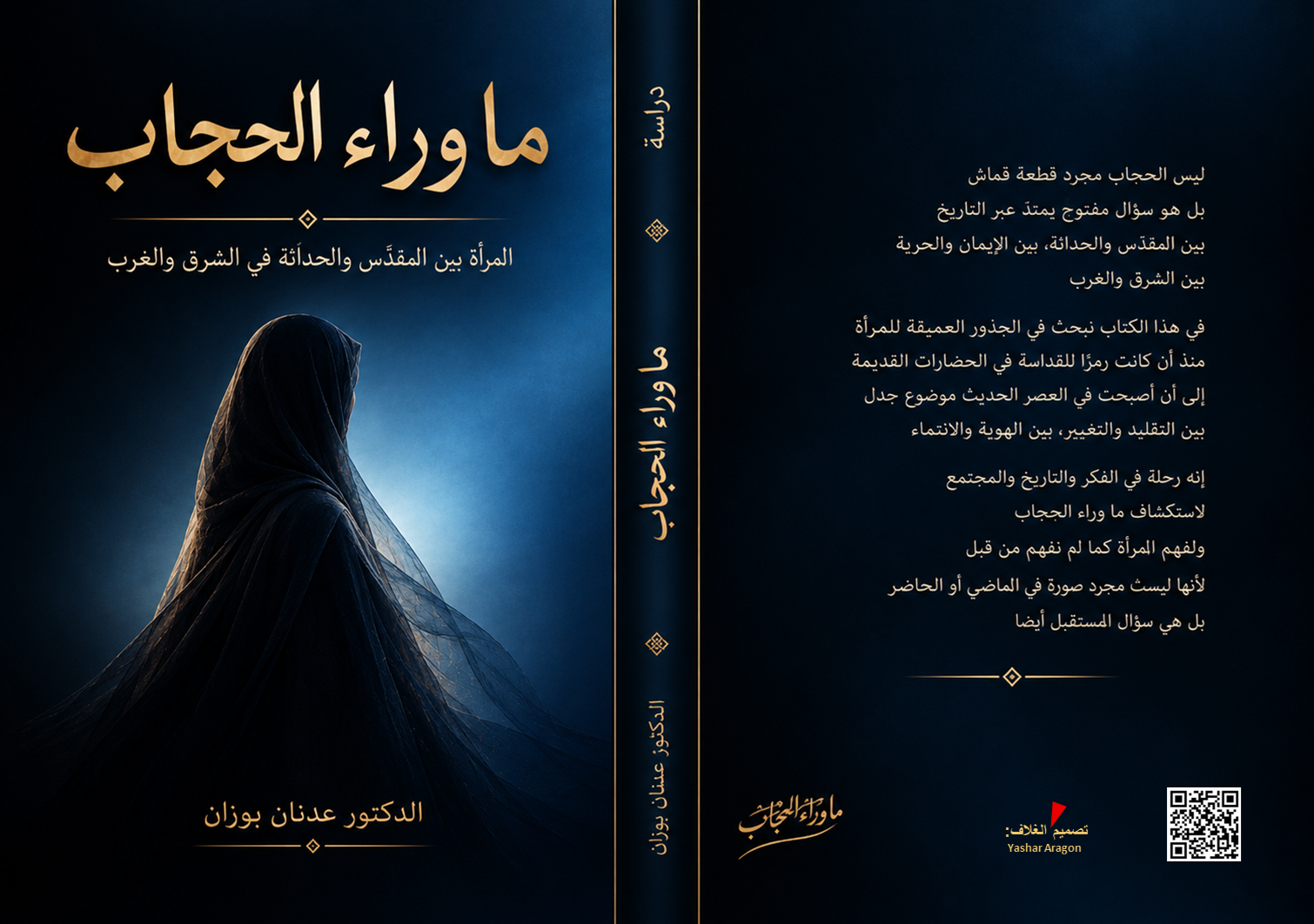
After a long journey of research, reading, reflection, and revision, Dr. Adnan Bozan presents his new book, Beyond the Veil: Women Between the Sacred and Modernity in East and West. This comparative historical and civilizational study examines one of the most prominent issues in the history of human societies, and one deeply intertwined with religion, culture, social customs, authority, and civilizational transformations: the covering of women's heads and the meanings, implications, and interpretations associated with this practice throughout the ages.
The idea behind this book did not emerge in a fleeting moment. Rather, work on it dates back to 2013, when the author began collecting historical material and investigating the civilizational, social, and religious roots of women's head covering, tracing its presence in ancient societies and examining the transformations it underwent in meaning, function, and significance. The research, writing, and revision process continued over the years, until the manuscript underwent an extensive process of reassessment, editing, revision, and proofreading in 2026. These efforts aimed to strengthen its scholarly structure, refine its language, enhance the precision of its historical analysis, and bring it to its final form.
The book begins with a fundamental historical and intellectual question: Can women's head covering be understood as a religious practice detached from the history of the societies in which it appeared, or does understanding it require a return to the civilizational and social contexts in which it emerged and developed, as well as to the structures of authority, social relations, and cultural perceptions that helped shape its meanings? From this perspective, the author does not approach the veil as a fixed concept or a phenomenon with a single origin. Instead, he examines it within a long historical trajectory characterized by diverse environments, traditions, and frames of reference, in which meanings have changed according to time, place, and the prevailing social, religious, and political structures.
The book explores the presence of women's head covering across several civilizations of the East and West, examining historical evidence, texts, social systems, and cultural practices associated with women's clothing and appearance. It distinguishes between practices rooted in social custom, those that acquired a ritual or religious character, and those that developed into legal regulations or markers of social status, class, and belonging. It also examines the differences among ancient societies, particularly Mesopotamia, ancient Egypt, Assyria, Persia, and Greece. It then turns to the study of head covering in pre-Islamic Jewish and Christian traditions, before proceeding to the Qur'anic texts, religious interpretations, and jurisprudential deliberations that contributed to shaping Islamic understandings of women's dress.
This work does not merely trace forms of clothing or describe manifestations of covering throughout history. Rather, it seeks to interpret the meanings these practices acquired within their respective contexts. In some societies, head covering was associated with social status, distinctions between classes, religious and cultural identity, or concepts of modesty and virtue. In later historical periods, it also became part of broader debates concerning society's authority over women's bodies, the boundaries of public space, the relationship between legislation and custom, and the interaction between the sacred and the transformations of modernity. Accordingly, the book situates this phenomenon within its historical and civilizational framework, avoiding sweeping generalizations and the projection of contemporary concepts onto past societies.
The author places particular emphasis on distinguishing between religious texts and their interpretations, between social practices and jurisprudential rulings, and between individual choice and the forms of compulsion exercised by authorities or communities. History cannot be read through texts alone, nor can comprehensive scholarly conclusions be drawn from a single archaeological image, isolated piece of evidence, or limited local practice. For this reason, the book examines historical evidence in light of its temporal and civilizational contexts, distinguishing direct evidence from possible inferences while taking into account the diversity of societies, women's experiences, and their differing social and legal positions.
The significance of this study is further heightened by the continuing contemporary debate surrounding the hijab, the niqab, women's freedom, and their right to choose. This debate is accompanied by conflicting positions ranging from the imposition of covering to its prohibition, as well as the use of dress as an instrument in political, cultural, and religious struggles. The critical perspective adopted in the book maintains that this issue cannot be understood by imposing a predetermined position on history. Rather, it requires questioning historical narratives, traditions, and interpretations; examining the circumstances in which they took shape; and distinguishing between faith as a personal experience and the transformation of belief or custom into an instrument of guardianship and coercion.
Beyond the Veil is neither an attempt to impose a single historical judgment on all civilizations nor an effort to reduce women's experiences to a one-dimensional interpretation. Rather, it investigates the multiple layers and accumulated dimensions of this phenomenon, as well as the distance between human practice and its religious, social, and political meanings. It invites readers to move beyond outward appearances and engage with deeper questions: How did the standards governing women's appearance come into being? Who acquired the authority to define modesty? How did certain customs move from the social sphere into the religious or legal domains? And how did understandings of these practices change with the emergence of the modern state and the development of concepts such as individual autonomy, freedom, and citizenship?
The book comprises 555 pages in medium format and offers an extensive historical and civilizational examination, bringing together chronological investigation, comparative analysis, and critical inquiry. It opens up a space for reflection on the relationship between women, society, religion, history, and modernity. It is the outcome of a research project that began in 2013 and underwent further review, proofreading, and development throughout 2026, reflecting the continuity of the author's scholarly engagement and his commitment to re-examining and refining the research material before presenting it to readers.
This publication forms part of Dr. Adnan Bozan's broader intellectual engagement with history, civilization, and questions concerning humanity, authority, and identity. It reflects his effort to examine social and religious phenomena within their historical contexts, not as realities detached from time, but as human experiences that have taken shape, evolved, and interacted with the circumstances surrounding them.
Beyond the Veil: Women Between the Sacred and Modernity in East and West is a book that calls for reading history before passing judgment, understanding phenomena before reducing them to simplistic explanations, and recognizing women as human beings possessing their own agency and right to choose—not merely as subjects caught between competing traditions, interpretations, and structures of authority.
Author: Dr. Adnan Bozan
Number of Pages: 555
Book Format: Medium format
Research Began: 2013
Revision, Editing, and Proofreading: 2026
You can read or download the book using the file attached below.
 كتاب ما وراء الحجاب | [كتاب ما وراء الحجاب ] |