

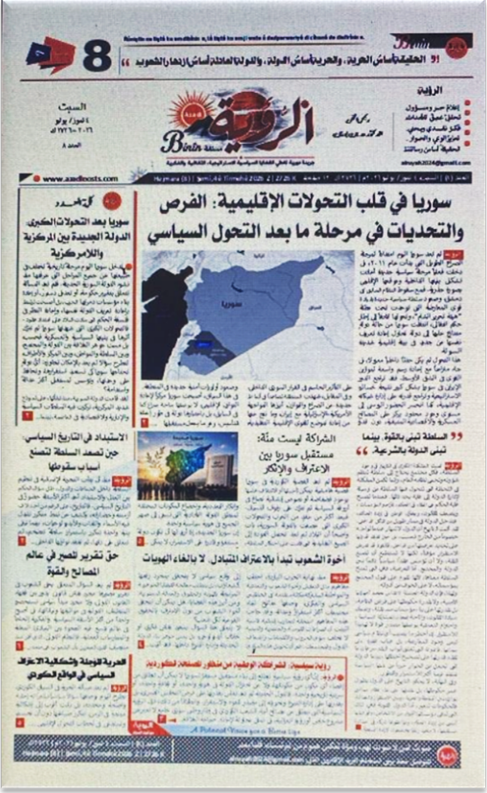
Publication of the Eighth Issue of Al-Ru'ya (Azadi) Newspaper | July 4, 2026
- Super User
- الجريدة
- Hits: 5961
Not every newspaper issue is merely another collection of pages added to the archive of publication, nor is every editorial an occasion to repeat what has already been said in previous editions or to revisit passing events that time will soon consign to memory. There are historical moments in which the written word acquires a significance that transcends ink and paper, moments when journalism evolves from a mere transmitter of news into a witness to profound transformations, and from an observer of events into an active contributor to shaping public consciousness and defending the right of peoples to understand the realities unfolding around them—far from the noise of propaganda, political polarization, and the competing interests that often obscure the truth.
The publication of the eighth issue of Al-Ru'ya comes at one of the most sensitive and complex periods in the contemporary history of the region. This is not simply an era marked by shifts in political balances of power; it is also a period that is fundamentally redefining the concepts of the state, authority, identity, citizenship, and regional relations in ways that no longer permit a return to the equations that governed the Middle East throughout the past decades. What is unfolding today is not merely a temporary political transition or a change in regional alliances. Rather, it is a prolonged historical transformation that is redrawing the maps of influence while reopening the fundamental questions that have remained unresolved for decades: the nature of the state, the future of societies, the limits of political authority, the rights of peoples, and the possibility of constructing political systems that are more just and more stable.
The past years have demonstrated that major crises do not emerge overnight, just as profound transformations cannot be reduced to the fall of one regime or the rise of another. History does not move through isolated moments but through the gradual accumulation of political, economic, social, and cultural imbalances until societies reach a stage where incremental reform is no longer sufficient. At such moments, the need becomes urgent to rethink the very foundations upon which the state has been built, as well as the relationship between authority and society, between the center and the periphery, and between national identity and the diversity that characterizes modern societies.
Syria today stands at the very heart of these transformations. It is no longer merely an arena of internal conflict or a geopolitical crossroads where the interests of regional and international powers intersect. Rather, it has become a genuine testing ground for the major political questions confronting the entire region. After years of war and fragmentation, the central issue is no longer confined to how military conflict can be brought to an end. The more fundamental question concerns the kind of state capable of preventing the recurrence of conflict in the future, and the type of political system capable of accommodating ethnic, religious, and cultural diversity, transforming it from a source of tension into a foundation for national stability.
In this context, the responsibility of intellectual journalism extends far beyond reporting daily events. Its mission is to deconstruct political and social phenomena, analyze their underlying causes, and anticipate their future trajectories. News informs us of what has happened, whereas political thought seeks to answer two more fundamental questions: Why did it happen? And where might it lead? For this reason, Al-Ru'ya does not regard itself merely as a newspaper that follows events. Rather, it aspires to serve as a platform for serious political dialogue, a forum for free intellectual debate, and an open space for ideas that seek realistic solutions beyond rigid slogans and fleeting emotional reactions.
Since its establishment, Al-Ru'ya has consciously chosen to align itself with the strength of ideas rather than the noise of rhetoric, with analysis rather than sensationalism, and with the future rather than captivity to the past. It firmly believes that societies passing through historic turning points require responsible journalism—journalism that raises difficult questions before offering easy answers, that opens the doors to discussion before they are closed by preconceived judgments. For the future cannot be built by endlessly repeating inherited narratives, but by possessing the intellectual courage to reexamine assumptions whose inadequacies have been exposed by reality.
In this issue, we seek to examine a number of questions that we consider central to this pivotal historical stage. Foremost among them are the future of the Syrian state, the challenges of centralization and decentralization, the prospects for a new social contract, the ongoing transformations in regional relations, and the place of the Kurdish question within any democratic national project. Alongside these themes, we present intellectual, cultural, and strategic studies that transcend the immediacy of daily events and instead engage with the deeper questions that will shape the coming years.
We make no claim to possess absolute truth, nor do we offer ready-made political prescriptions. Great national issues cannot be resolved through slogans or closed certainties, but through dialogue, critical thinking, and the willingness to reassess previous experiences and draw lessons from them. Accordingly, everything published in this newspaper seeks to enrich public debate and broaden the space for diverse viewpoints, based on the conviction that democracy begins with freedom of thought before it is translated into institutions and laws.
We also believe that the future of Syria—and indeed the future of the entire region—cannot be built upon the logic of domination and exclusion. It must instead rest upon political partnership, mutual recognition, respect for ethnic, cultural, and religious diversity, the consolidation of the rule of law and strong institutions, and the protection of human dignity as the supreme value around which all public policies should revolve. Stable states are not simply those that possess power; they are those that succeed in building trust among their constituent communities and in fostering within every citizen a genuine sense of equal partnership in the homeland, in political authority, and in shaping the future.
As the eighth issue of Al-Ru'ya – Azadi is published, we reaffirm our commitment to the principles upon which this journalistic endeavor was founded: the defense of freedom of thought, respect for pluralism, dedication to rational dialogue, and the presentation of balanced political analysis grounded in objectivity rather than narrow political alignments. We likewise renew our conviction that the free word remains—regardless of the severity of crises—one of the most powerful instruments for building the future, for it precedes political decision-making and contributes to the formation of the public consciousness from which societies embark upon meaningful change.
The profound transformations taking place across the Middle East today do not represent the end of history; rather, they mark the beginning of a new era in which the peoples of the region will be tested in their capacity to build states that are more just, political systems that are more open, and social contracts that are more balanced and inclusive. At such historical moments, the written word becomes a responsibility, thought becomes a necessity, and a free press becomes not merely a witness to history, but an active partner in shaping it.
With this conviction, we present this new issue to our readers, hoping that through the analyses and perspectives it offers, it will contribute to broadening the horizons of dialogue, deepening public debate, and illuminating the path toward a future worthy of Syria and of all the peoples of the region—a future founded upon freedom, justice, democracy, the rule of law, national partnership, and respect for diversity as a source of strength and enrichment rather than a cause of division and conflict.
Editor-in-Chief
Dr. Adnan Bouzan
ــــــــــــــــــــــــــــــ
For online reading, please visit the following link:
https://online.fliphtml5.com/uczyba/ohrn/#p=1
To read or download this issue, click the file below.
 العدد الثامن من جريدة الرؤية -آزادي العدد الثامن من جريدة الرؤية -آزادي | [العدد الثامن من جريدة الرؤية -آزادي] |