


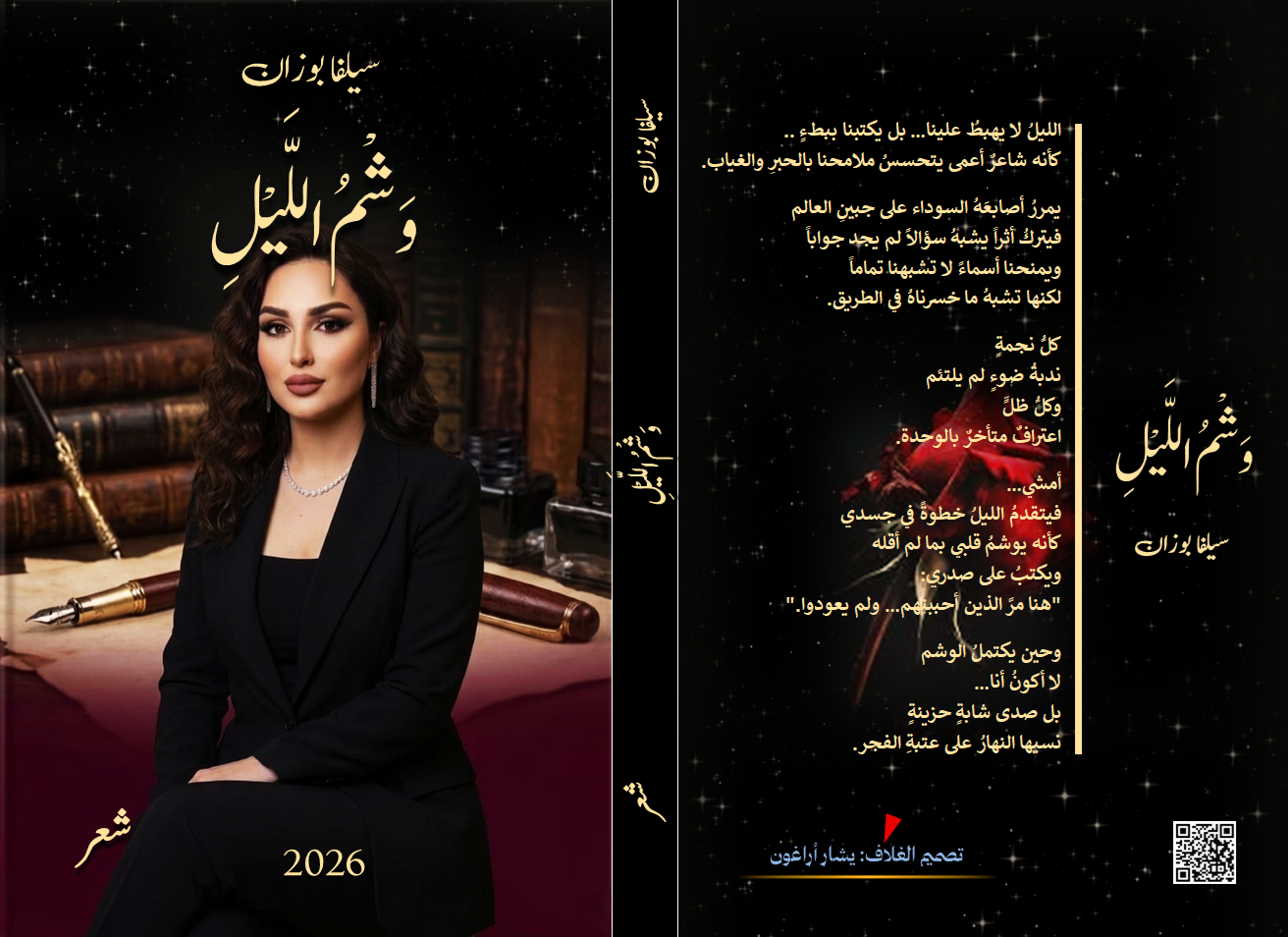
Tattoo of the Night emerges as a remarkable addition to the contemporary poetic landscape, announcing the birth of a young literary voice whose experience carries the depth of human pain and the sincerity of memory and absence.
In an age where stories multiply and voices often resemble one another, this collection arrives to offer a different poetic experience—profound, introspective, and saturated with a distinct existential sensibility. Here, poetry is not written as a linguistic luxury, but as an inner necessity, a continuous attempt to understand the self in the face of loss and exile. This is the first publication of the poet Silva Bozan, whose texts carry the memory of a wounded city and the pain of a human being uprooted from her first homeland, while that homeland itself remains deeply rooted within her.
The poet belongs to the city of Kobani, a city that in this collection is no longer merely a geographical location, but a symbolic center of memory, longing, and loss. Kobani here is not simply remembered—it is lived. Its presence appears in the texture of language, in the tone of sorrow, and in the insistence on holding onto whatever fragments of meaning remain. Despite the poet’s life in exile and her studies at the Faculty of Pharma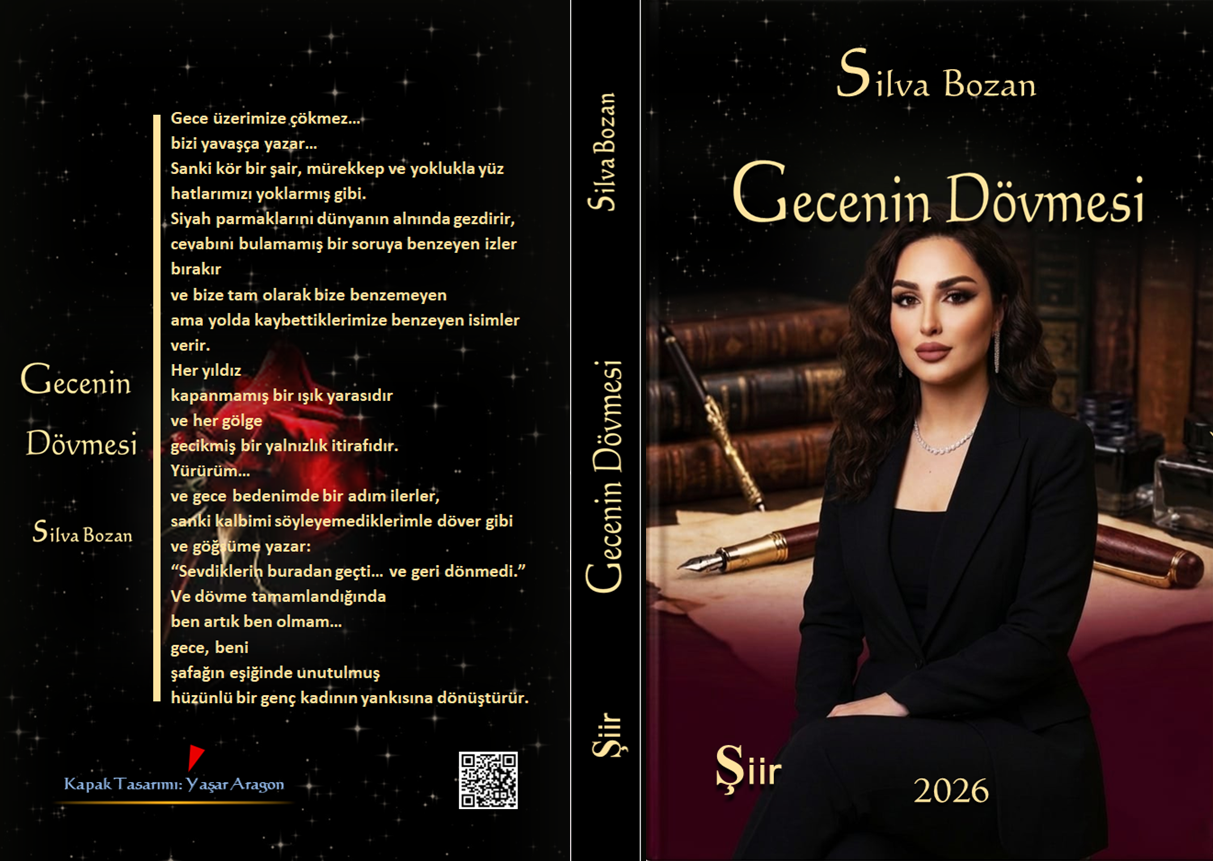 cy in Istanbul, this reality has not distanced her from her roots; rather, it has deepened her connection to them and transformed writing into her primary means of preserving what cannot be replaced.
Published in both Arabic and Turkish editions (150 pages, 41 poems), Tattoo of the Night gathers texts that explore pain, separation, alienation, and longing for homeland and childhood. Yet these themes are not presented as abstract titles; they are approached from within lived experience itself, where sorrow becomes a complete emotional structure, and loss takes on a continuous presence that is not tied to a single moment, but seeps into memory and reshapes one’s relationship with the world.
The language of the collection is distinguished by its sensitivity and expressive density. The poet blends emotional depth with inward contemplation, constructing her texts upon a delicate balance between confession and silence. Her poems do not say everything directly; instead, they leave open spaces for interpretation, inviting the reader to participate in rebuilding meaning. Equally evident is her awareness of exile as a complex condition—not merely geographical displacement, but an inner rupture from the original self and from the small details that once shaped the feeling of belonging.
Within this context, longing in the collection transforms from mere remembrance of the past into a permanent state of searching, a continual attempt to recover what can no longer be restored. Separation, too, appears as an open-ended experience that does not end with distance or the conclusion of a relationship, but continues shaping consciousness and language, reflecting itself in the poet’s perception of life and others. This is what grants the poems their human depth and makes them deeply relatable, especially to those who have experienced different forms of absence or fracture.
Tattoo of the Night does not present itself as a conventional poetry collection, but as a literary work carrying both documentary and human dimensions, intertwining individual experience with collective memory. It is a collection about the human being who loses their first place in the world yet refuses to lose memory itself; about language when it becomes a means of survival rather than merely a tool of expression.
In this sense, the publication marks a promising beginning for a poetic voice capable of expressing contemporary concerns through a language that is both sincere and profound. It confirms that writing still possesses the power to become a space of resistance and a safeguard against oblivion.
Published in both Arabic and Turkish, Tattoo of the Night reaches readers as a poetic experience worthy of reflection and contemplation—a voice carrying within it the story of an entire generation living between memory and exile, searching within words for a form of survival.
And here is one of the poems from Tattoo of the Night:
Who Am I
Who am I…
when the question leans against my chest
like the last traveler crossing toward meaning?
I am the daughter of fire and light—
not as a ready-made answer,
but as a scar that glows whenever it is extinguished.
I move between them
like the trace of an unfinished burning,
like a cloud that learned to rain while ablaze
and never falls.
My soul…
does not dwell in stillness.
Each time, it is born again from its own ashes,
rising with a light in its hands
that resembles nothing of peace.
My life is a revolution of sleepless burning…
Whenever they said, “You are finished,”
I opened a new window in the ashes
and entered more certain of the light.
I am sacrifice before departure.
I walk toward my heart
like one who throws herself upon life
without asking salvation what it means.
I remain steadfast…
like a statue in the square;
the wind tires around it, but it does not tire,
because it does not know how to become a fall,
only a witness to what has fallen.
So let departure come…
Let the season of harvest and farewell arrive.
Let the ships lose themselves among waves and winds.
I am not what is searched for in the end…
I am the trace that remains
when all roads come to an end.
 ديوان شعري وشم الليل نسخة عربية ديوان شعري وشم الليل نسخة عربية | [ديوان شعري وشم الليل نسخة عربية ] |
| ديوان شعري وشم الليل نسخة تركية | [ديوان شعري وشم الليل نسخة تركية] |