

“Nowruz: Kurdish Identity Between Festival and Politics — A Reading in the Dialectic of Being” by Dr. Adnan Bozan
- Super User
- مؤلفات سياسية
- Hits: 30412
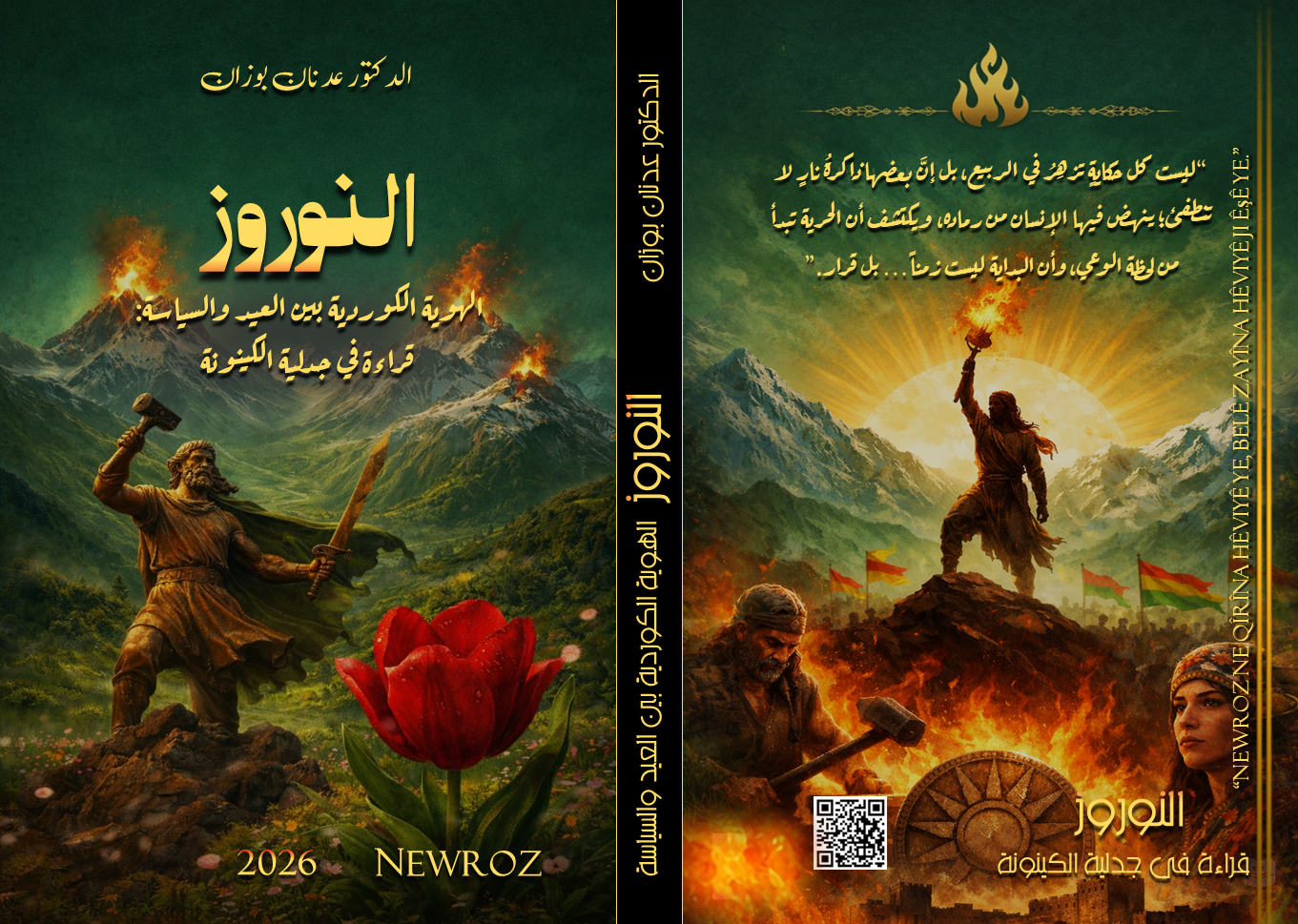
“Nowruz” is not merely the title of a book, nor simply a festival that passes through the calendars of peoples and then fades away. In this work, which spans 260 medium-sized pages, Nowruz becomes an open space of thought and a profound question about the relationship between human beings and history, between memory and power, between ritual and identity, and between joy as a cultural act and its transformation into a politically charged symbol. This is explored within the context of Kurdish identity between festival and politics, as it is re-examined and deconstructed through the dialectic of being.
In this book, Nowruz is not treated merely as a folkloric celebration, but as a layered historical structure that has accumulated over centuries multiple strata of meaning: from myth to ritual, from nature to collective consciousness, and from individual joy to collective identity. Here, Nowruz becomes more than an annual moment; it becomes a memory moving through time, and a consciousness renewed each year in the form of a fire that ignites meaning rather than wood.
The book traces the origins of Nowruz in its earliest roots, examining how it emerged as a festival linked to cosmic transformation, the arrival of spring, and the idea of rebirth after the symbolic death of nature. However, it does not stop at the mythological or cultural dimension; it moves toward a more complex question: how does a festival become a political identity? And how does joy itself become a battleground between power and memory in the formation of modern Kurdish identity?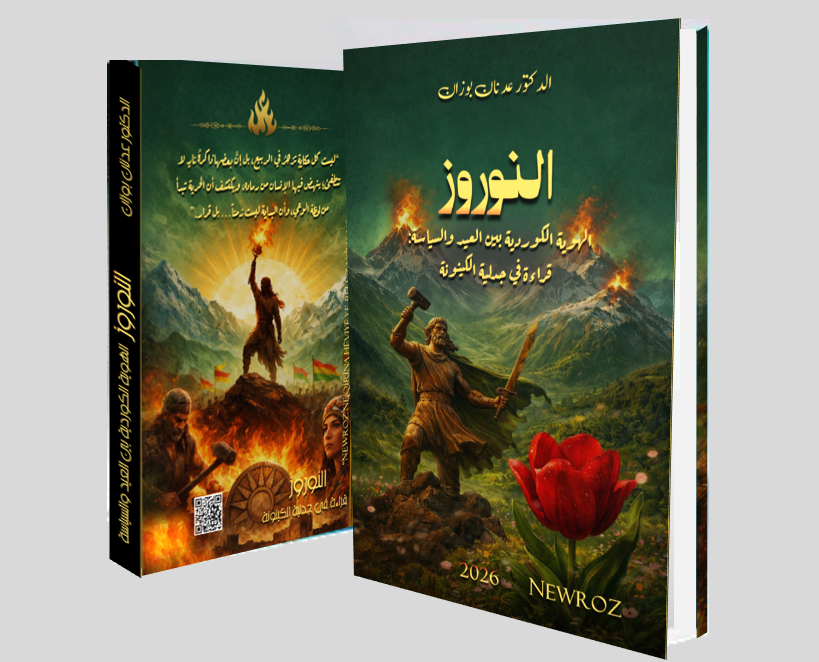
Nowruz, as this book argues, is no longer a simple innocent ritual. It has entered modern history as a symbol of existence, recognition, and cultural resistance. It has become a political language spoken by peoples when they are denied speech, and a symbolic banner raised when identities are pushed to the margins. Here emerges a central paradox: how can a festival turn into a discourse? And how can a celebration become a political stance within the equation of festival and politics?
The book further examines Nowruz in relation to the state, power, and modern identity projects, and how different political systems have reshaped its meaning—through incorporation, exclusion, or reinterpretation. In this sense, Nowruz becomes a mirror of a deeper conflict: the struggle between collective memory and attempts to politically re-engineer it within the structure and transformations of Kurdish identity.
However, the book is not limited to political analysis; it also delves into the philosophical dimension: what does it mean for a people to celebrate a festival that carries within it the idea of a “new beginning”? Is Nowruz a promise of salvation, or a constant reminder that beginnings never come without pain? And can a festival become a form of quiet resistance against forgetting?
“Nowruz” is not a book about the past alone, but also about the present, and about how symbols can outlive politics, how rituals can be defeated once and rise again many times. It is an attempt to understand how joy becomes meaning, meaning becomes identity, and identity becomes an open-ended question in the dialectic of being.
In the end, this book is not a celebration of Nowruz as much as it is a reflection upon it: a deconstruction of its layers, a reinterpretation of its symbolism, and an attempt to understand why this festival continues to ignite questions every year, as if it refuses to remain merely a memory, insisting instead on being a living continuation of the idea that peoples, no matter how broken, always retain the right to begin again.
──────────────────────────
Read the book online via the following link:
https://online.fliphtml5.com/uczyba/zaab/#p=1
To read or download, click the file below.
 Newroz: nasnameya kurdî di navbera cejn û siyasetê de Newroz: nasnameya kurdî di navbera cejn û siyasetê de | [Newroz: nasnameya kurdî ] |
| النوروز: الهوية الكوردية بين العيد والسياسة | [النوروز: الهوية الكوردية بين العيد والسياسة] |