


The book “Nowruz” has recently been published in both Arabic and Kurdish editions by Dr. Adnan Bozan.
- Super User
- kurdi
- Hits: 548
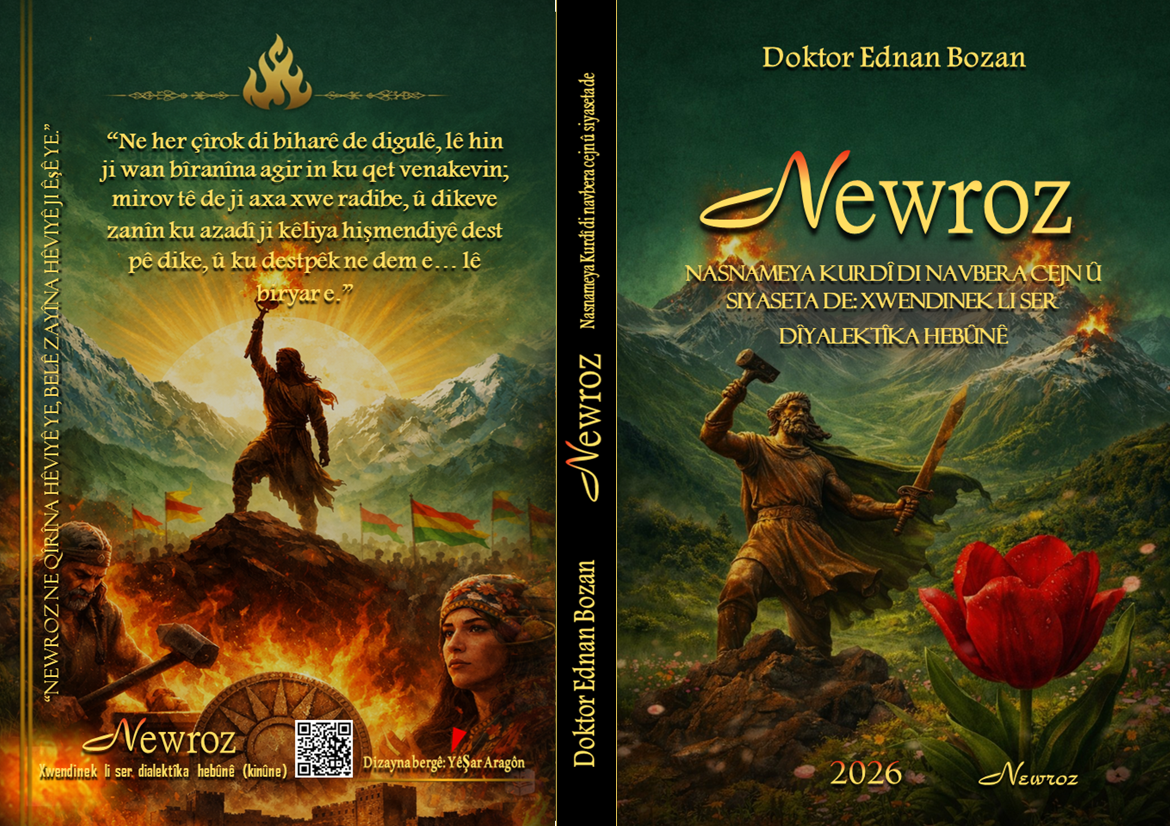
Here, “Nowruz” emerges once again from the ashes of centuries—not as a passing celebration in the calendar of nations, but as a living memory walking on the feet of history, carrying in its eyes the first flame of freedom.
It is a book written with ink and pain, with a voice that has crossed mountains for a long time, and with songs that have survived destruction whenever empires tried to extinguish the sun of the East.
The book “Nowruz” has been published in its Arabic and Kurdish editions as a comprehensive historical, political, and cultural work, in a medium format, ضمن a series of intellectual studies that seek to reread the region from within its deep memory, rather than through official narratives written by victorious powers upon the ruins of peoples.
This is not merely a study of a popular festival, nor a folkloric attempt to revive a seasonal ritual; it is a long journey through the layers of human consciousness, and through the complex relationship between fire and human beings, between myth and politics, between identity and resistance, and between spring as a natural season and spring as a historical moment of rebirth for nations that time tried—but failed—to erase.
In this work, Nowruz does not appear as an isolated celebration, but as a major civilizational issue; a mirror of the ancient memory of the East, and a bridge connecting mythology with history, and connecting peoples with their right to exist.
It is a book that seeks to trace Nowruz back to its earliest roots in Mesopotamia, through its religious and cultural transformations, up to its contemporary political presence as a symbol of identity, freedom, and resistance against systems of oppression and denial.
In this book, I have sought to move beyond the superficial reading that reduced Nowruz to dance, clothing, and songs, and to approach more deeply its philosophical and human essence; the fire that was never merely a festive flame, but a symbol of knowledge against darkness, of rebellion against tyranny, and of the extraordinary ability of peoples to rise from their ashes whenever the world believed they had ended.
Speaking of Nowruz, at its core, is speaking of the Eastern human being when defending their right to existence, and of peoples who were fought through their language, memory, and songs, yet continued to light the fire every year, as if declaring to the world:
“Destruction may swallow cities, but it cannot extinguish the idea.”
This book is also an attempt to understand the historical relationship between the Kurds and Nowruz, بعيدًا from narrow emotional narratives, and through an approach that combines political analysis, cultural depth, and civilizational perspective.
Nowruz was never merely a festive event; throughout history, it has become a language of resistance and a symbolic space through which peoples preserved their right to express their identity, even in the harshest of times.
Because true history is not written from the thrones of power, but from within human suffering, this work stands as an intellectual testimony to a long period of struggle between attempts at erasure and annihilation, and the will to survive.
It is a book about fire that triumphed over ashes, about memory that survived oblivion, and about a human being who kept searching for the sun even in the darkest ages.
To everyone who sees Nowruz as more than a festival…
To everyone who believes that freedom begins with awareness, and that peoples who preserve their memory do not die…
To everyone who carries within them something of the ancient fire of the East…
I present this book to you.
 Newroz: nasnameya kurdî Newroz: nasnameya kurdî | [Newroz: nasnameya kurdî] |