

By: Dr. Adnan Bozan
Language is not merely a means of communication among human beings, nor is it simply a set of sounds and letters used to exchange meanings and ideas. Rather, it is the vessel in which societies preserve their collective memory, and the bridge through which culture, values, and history are transmitted from one generation to the next. When a nation loses its language, it does not merely lose a tool of expression; it loses part of its spirit and relinquishes one of the most essential foundations of its civilizational and human existence.
Language is the first homeland in which human beings reside before they become familiar with the maps of geography and the borders of states. Through language, individuals learn the names of things, discover the world, and shape their emotions, dreams, and perceptions of life. For this reason, language has historically constituted one of the fundamental pillars upon which national and cultural identities are built, as it provides human communities with a shared sense of belonging and weaves bonds that transcend the limits of space and time.
Nations that have preserved their presence throughout the centuries have not been strong through military power alone or economic strength alone, but through their ability to protect their language and safeguard their culture. Language is not merely a reflection of identity; it is one of the primary forces that shape and continuously renew that identity. It is the living repository in which folk tales, songs, myths, proverbs, literature, philosophy, and all human accumulated experience across ages are preserved.
From this perspective, the Kurdish language occupies a distinct place in Kurdish consciousness. It has never been merely a tool of daily communication; rather, throughout long historical periods, it has functioned as a symbol of cultural resilience and a means of preserving national existence in the face of marginalization, denial, and assimilation. While political maps shifted and regimes changed, the Kurdish language continued to carry the memory of the Kurdish people, transmitting it from one generation to another and preserving cultural continuity despite historical transformations.
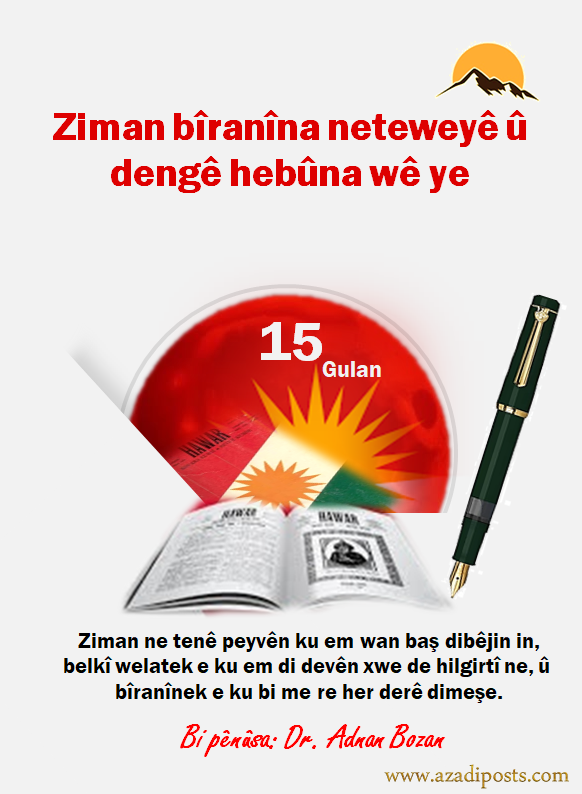
Within this historical and cultural context, the journal Hawar emerged as one of the most significant milestones in the development of the modern Kurdish language. When Prince and intellectual Celadet Ali Bedir Khan published the first issue of the journal in Damascus on 15 May 1932, he was not merely establishing a literary magazine; he was launching a comprehensive intellectual and cultural project aimed at developing the Kurdish language, modernizing its expressive tools, and opening new horizons for literature, thought, and culture.
Hawar appeared at a time when the Kurdish language faced considerable challenges. It played a crucial role in consolidating the use of the Latin alphabet, publishing articles, studies, research, and literary works, and advancing methods of writing and expression. Over time, it evolved into a cultural and linguistic school that left a profound impact on the trajectory of the modern Kurdish renaissance.
The name Hawar—meaning “call” or “cry”—was far from a casual or purely aesthetic choice. It expressed the need of a people to have their voice heard, to write in their own language, and to preserve their memory from disappearance. It was a cry against oblivion and a call to keep the language alive within the collective consciousness of the nation and present within the fields of knowledge and creativity.
Since then, Hawar has ceased to be merely a journal; it has become a symbol of an entire era of Kurdish cultural renaissance. Consequently, 15 May has become recognized as Kurdish Language Day, marking the launch of one of the most important cultural initiatives that contributed to the development, preservation, and institutionalization of the Kurdish language in contemporary cultural life.
The defense of language does not imply isolation or hostility toward other languages; rather, it signifies the protection and enrichment of human cultural diversity. Every language represents a unique vision of the world, carrying within its vocabulary, structures, and experiences a distinct aspect of shared human heritage. When a language disappears, humanity loses not only a means of communication but also part of its spiritual and civilizational richness.
Therefore, the responsibility of preserving the Kurdish language does not rest solely with linguists and writers, but is a collective responsibility that begins within the family and the school, and extends to journalism, cultural institutions, universities, and the media. A language that is not written, read, or used to produce knowledge gradually loses its capacity for renewal and adaptation to contemporary life.
If nations are built through will and action, language remains the foundation upon which that will rests. It is the living memory of peoples, their ageless voice, and the mirror in which they see themselves across time. Thus, Hawar remains more than a magazine, and language remains more than words; together they tell the story of a people striving to preserve its cultural identity, affirm its presence in history, and write its future with the very letters that safeguarded its past.