


The Publication of the Poetry Collection “The Sanctuary of Longing” in Arabic and Kurdish by Dr. Adnan Bouzan
- Super User
- Berhemên Kurdî
- Hits: 92
Not all poems are written in in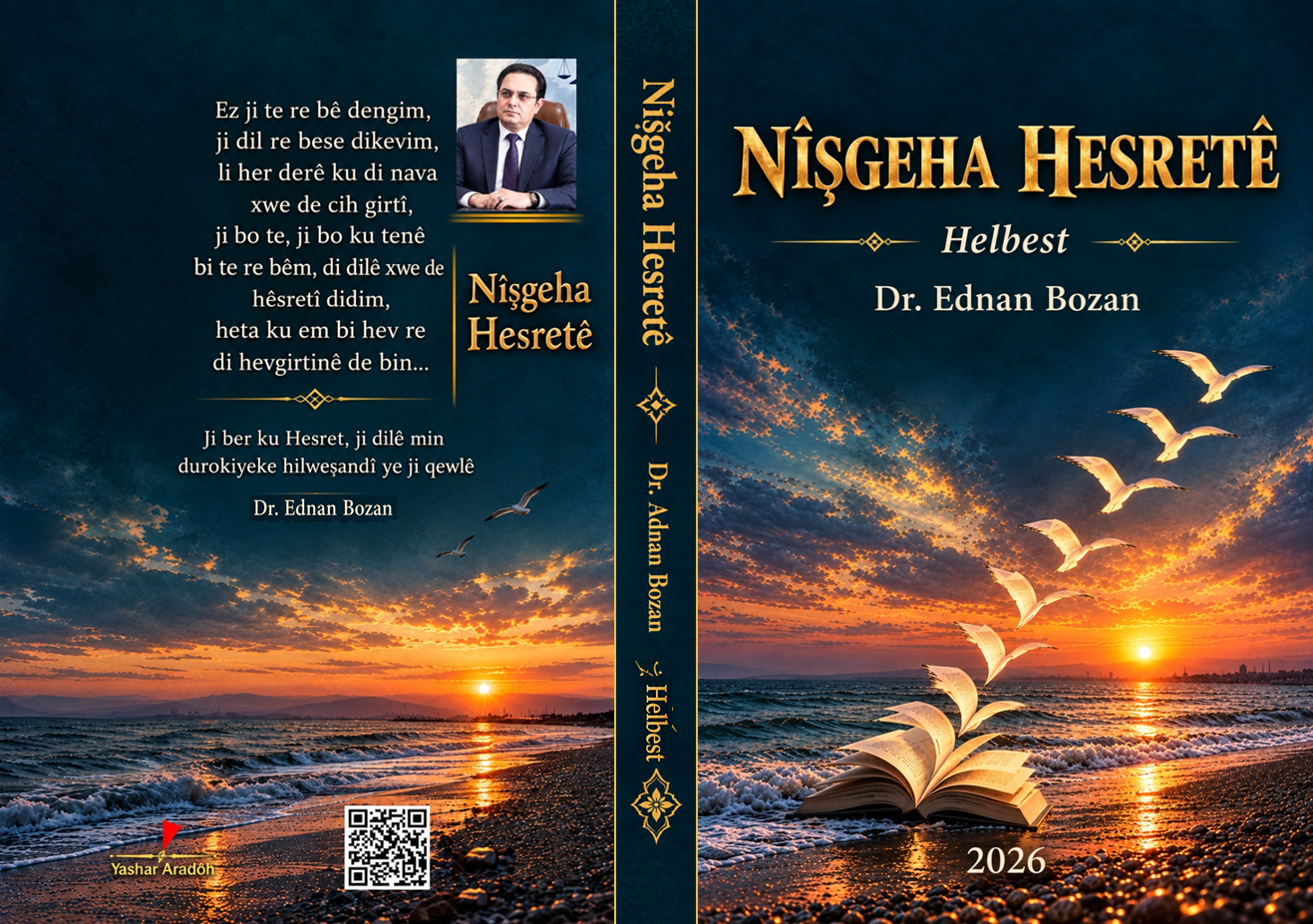 k; some are written with what absence leaves behind in the soul, with the faces, places, and voices hidden within memory, and with that part of the human being that remains standing at the threshold of the past, no matter how far the roads may carry them. From this distance between what once was and what is no more, between homeland as a place and homeland as memory, and between love as presence and love as an enduring trace, “The Sanctuary of Longing” is born.
“The Sanctuary of Longing” presents itself as a poetic experience that transcends longing in its immediate emotional sense, reaching into the deeper human realm where loss, memory, love, exile, homeland, and departure take shape. Here, longing is not merely a glance toward the past, nor simply a desire to reclaim a time that has gone by. Rather, it is an existential condition experienced by a person who finds themselves between places they have left behind, faces that have grown distant, dreams that remained unfinished, and things they once believed would endure—only to discover that what remains longest is the trace they have left within.
The very title of the collection, “The Sanctuary of Longing,” carries a vast world of meanings. The sanctuary here is not a physical place, but an inner space to which memory retreats when life becomes too narrow for it, and to which the soul returns when it can no longer reclaim what it has lost in reality. It is a symbolic place where different times meet; where the absent becomes present, the distant becomes near, and the past becomes part of the present. There, memories cease to be passing images and become questions that refuse to fall silent.
In this collection, the poem becomes a space for confession, contemplation, and confrontation: a confrontation with memory, with places one has left but which have never left them, with faces that have gone away yet remain present in the smallest details of life, and with the questions through which a person grows without ever finding definitive answers. Places are not silent geography, roads are not merely distances, and night is not simply the passing of time. Everything here carries memory; every image may become a doorway to a story, and every story leads to a part of the human being.
“The Sanctuary of Longing” comprises 37 poems across 192 pages, where the worlds of love, loss, homeland, exile, night, departure, and memory intersect. Human experience meets poetic language in an attempt to grasp what ordinary speech can scarcely contain. The poem does not come here merely to explain longing, but to give it a voice, an image, and a rhythm, allowing the reader to recognize something of themselves in the mirror of words.
In this collection, homeland does not remain confined to the boundaries of a place, nor does exile become merely a distant geography; both become inner states. A person may leave their homeland, yet they cannot always leave the homeland that lives within them. They may move away from those they have loved, yet some faces need no physical presence to remain permanently alive in memory. Thus, departure in “The Sanctuary of Longing” is not the end of the road, but the beginning of another journey—a long journey into the self.
Memory occupies a special place in this experience. It is not an archive of the past, but a living presence that continually reshapes the present. It recalls what we have lost, awakens what we have tried to forget, and gives the things that have disappeared from our lives a new existence through language. Poetry therefore becomes a form of resistance to oblivion: an attempt to save faces, places, and voices from silently passing into disappearance.
Love, too, appears in the collection not as a state detached from the rest of the experience, but as one of the deepest paths toward the vulnerability of being human. When love is fulfilled, it becomes life; when it breaks, it becomes memory; and when it disappears, it may remain more present than many things that never left. Between presence and absence, poems are born in search of meaning within the smallest details that another person leaves behind in the soul.
The poetry collection “The Sanctuary of Longing” has been published in two editions, Arabic and Kurdish, carrying its poetic experience into two linguistic spaces that meet in memory while differing in expression. It gives the poem the possibility of crossing between two languages, each preserving its own distinctiveness and richness. Language here is not merely a means of transferring a poem from one tongue to another; it is a bridge across which emotions, images, and memory travel, allowing the experience to reach its readers in two spaces that differ in expression yet converge in their human depth.
The Kurdish edition is not simply an addition to the Arabic edition; rather, it is an extension of the poetic experience into another linguistic space, allowing the text to reshape its images, rhythms, and meanings within a language that carries its own memory. Thus, in its two editions, the collection becomes a meeting place between language and memory, poetry and identity, and individual experience and the broader human consciousness.
And so, the collection comes as a book about the human being before it is a book about longing: about the person who moves through life carrying what they cannot leave behind, continuing along the road while a part of them remains suspended somewhere—in front of an old window, in the face of someone absent, in a city that is no longer what it once was, or in a time that can only be recovered through words.
“The Sanctuary of Longing” is not an invitation to weep over what has passed, so much as a meditation on what it means to remember, to love, to lose, to depart, and to carry within us more of places and people than we are ever capable of saying. It is an attempt to search for the human being in the shadows of memory, for life in the things we once believed had ended, and for poetry in that mysterious space between the heart and the world.
These are poems that regard longing not as a weakness before the past, but as one of the most honest paths toward discovering the self. Everything we miss leaves a mark upon us; everything we love reshapes us; and every place we pass through leaves something of its features within us. Perhaps this is why poetry, in the end, is nothing more than an attempt to give what cannot be recovered another life, and to give absence a language through which it can speak.
37 poems… 192 pages… and two languages in which the memory of poetry meets.
When life leaves us without the words to say what lies within, poetry begins to speak.
ــــــــــــــــــــــــــــــــــــ
To read the Arabic edition online, please follow the link below:
Arabic Edition — Online Reading
To read the Kurdish edition online, please follow the link below:
Kurdish Edition — Online Reading
ــــــــــــــــــــــــــــــــــــ
To read or download the collection, please click on the file below.
n;
 محراب الحنين نسخة كوردية محراب الحنين نسخة كوردية | [محراب الحنين نسخة كوردية] |