



Where Is My Blood… O Scent of the Elm? A Poetry Collection by Dr. Adnan Bouzan
- Super User
- مؤلفاتي الأدبية
- Hits: 59705
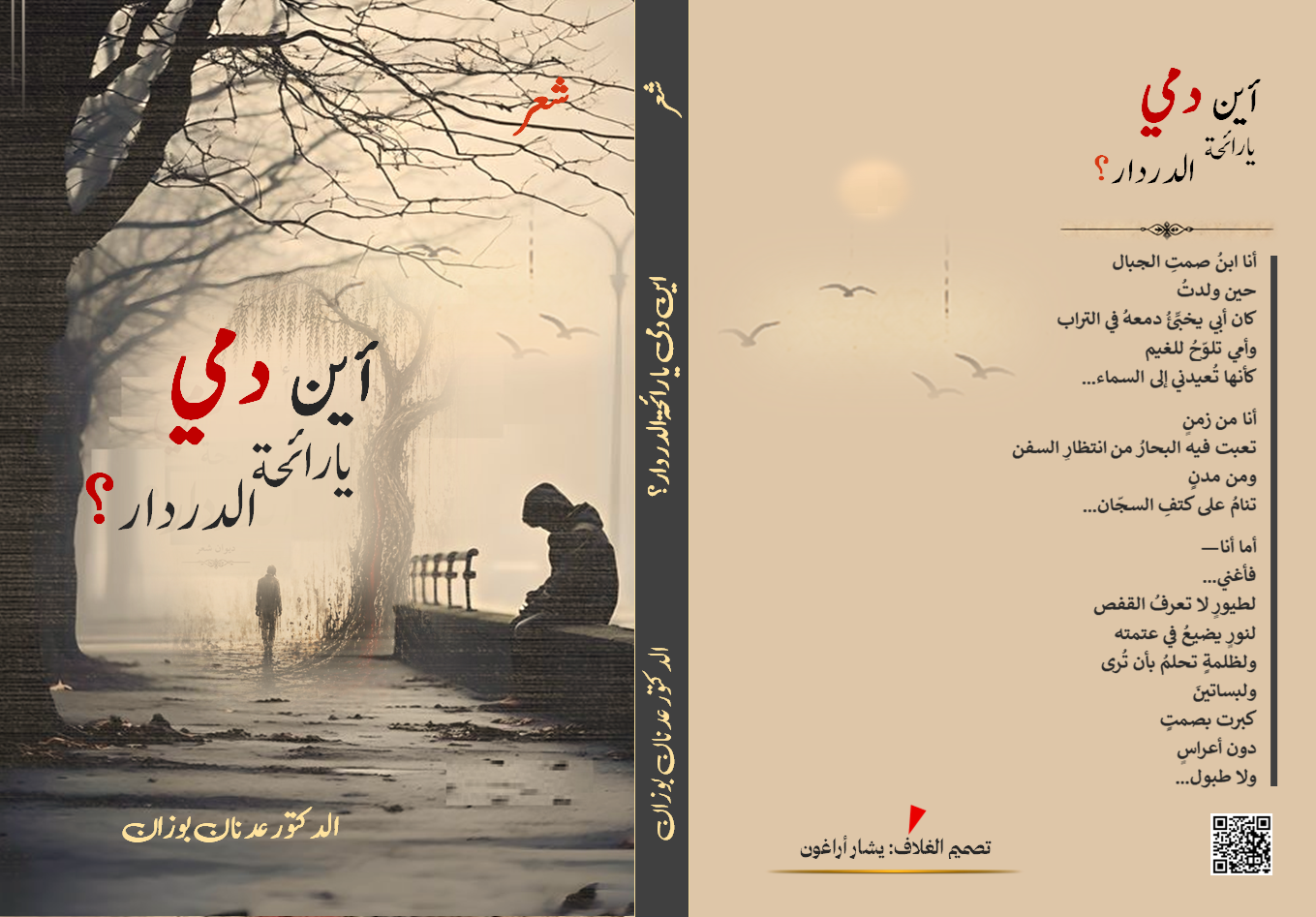
In a time when silence multiplies until it becomes an alternative language, and meaning narrows until it nearly suffocates beneath the noise of the world, this collection returns to pose its first and eternal question: Where is my blood?
It is not a passing question, nor an immediate cry, but an open wound stretching across the breadth of memory, leaning on the scent of the elm—that scent which belongs not only to the tree, but to the earth when it conceals its blood, and to the human being when they lose their voice in the crush of oppression.
In its second edition, this collection does not return as old texts republished, but as a living being that has survived time and come back to question us anew. It was first released in 2009, at a moment when great questions were forming quietly, before erupting into bloody realities. Today, as it is republished in a digital space, it does not merely reclaim itself, but re-creates itself within a broader context, where individual memory intertwines with collective memory, and poetry becomes at once an emotional and political document.
This work spans 137 medium-sized pages and contains 31 poems. Yet these numbers do not encapsulate the experience; they merely hint at its outward form. At its depth, we encounter a fragmented world where the self stands beside the homeland, love beside loss, longing beside anger, all within a dense linguistic fabric rich with imagery and metaphor. It calls upon the reader not only to read, but to listen… to what lies between the words.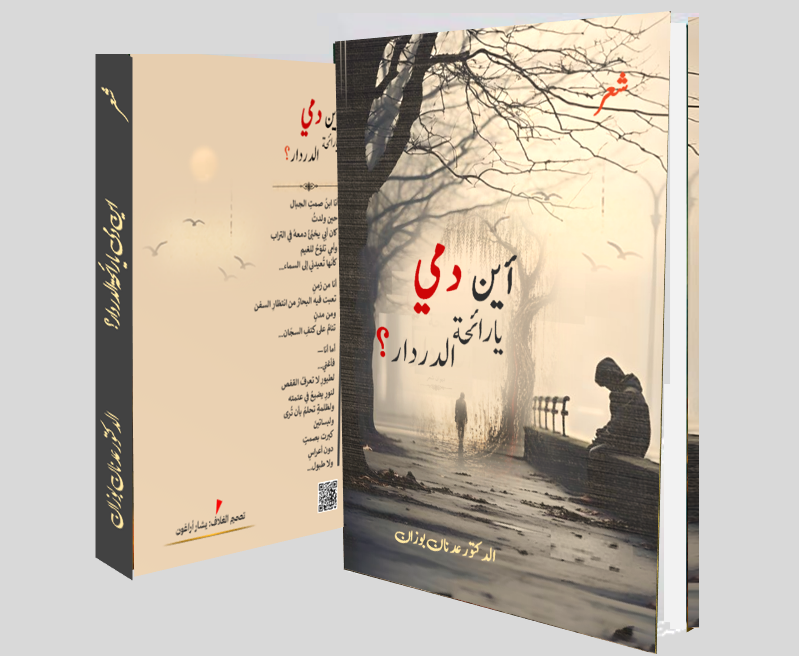
“The Scent of the Elm” is not merely an aesthetic title, but an interpretive key that opens the text to multiple layers of meaning. The elm, with its natural presence, becomes here a silent witness to pain—a vegetal memory preserving what humans have failed to express. From this tension between nature and history, between body and absence, the question arises: Where is the blood? Is it the blood of the individual spilled in darkness? Or the blood of the collective lost within the maps of politics? Or is it that symbolic blood, pointing to meaning itself as it is drained into emptiness?
In this collection, poetry occupies a space between literature and politics—not as a direct or slogan-driven discourse, but as an existential experience approaching reality through the lens of deep human suffering. Here, language is not separated from its context, nor is imagery detached from its meaning. Instead, all elements intertwine to produce a text that stands at the threshold of beauty and pain. It is poetry that rejects empty ornamentation and moves directly toward the essence of things, where truth stands bare, and the human being faces themselves.
If this collection declares its belonging to political literature, it does so from within language, not from outside it. Politics here is not a subject, but a fate that seeps into daily details: into relationships, memory, and dreams. Thus, the poems do not deliver speeches; they pulse, suffer, and rebel—as if they were living beings seeking their own redemption in a world that confines them.
Republishing this work today is not merely an act of archiving or retrieval, but an intellectual and aesthetic stance. A text written in a specific context now returns to be read across multiple contexts, reproducing its questions and granting them new dimensions. This makes the collection an open text, belonging to no single moment, but extending through time—as if it converses with the future as much as it recalls the past.
“Where Is My Blood… O Scent of the Elm?” is not merely a poetry collection, but an attempt to grasp meaning at the moment of its fracture, to write memory as it bleeds, and to pose, one last time, the question in the face of silence:
Is there still within us something that deserves to be called blood?
Or, in the chaos of this world, have we lost even the ability to feel that we are bleeding?
ــــــــــــــــــــــــــــــــــــــــــــــ
You can read the collection online via the following link:
https://online.fliphtml5.com/uczyba/pcwe/#p=1
For reading and download, click the file below.
 أين دمي .. يا رائحة الدردار ؟ أين دمي .. يا رائحة الدردار ؟ | [أين دمي .. يا رائحة الدردار ؟] |