



Capitalism: From Imperialism to Socialism — The Major Transformations in Human History
- Super User
- مؤلفات سياسية
- Hits: 11867
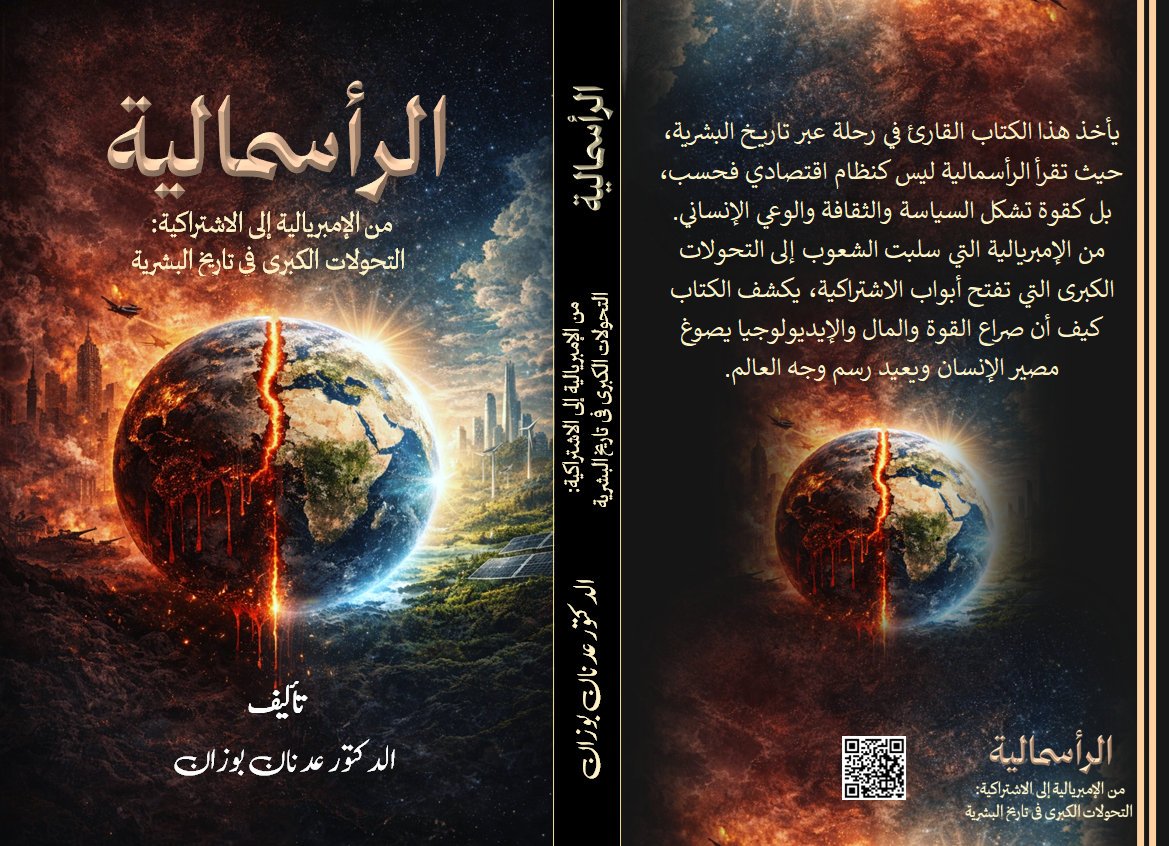 In a world standing on the brink of transformation, where crises accumulate like heavy clouds before a storm, speaking about capitalism is no longer an intellectual luxury—it has become an existential necessity. We are not living in ordinary times, but in an age in which history intensifies, interests intersect, and powers collide in new forms, to the point that the contours of a third world war are beginning to emerge—not as a distant संभावना, but as a logical extension of a long trajectory of competition, domination, and deferred explosion.
What we are experiencing today is not merely a series of scattered crises, but a structural crisis striking at the core of the global system. Capitalism is no longer capable of concealing its contradictions, nor of reproducing its stability except through more expansive and violent means. Every regional conflict, every economic tension, and every arms race is but an expression of a deeper imbalance in the structure of global power—and a sign of an approaching moment that may reshape the world in its entirety.
This book is not merely an announcement of an intellectual work; it is a cry of awareness in a critical moment of human history. It is an attempt to understand a world in fracture—not from the surface of events, but from the depth of the structure that produced this fracture: capitalism, in its transformation from a project of production and expansion into an imperial system that redraws maps in blood, and redefines the human being as an exchangeable value, a component within a vast machine governed solely by the logic of profit and accumulation.
From imperialism—where the world was divided among great powers as spoi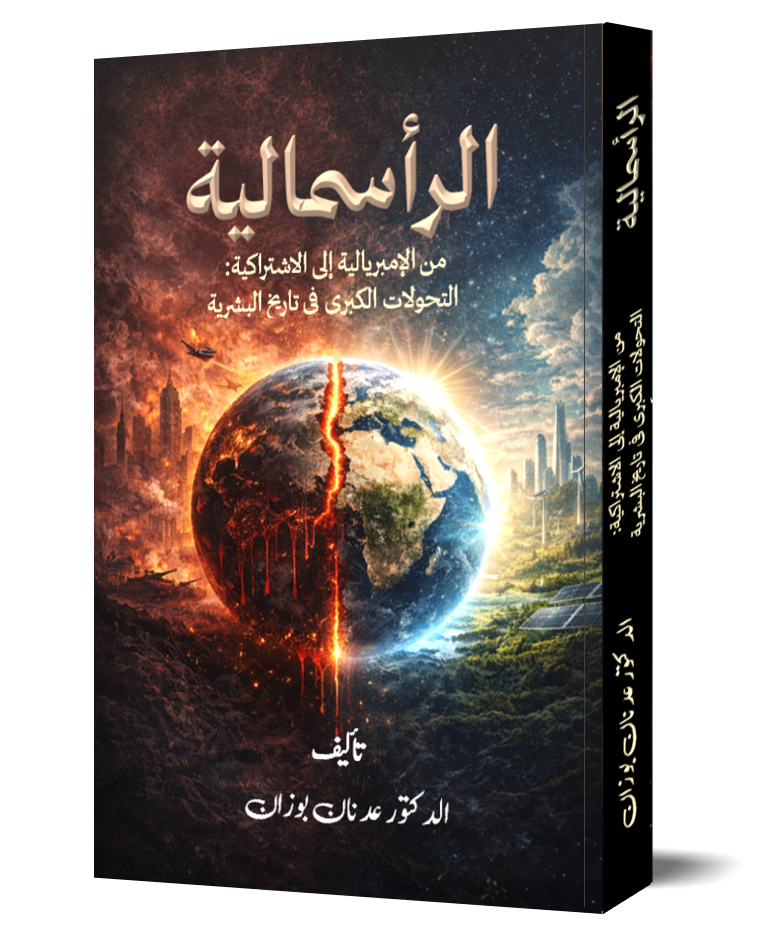 ls are divided, and where continents were turned into open arenas of plunder and domination—to socialism, which emerged as a historical horizon of justice and an attempt to restore the human being in the face of exploitation—this book traces the major transformations that have never been separate from war, but for which war has often been the clearest and most brutal language. Every major economic crisis has been a prelude to explosion; every imbalance in the balance of power an open invitation to redraw the world through fire; and every fragile peace nothing more than a temporary truce between two conflicts.
Yet this work does not stop at description or historiography; it goes further, toward deconstructing the deep structures that govern the movement of history: How are empires formed? How do markets become instruments of domination? How is hegemony reproduced through culture, media, and economics? And how do forces of resistance emerge from within these contradictions, striving to break the cycle and rebuild the world on more just and humane foundations?
Amid all this, the book raises an unavoidable, existential question: Are we on the verge of repeating history, or on the threshold of a qualitative transformation that will alter its course? If the coming war erupts, will it merely reproduce the tragedies of the twentieth century, or will it mark the birth of a new global order? And will socialism—once seen by many as a deferred dream or an incomplete experiment—return today as a historical necessity imposed by the very crises of capitalism?
Across 697 medium-sized pages, this work does not merely recount or analyze events; it delves into the contradictions that produce them, uncovers the hidden relationships between economics, politics, and culture, and offers a comprehensive reading of humanity’s path as it oscillates between domination and liberation, accumulation and rupture, power and justice. It is a book that confronts the reader with an unavoidable truth: the world we know is not final, and every system carries within it the seeds of its own end—as well as the possibilities of what may come after.
This is not a book to be merely read, but a lived intellectual experience—a confrontation with profound questions that cannot be postponed. It is an invitation to rethink what we take for granted, to move from passive reception to active understanding, and from the illusion of stability to the awareness of transformation.
In an age where the chapters of the next war may already be in the making, awareness is no longer a luxury—it is a necessity. And understanding is no longer a choice—it is a condition for survival.
Now available — a book that places you at the heart of transformation, not on its margins.
To read and download the book, click the file below.
 كتاب عن الرأسمالية كتاب عن الرأسمالية | [كتاب عن الرأسمالية] |