



A Historic Warning Appeal to the Kurdish Leadership in Kurdistan of Iran
- Super User
- Politics
- Hits: 6319
To the Kurdish leadership in Kurdistan of Iran,
Peoples who fail to read their historical moments with precision are driven, without realizing it, to become instruments in writing the history of others, not their own. The most dangerous threat a nation struggling for its existence and rights can face is not only direct repression, but also being drawn into conflicts that do not arise from its own priorities, do not serve its national project, and are instead imposed upon it within larger geopolitical balances and managed according to wills that do not represent its true interests.
The phase the region is going through today is not merely a passing political crisis, but a moment of historical reconfiguration, in which major powers compete to redraw maps of influence and shape the contours of the coming regional order. In such moments, Kurdish geography once again becomes a sensitive factor in international calculations—not as a homeland of a people deserving freedom and self-determination, but as a strategic location within equations of power and balances of influence.
From this perspective, it becomes necessary to affirm a truth that admits no ambiguity: the international and regional conflicts unfolding today, including those connected to Iran, do not originate from the Kurdish cause, nor do they aim to secure the national rights of the Kurdish people. Rather, they are struggles of major powers, governed by the logic of interest and power, not by the logic of justice or the historical rights of peoples.
Kurdish history, through its painful and repeated experiences, has taught us that great powers—no matter how supportive they may appear—do not view the Kurds as permanent strategic partners, but as temporary allies shaped by circumstantial necessity. When interests change, positions change accordingly, regardless of the scale of sacrifices made or the promises once given. This is not a theoretical conclusion, but the outcome of a long historical experience for which the Kurdish people have paid with their blood, their stability, and the future of their generations.
The experience of Kurdistan in Syria stands as a clear example of this reality. The Kurds there became involved in one of the most complex conflicts in modern regional history, within complicated international frameworks, under major alliances, and based on promises presented as a gateway to recognition and guaranteed rights. Once again, the Kurds proved their capacity for resistance and sacrifice. Yet when international calculations shifted and the priorities of influential powers changed, commitments receded, equations were altered, and the Kurds found themselves facing a reality that neither reflected the magnitude of their sacrifices nor ensured their national rights in a just and lasting manner.
This experience must not be read as a passing event, but as a profound strategic lesson revealing the true nature of relations between great powers and peoples who do not possess independent sovereign power. It has demonstrated that reliance on external will, without possessing an independent national project grounded in internal strength and free decision-making, exposes peoples to the danger of becoming temporary instruments within the conflicts of others.
Based on this historical understanding, your responsibility—as political leaders representing part of the will of this people—extends beyond immediate political decisions. It becomes a historical responsibility tied to the destiny of an entire nation. Any uncalculated involvement in regional or international conflicts that do not directly and clearly serve the Kurdish national project carries strategic risks whose consequences may extend far into the future.
The Kurdish people in Kurdistan of Iran are not a party to the conflicts of major powers, and must not be transformed into an instrument within battles that do not arise from their own will or serve their national future. The historical priority at this stage must be the protection of national existence, the strengthening of political awareness, and the building of an independent national project grounded in the will and internal capabilities of the Kurdish people—not in uncertain external wagers.
Nations that have achieved their freedom have not done so by relying on the will of others, but by building their internal strength, consolidating their internal unity, and establishing the independence of their political decision-making. The Kurdish people, who have endured centuries of exclusion and marginalization, possess the capacity to shape their own future—if they maintain clarity of vision, independence of will, and strategic awareness.
The present stage is not a stage of impulsiveness, but a stage of historical awareness. It is not a stage for entering the conflicts of others, but a stage for protecting national existence from exhaustion. It is not a stage of slogans, but a stage for building the realistic foundations of a national project capable of endurance and continuity.
Your responsibility today is not only before current political realities, but before history and future generations. The decisions made at this moment will help define the contours of the future, the limits of possibility, and the scope of freedom that our people will possess.
History does not forgive those who repeat their mistakes, but it does justice to those who possess the courage to avoid them and the wisdom to protect their people from being drawn into conflicts that do not serve their future.
The greatest victory at this stage is not entering war, but protecting the people. Not relying on promises, but establishing the capacity for independent self-determination. Not rushing into the unknown, but building a future founded on awareness, independence, and free will.
This is a moment of historic responsibility—one that does not tolerate error, nor allow the tragedies of the past to be repeated.
Let the standard of decision be the survival of the people, their dignity, and their future.
Glory to our Kurdish people.
Endurance to their free will.
And the future belongs to those who protect their existence, not those who gamble with it.
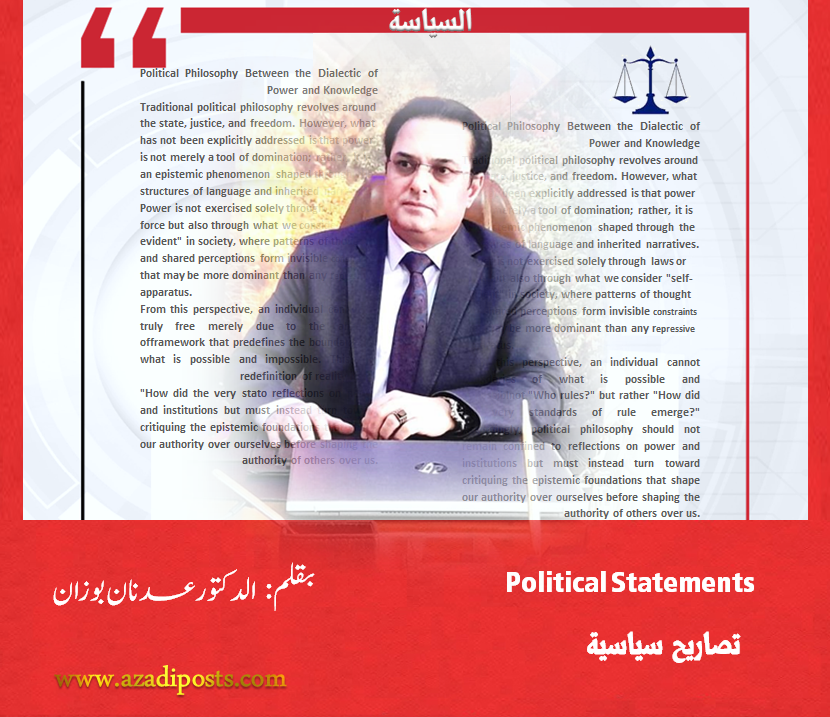
Dr. Adnan Bozan