



Political Warning to Kurdish Parties in Northern Kurdistan: The Risks of Timing in Raising the Issue of Self-Determination
- Super User
- Politics
- Hits: 5311
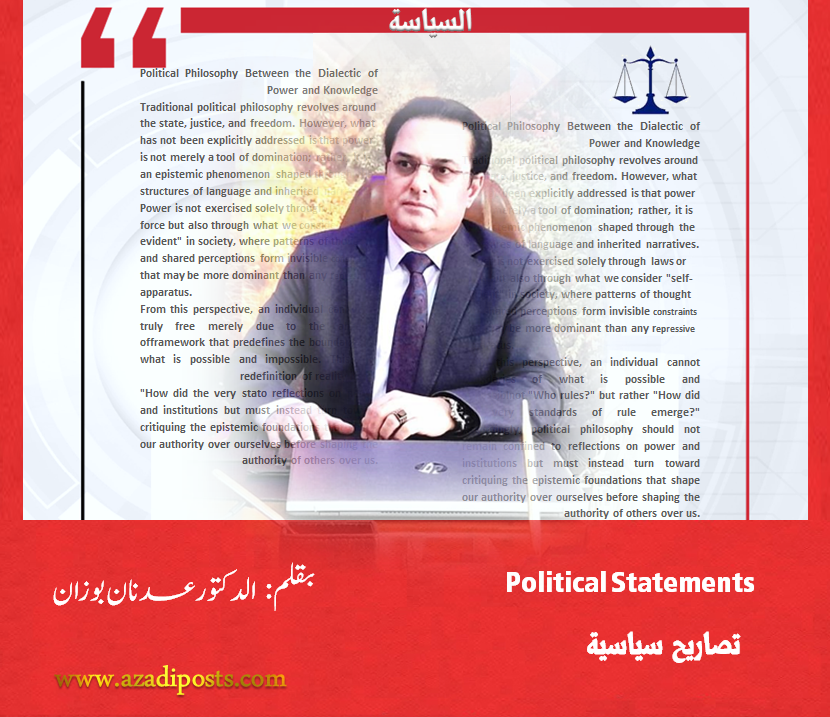
At this critical historical moment, where regional transformations are intensifying and international interests intersect at the expense of the peoples, I find myself compelled to issue a clear and direct warning to the Kurdish parties in Northern Kurdistan and Turkey regarding the slogans and demands being raised today concerning the right to self-determination.
The demand for self-determination, in principle, is a legitimate right for any people seeking freedom and dignity. However, politics cannot be read through intentions alone; it must be assessed in terms of timing, context, and consequences. Therefore, raising this slogan at this particularly sensitive stage cannot be separated from the complex security and political entanglements surrounding the region.
Here, I pose a series of legitimate questions:
Why were these demands not raised in earlier stages, when the political and military conditions were more favorable?
Why was this project not proposed before the Kurdish experiment in eastern Euphrates faltered, and before the political and military exposure that affected it?
And why is it being raised now, at a moment when influence maps are being redrawn, and gradual processes of erasing the remaining Kurdish gains are underway?
A careful, realistic reading leads to a highly dangerous conclusion: this proposal, at this particular time, does not necessarily reflect an independent political will; rather, it may result from directed security pressures aimed at creating a pretext to justify targeting the remaining Kurdish presence politically and militarily.
Raising demands without possessing the means to achieve them, within a context of an unbalanced power equation, does not lead to liberation, but to isolation, and possibly collapse. History is full of experiences in which grand slogans became deadly traps when used outside their proper conditions and realistic contexts.
I see clearly that this step may be exploited to portray the Kurds as an existential threat, thereby opening the door to justify policies of exclusion and elimination, and possibly to broader operations targeting their remaining political and demographic presence in the region. In my view, this makes it a catastrophic move that does not serve the Kurdish cause, but rather accelerates its marginalization and eradication.
Historical responsibility demands that Kurdish parties exercise the highest degree of political awareness, distinguishing between productive, realistic struggle and falling into projects that may be orchestrated from outside their control. It also requires them to re-examine the situation deeply, moving from reactive politics toward building a long-term strategy focused on protecting their existence and consolidating gains before raising the ceiling of slogans.
The Kurdish cause today does not need reckless political adventures; it requires historical prudence, a coherent strategic vision, and genuine capacity for resilience and reconstruction.
I state this clearly:
Not all slogans lead to freedom; some may in fact be the shortest path to the abyss.
March 17, 2026
Dr. Adnan Bozan